Monday, August 22, 2011

Aristocats

Disney animator/director Art Stevens told me once :" You never asked for changes in a Milt Kahl scene, because it was always perfect."
I myself do know about a few corrections and scene cuts that even Milt had to endure, although most likely that didn't happen very often.

Look at the pencil animation of this sequence where Duchess meets O'Malley for the first time. There are a few fascinating aspects to it.
Milt had set the desgin of the characters, and he also animated the opening scenes here, Ollie did the second half. You can see that Milt's version of O'Malley is much leaner than Ollie's, and yes, there were arguments about how to draw this character.
Ollie told me that during production of "The Aristocats" Milt took a vacation to Europe. Even being away from the studio for a while, O'Malley's model was still on Milt's mind. So he sent Ollie a postcard almost every day, reminding him that the character is not to be drawn too fat. "Can you believe that?" goes Ollie.

When I look at Milt's version, I can sure see a "Shere Khan hangover". 
The expressions in his eyes and the jaw overbite for example.
The acting seems a little busy, the close up scenes don't quite have the feeling that the situation calls for. O'Malley is trying to charm Duchess, but his head moves in ways that is a little distracting. 
Milt's scene of Duchess clapping her paws was later redrawn, the hair on her cheeks is longer and has more overlap. I was told that Milt never noticed when this change was made. 
As  O'Malley talks about her eyes, her close up was replaced by a different looking Duchess.
In the long shot O'Malley opens his arm when he talks about bright sparkles.
Perhaps Woolie thought that this gesture looked too human, because it was cut in the final version.
I do like the stripes on O'Malley, but I can see that they had to go for economical reasons.

It's so interesting to compare the two versions of the same sequence, and to find out that Art Stevens wasn't completely right on this one.


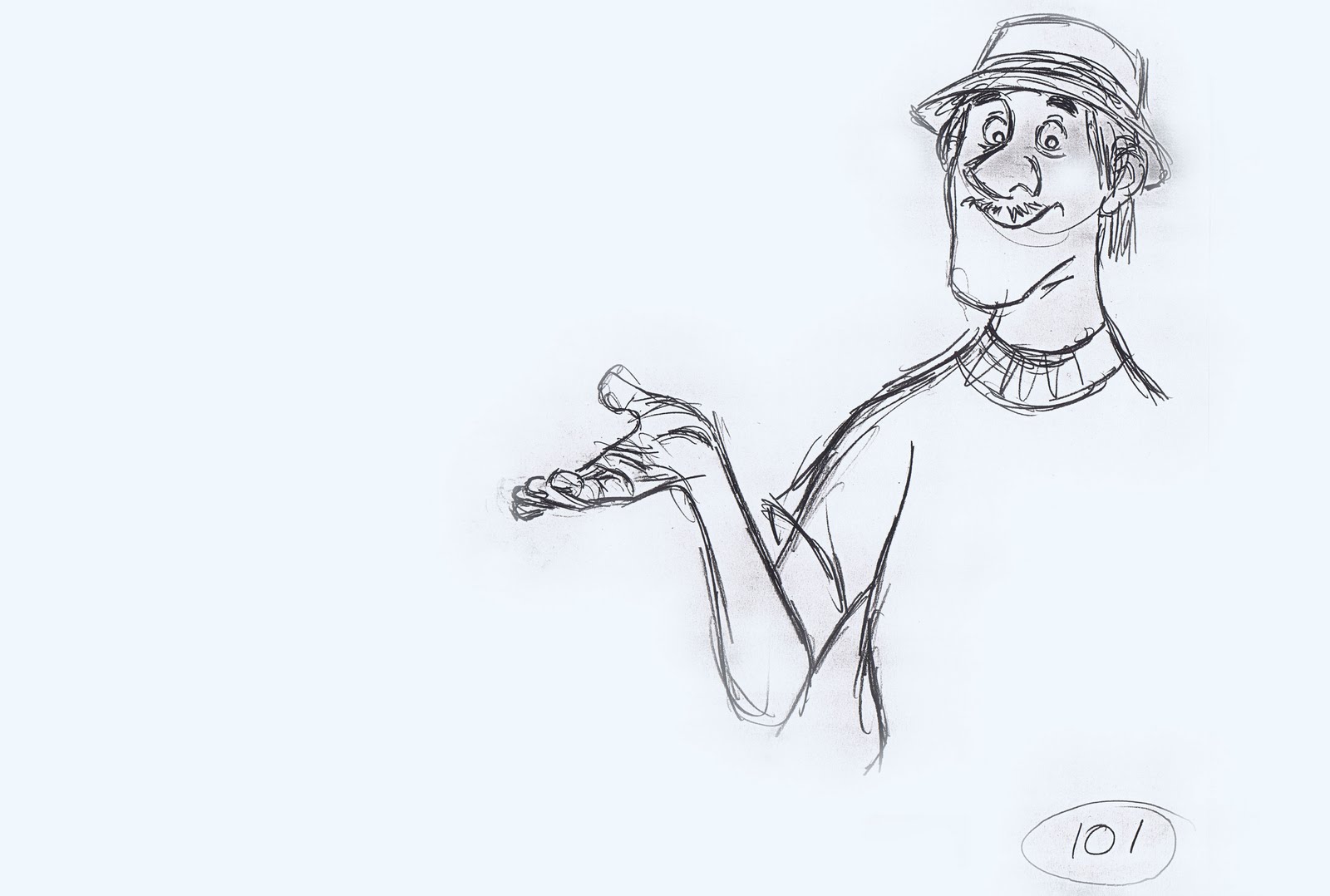
This is an example for how Milt used a Ken Anderson sketch as inspiration for his character designs.


One day Ollie found this drawing on his desk with a note of Milt's disapproval of how he was drawing O'Malley.

Saturday, August 20, 2011

Paul Jouve

Paul Jouve was a French painter, sculptor and animal artist.
I first noticed his work while browsing through clip files at the Disney Studio library many years ago. But there were only a few samples of some of his animal art.
There seemed to be no major publication on his life's work until 2005.
When I found out about it I immediately ordered it from France. 
The book is titled "Paul Jouve, Peintre, Sculpteur, Animalier" , written by Felix Marcilhac, published by Les Editions de l'Amateur.
Well, an amateur Paul Jouve was not.  He lived from 1878-1973.
He developed his distinctive, powerful style during the 1920ies, when Art Deco was a main artistic trend.
When I first  saw these  drawings and paintings of big cats I almost screamed:
"Where were you when I worked on Lion King???!!"
So much grace, beauty and power in these images. The cats are stunningly stylized, their anatomy simplified and their poses have such elegance to them. 

I believe, had I known his work more before or during production of The Lion King, it would have had an influence on my animation of Scar.
Oh well....

By the way, Jouve depicted all kinds of animals during his long career. He did stunning illustrations for an edition of Kipling's "Jungle Book".


© Les Editions de l'Amateur

Wednesday, August 17, 2011

The Bear that never was

Cartoon Brew recently had a post about a cut song from "The Rescuers".
Here is the link:

I want to add a few visuals to that.
The song was sung by Louis Prima and the character was a bear, performing tricks at a zoo. Penny befriended the bear in this early version of the film.
Disney artist Fred Lucky started out with a few design sketches, Ollie did some
and then Milt Kahl took a crack at the bear.
As far as I know no animation was done on this character, but even these sketches by Milt are great to look at.  Wouldn't it be fun to do a test scene from Louis Prima's track with this design?

Milt DID animate a few scenes with spectators at the zoo, though.
In one an overweight guy is sitting down on a bench, pushing people next to him
sideways away from him. A girl at one end takes a fall.
Another scene shows a man throwing a coin to a coke salesman. The coke bottle is handed to the nearest person to be passed on, but the bottle never reaches the buyer.
Here are a few key drawings from that section. I'll try and put a pose test together in an upcoming post.

By the way I am a huge Louis Prima fan, and discovering this "new" song is a real find. There is such an enthusiasm in everything Prima sang, he is one of a kind.


Monday, August 15, 2011

Disney Staging

The best of Disney's animators knew how to stage their characters in a way that made them easy to read on the screen. That way their personality statements were uncluttered and to the point.
Every line put on paper supports a main thought, and the rhythm of the drawing leads your eyes toward the area you are supposed to look at.
This is not an easy thing to achieve. An animator needs to boil things down to a clear essence, because the audience only has a split second to see and understand what's going on.

I traced these classic Disney moments off from xeroxes of the originals. In most cases the characters were animated on different levels, I combined them here for the final composition.
This stuff leaves me in awe. I know that some animators like Frank Thomas and Eric Larson worked hard to achieve this simplicity, while others like Milt Kahl and Marc Davis did it intuitively.
Each drawing is accompanied by an overlay that shows the flow toward the focused area.


The first example from "Pinocchio" even had two animators who worked out the staging issues. Stromboli was animated by Tytla, Pinoke by Frank Thomas.
Combined they form a powerful composition, the main focus is Stromboli's right hand grabbing Pinocchio. The characters connect very strongly. That firm grip 
showes Stromboli's physical strength, and Pinocchio's vulnerability.


Milt Kahl did all three characters in this scene from "Song of the South".
They relate sooo simply, clear personality and attitude in each of them.
Your eyes end up at the rabbit.


Frank Thomas animated Merlin and Mim. Props like Merlin's hat and his magic wand help point to his nose being grabbed by Mim. That's the business of the scene and all lines support the idea.
Here again opposing attitudes make up for an entertaining statement.


Robin and Maid Marian were done By Milt, their hands/paws connect in such a simple and elegant way. Even the feather on Robin's hat is curved and points toward Maid Marian. This looks so simple, but it really is quite sophisticated.


Milt again, drawing Penny and Medusa. 
It is absolutely clear who is the forthcoming character, and who is reacting.
Medusa is as usual overpowering, and here even her lips help the visual connection with Penny.

I don't know about you, but I find studying this stuff fascinating.


Friday, August 12, 2011

Peter Pan

Do yourself the favor and actually read this article from "This Week Magazine",
It was published in July of 1952, not your usual "Behind the Scenes" write up,
that's for sure.
How about those beautiful mermaid sketches by Fred Moore?
And who knew that June Foray and Margaret Kerry modeled for live action reference as mermaids.
June of course is known for her legendary voice acting in Warner Brothers cartoons, and Margaret's main role in "Peter Pan" was to act out scenes for Tinker Bell.

These drawings again are all by Milt Kahl, even the Captain Hook ones as well as Smee. Perhaps you can see why Walt assigned the more realistic characters like Peter and Wendy to Milt. Those two demanded very subtle animation combined with fine draughtsmanship. 
And that's exactly what Milt could do better than most animators. 
These early Peter Pan design studies are based on Bobby Driscoll, who voiced the character and provided live action reference for the acting scenes.
Kathryn Beaumont did the same for Wendy. And the sheet showing a variety of hair styles sure looks like Kathryn at that time.
I really like the drawings of John, they were done for other animators' scenes.
Amazing confidence in these, with a perfect combination of realism, caricature and appeal.

Milt told me a story about Walt being dissatisfied during production with all the different looks in scenes with Peter Pan. He told Milt: "What's going on with your unit, the character looks too old and muscular in a bunch of scenes." To which Milt responded:
"You want to know what's going on? You don't have any X@%#  talent in this place."
According to Ollie Johnston, only Milt could have an arguement like this with Walt.

I want to thank David Pacheco for letting me post his magazine article, and other ones I will show in the future.