Sunday, February 19, 2012

Bambi in Wire


A few years ago, after I had finished work on "Bambi 2", I did a wire sculpture of that character and gave it to animation director/story artist extraordinaire Brian Pimental as a thank you gesture for having me be a part of the production.
From all the wire sculptures I have done this one is the most unsteady and wobbly.
I tried to use as little wire as possible, I wanted to get to a certain simplicity and elegance.
Maybe one of my better ones.


Merryweather's Wardrobe Malfunction

In "Sleeping Beauty" when it came time to create a wedding dress for Aurora, it was Flora who insisted on taking on this challenge. She only needed Merryweather as a model.
We all know how well that turned out. I love the dialogue between the two.
Merryweather: "It looks awful!" Flora: "That's because it's on you, dear."

Marc Davis came up with a couple of different "fashion" designs for the situation, and they look great. Ollie Johnston combined ideas from both sketches and created the final version, as you can see in the last image.


Wednesday, February 15, 2012

Pinocchio by Frank Thomas

Frank animated Pinocchio brilliantly in the song sequence "I've got no strings on me".
There is a character defining section of the film. Pinocchio tries very hard to be an actor, and even when little accidents happen during his first performance, he carries on the best he can.
I had the chance to listen to a short Frank Thomas lecture on how to animate Pinocchio, which was recorded during production…when Frank was still a kid!!
The interesting thing he pointed out was that you shouldn't use the usual squash and stretch on him because he is made out of solid wood. So when his head hits the floor, it bounces, but without any deformation of the head mass.
Here are a few drawings from that sequence. Eric Larson did the beautiful animation of the puppets.
They move and perform, but without life.


Monday, February 13, 2012

Masterful Doodles

When Ollie Johnston showed me his collection of Disney drawings years ago, he came across these two small sheets (8 1/4 x 6") showing design sketches of the character Georges Hautecourt from "The Aristocats". 
"Are these Ronald Searle drawings?" I asked Ollie. "No, these are Milt's", he responded.
As I examined them closer it became obvious that Ollie was right. But I had never seen Kahl drawings that resembled Searle's style to this degree. 
Then again Milt shared Searle's sensibility for a sophisticated balance of strong straight lines against curves. And when the drawing is rough and loose, the lines remain thin and delicate.

I don't know why Milt used such small sheets of paper for these character studies, he normally drew design work on large 16 field animation paper. Perhaps there were done during a story meeting, and only small sheets were around.
In any case, even in this size there is great detail in the definition of bony hands and loose facial skin. Just beautiful!


Friday, February 10, 2012

Mistress Masham's Repose

Way back toward the end of production of "The Black Cauldron" there were a few new animated projects in development at Disney. One of them was "Mistress Masham's Repose", based on a 1946 book by T.H.White (the guy who also wrote "The Sword in the Stone").

This info is from Wikipedia:
Mistress Masham's Repose (1946) is a novel by T. H. White that describes the adventures of a girl who discovers a group of Lilliputians, a race of tiny people from Jonathan Swift's satirical classic Gulliver's Travels. The story is set in Northamptonshire, England, during or just after the Second World War.

Plot:
Maria, a ten-year-old orphaned girl, lives on a derelict estate, her only companions a loving family Cook and a retired Professor of Ancient Latin. These are often unable to protect Maria from her tall, fat, strict Governess, Miss Brown. The Governess makes the child's life miserable. She takes her cue from Maria's guardian, a Vicar named Mr. Hater, the reason why Maria is poor and abandoned. The little girl does not go to school. In church, she has to walk all the way to her seat in over-sized boots which make a great deal of noise. She is shy, lonely, and starved for affection. Meeting the Lilliputians, and being tempted both to fear and to bullying, she must save her friends and herself.

I forget now how long I worked in pre production on the project, but I did enjoy doing this early character development. I even sent copies to Milt Kahl for possible input. He said he liked them ok as far as early concept art goes, but he feared that the studio would probably reuse some of the mice business from "Cinderella" for situations with the Lilliputians. He obviously still felt burnt because of all the reused animation during the 1960ies and 70ies.
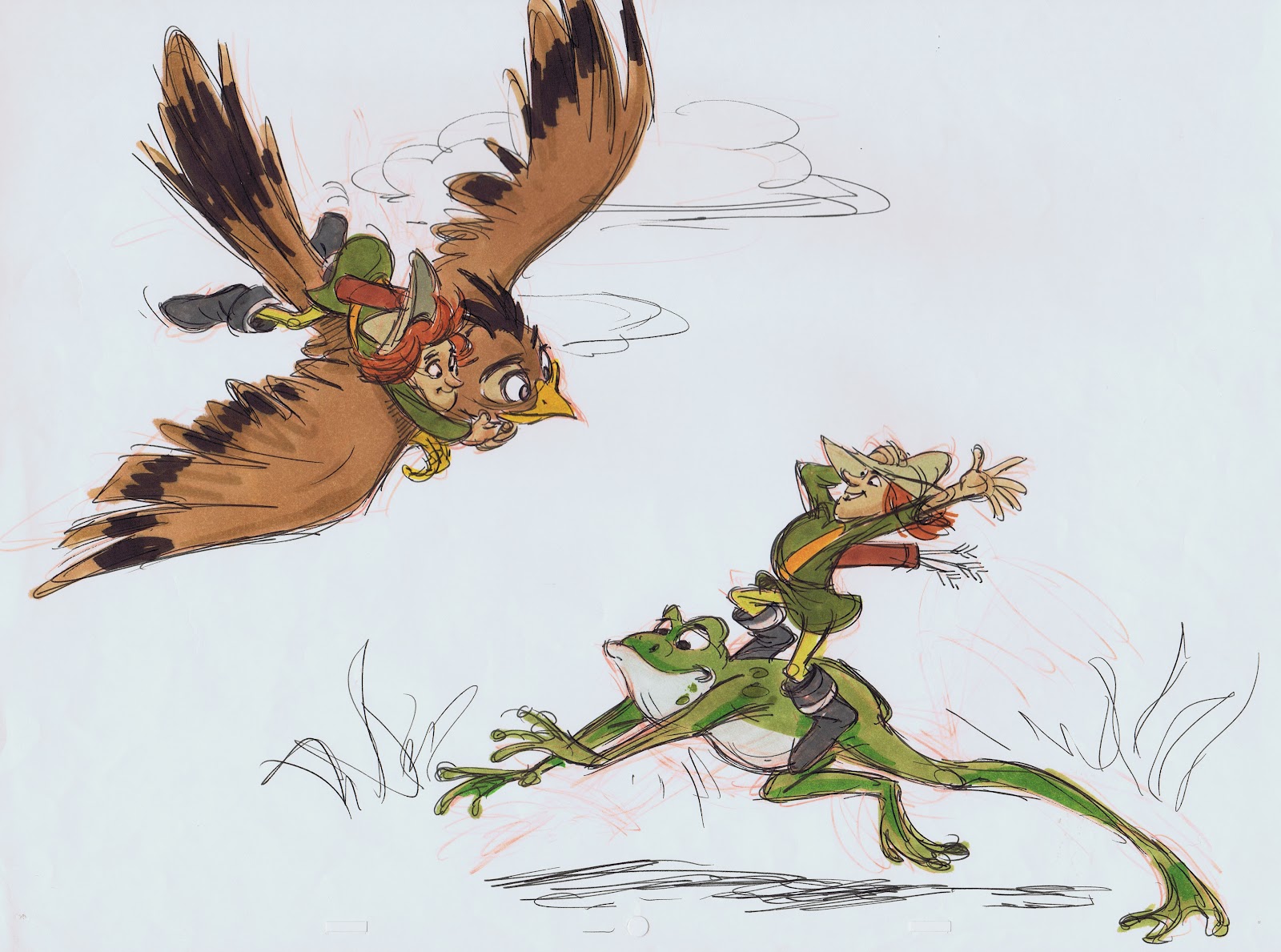
As far as style goes, I had Ronald Searle and Milt Kahl in my head, and I think you can tell, for better or for worse.


Tuesday, February 7, 2012

Rembrandt Bugatti


Among my favorite sculptors are Michelangelo, Rodin and Rembrandt Bugatti.
Bugatti was born in Milan in 1885 into a highly artistic family. His grandfather and his father were both famous in their time for sculpting, painting and engineering.
One of his brothers Carlo made stylish groundbreaking furniture, the other, Ettore became one of the best known automobile manufacturers.
In 1902 the family moved to Paris, where Rembrandt Bugatti developed his passion for sculpting animals. He spent a lot of time at the Antwerp Zoo in Belgium. 
That zoo unfortunately was forced during World War I to kill off most of their livestock. Bugatti, who had used many of these animals as models for his sculptures, was devastated. 
He already had problems with depression, and in 1916 at the age of 31 Rembrandt Bugatti killed himself.

His work astounds me. Even though he never travelled to wild places in order to study wild life, his research was done at zoos, the sculptures truly capture the spirit of the animal.
Stylistically they range from a rough Rodin like approach to an Art Deco design.

The first time I saw his work was at the Musee d'Orsay in Paris, and I immediately fell in love with it.


Sunday, February 5, 2012

Shere Khan crouches

This post took a while to put together. As you know, creating pencil tests is time consuming, but when the result looks like this…who cares?!!

Before I get started, I had a great time at the Annies yesterday. It was good to talk to people I hadn't seen in a while. Thought the presentation was hysterical, congratulations to my fellow nominees and the winners.

Back to the tiger. Before I shot these copies I noticed that one image was missing, so I drew one inbetween to complete the scene. First of all, that took me forever. When you look at two tiger keys on your drawing desk, just try and figure out the subtle change in the stripes. Insane.
Whoever inbetweened Shere Khan (Dave Michener did some of it) deserves a medal! 
Of Course Milt Kahl wouldn't tolerate the slightest inbetweening mistake.
Just look at how all those stripes define the subtle movement of skin over the body.

I have always loved this introduction to Shere Khan. His controlled, withheld power and strength are breathtaking. And the draughtsmanship is  -as usual-  awe inspiring as well as intimidating.
The movement of the tiger's shoulders in the second scene is sort of a cycle. Milt animated that move once, then timed it a couple of different ways, slow and a bit faster. That's the only time I have seen him do this. Careful trace backs of the parts of the body that don't move give the scene so much life. If you'd use a partial hold for that, it wouldn't look this great.

Without any further ado, here is some of the most amazing animation ever drawn!