Saturday, December 22, 2012

Sarah and Mushka


I will be living with these two for a while, since they are the main characters of my animated film.
It is a story of love and sacrifice, set in Russia. I have been working on story and pre-production throughout the year and will go into production next year.
The style will be a sort of like an animated sketchbook. I had been wondering if instead of using digital color I could just use color pencil shading right on the animation drawings. When applied very carefully the flickering will be minimal. 
Here are just a few character studies to give you an idea where I am going with this.
Luckily the LA Zoo had a couple of tiger cubs (they are almost fully grown now), so I did spend some time there to observe and sketch them. 


This is a little teaser I put together. The idea behind the scene is that Sarah, who is raising this tiger cub, realizes for the first time that even at this young age he already has a "killer instinct".


All artwork and video © Andreas Deja

Wednesday, December 19, 2012

Sleeping Beauty Story Meeting


The artists attending the meeting from left to right are sequence director Eric Larson, story artist Joe Rinaldi, production designer Don DaGradi and directing animator Marc Davis.
The storyboards behind Eric are part of the "Boy meets Girl" sequence, which he directed.
Everything went into this section, the most elaborate backgrounds, multiplane shots with animation from Milt Kahl, Marc Davis and John Lounsbery. All this turned out to be very expensive, and when the sequence went far over budget, Walt Disney was not too happy about it. I am sure he had a word or two with Eric.
Next time you watch the film, keep in mind that Eric did his best to make this an outstanding sequence, but he caught some flak nevertheless.

The boards being discussed show the Three Fairies in the jewel box. If you remember they are trying to figure out how to deal with Maleficent's curse.
Marc Davis brought some of his character designs of Maleficent and the raven to the meeting. They are on the floor along with DaGradi's compositional studies.

What a great captured moment in Disney history!
I might read too much into it, but Eric Larson looks a bit distraught while Marc Davis' expression seems sympathetic toward him: It's gonna be ok, Eric.
Click twice on the image, and you are in the room with these guys.

Here are copies of Marc's sketches. He depicted Maleficent's colors in black and red, a concept he saw in a book on medieval art. Marc told me years ago that he felt strongly about those colors, but background and color stylist Eyvind Earle had other ideas and settled for black with purple.
Sometimes teamwork isn't easy.


Extraordinary sinister poses for the raven. What beautiful shapes!


Marc also did design work for various crowd scenes, in vibrant colors. 
The crowds in the final film are more of a backdrop and show less personality.
If these are supposed to be caricatures of studio personal, then the guy in the middle back is a dead ringer for a very old Milt Kahl! And maybe...just maybe the character on the left is a self portrait.


Monday, December 17, 2012

Wilhelm M. Busch 1971


These wonderful spot illustrations by Wilhelm M. Busch were published in 1971 in a little German book titled "Graf Bobby" (Earl Bobby).
This is the result when a realistic master draughtsman loosens up and caricatures his human subjects. Every drawing is entertaining and full of personality. The lack of formulas in them is refreshing and his economy of lines is inspired. I often find what an artist leaves out just as interesting as what he puts in. 
Great looking characters, beautifully staged, all this totally applies to animation.

Graf Bobby was a popular character in the German speaking countries, the humor in his stories range from silly to philosophical.


Friday, December 14, 2012

Invisible Ink


This picture was taken sometime in 1987 when Steven Spielberg was visiting the animation crew in London. We were early on in production for "Who Framed Roger Rabbit". 
I believe Mr Spielberg had his picture taken with almost everybody in the animation crew. And he signed all those photos, too.
The camera that day sure didn't capture what I was working on, so it looks like I only have a blank sheet of paper to show for. 
Steven Spielberg is a very cool guy. He talks to you on the same level, from one filmmaker to another. I remember his enthusiasm for film and animation.
A few years later I even had the chance to have breakfast with him at the newly founded Dreamworks Studio. And again I felt like I could comfortably talk to this movie giant about anything, film or otherwise. I remember asking him if I could stop by the set of Jurassic Park II. He said, you won't be seeing any dinosaurs, there's just a lot of waiting around on the set. (I didn't end up going.)

I've kept shockingly little of my animation drawings from Roger Rabbit.
Here is a sketch with the Weasels' leader Smart Ass. I enjoyed animating his introduction very much.
He was interacting with live action props like a chair and a pistol, then he threatened Bob Hoskins: "Where's the Rabbit?" 


I also did the Bouncer at the Ink & Paint Club. Completely different character, powerful, slow moving like a big oaf.  So I had the chance to animate a lot of different character concepts for the film, and I learned a ton.


A post-Academy Awards-photo with Dick Williams, his mother and some of the animation crew.
Good times!! 


Sunday, December 9, 2012

Christmas Cards


Many animators like to send out Christmas cards, because they can draw them themselves.
Lounsbery, Kimball, Marc Davis, Frank and Ollie, they all sent out drawn holiday greetings over the years. Not Milt Kahl. 
Remember, he said: I only draw when I have to.
In the early 1980ies I sent Milt this card with a self caricature to wish him and his wife Julie Happy Holidays.
Julie told me later, Milt doesn't do Christmas cards, but she had asked him to send me one in return.
I treasure this card. Milt picked this store bought card with a graphic image of Santa, and the open invitation to see him and Julie is very special to me!!


Friday, December 7, 2012

Runaway Brain


This short film was produced right after Lion King, but not at the Burbank studio.
A group of very talented artists in Paris/France had completed work on The Goofy Movie for Disney, and the plan was to have this terrific French studio be part of Feature Animation's films.
To start out it was decided to do a short with Mickey. Endless ideas were thrown around, but nothing seemed to stick. Then story man Tim Hauser had the idea to do a satire on the old Frankenstein story. I had too much fun sketching little Mickey monsters, like the ones above, before animation.
I was lucky to be sent to Paris along with a small group of supervisors. My job was to animate but also help supervise the animation as a whole.
Let me tell you, there was no hand holding necessary on my part, the French animators were fantastic. They were Bohlem Bouchiba, Uli Meyer (from London), Chris Bradley (from the US),
Dominique Montrey, Sylvain Deboissy, Sergio Pablos, Patrick Delage, Catherine Poulin, Marc Eoche Duval, Yoshimichi Tumara and Stephane Sainte-Foi.

I ended up animating a few opening scenes with Mickey and Pluto, the introduction of mad scientist Dr. Frankenollie and other shots here and there. 
One scene was a bit challenging, but a lot of fun.
Minnie is hugging Mickey because she mistakenly thinks they are going to Hawaii on vacation.
Mickey, shocked over this misunderstanding, pronounces the word "Hawaii" silently.
It was an unusual bit of acting for him, but I think it communicates.

These are a few of my rough animation keys from the opening scene. I remember animating the cord coming from Mickey's remote control, something that normally an effects animator would take care of. I really enjoy doing effects work once in a while.


The short was art directed by Ian Gooding and I think it looks beautiful.
A couple of pages from the Disney book "Mickey Mouse, My Life in Pictures".


Soon after the release I got my hands on a cool looking toy figurine from Japan.


This was the back of our crew jackets.
I wore it once while visiting Disneyland Paris, when suddenly a Disney sales person commented on the image, which she found outrageous. I tried to explain about the movie, but she insisted I shouldn't be wearing something like this in the park. She thought it was a counterfeit product.
Adorable…the way she was defending Mickey's image!


By the way, at the time I thought director Chris Bailey paced the film a little too fast, but watching it now, it feels just right.
You can find it on the Walt Disney Treasures DVD Mickey Mouse in Living Color, Volume Two.

Wednesday, December 5, 2012

Staging Pongo and Perdita II


Storyman Bill Peet drew this story sketch of Pongo and Perdi enjoying a peaceful moment together just before their lives would change with the upcoming visit of Cruella De Vil to the house.
For animation Ollie Johnston considered a different type of staging, more of a downshot of the two dogs through the window.


Frank Thomas referred back to Peet's staging, but simplified the silhouettes by hiding the dog's legs.
He also changed Perdita's head angle which makes for a better contact with Pongo. Even in this very rough sketch Pongo's muzzle reacts nicely to the hard surface of the windowsill.


Milt Kahl started out be defining Pongo's  appearance more clearly. It seems like he wasn't entirely happy with this version.


So he redrew it and referenced Frank's muzzle shape. Milt also felt that leaving out the dog's legs would simplify the staging, and guide the viewer's eye to the center of the frame, the Dalmatians' heads contacting.
There is also an abstract quality to the composition. The contour of the dog's bodies looks like an idyllic landscape with little hills and valleys. (The calm before the storm).
Milt did this sort of thing intuitively, he could never explain it.


There is no photo of Pongo's voice actor Rod Taylor working at the Disney studio to be found.
He either was photo shy or he chose early on not to promote the film.
Here is a picture of co-director Clyde Geronimi showing actress Lisa Daniels a story sequence.
Lisa voiced the character of Perdita. (Not to get confused with Lisa Davis, who voiced Anita.)


Tuesday, December 4, 2012

Atlanta, Georgia 1946


I did a little research to find out what's going on in this vintage photograph.
Posing behind this very impressive car are Disney artists, from left to right story man Bill Peet, unknown, background stylist Claude Coats, art director Ken Anderson, director Wilfred Jackson and directing animator Milt Kahl.
If you look closer you see a Song of the South sticker taped to the windshield. The car to the right has one, too.
These gentlemen are attending the world premiere of Disney's Song of the South, a film that mixes live action and animation footage. 
"The animation in Song of the South was a high for us"  Milt Kahl reminisced years later.
I would add that the film has some of the richest characters ever that were animated with razor-sharp timing. 

Incidentally Walt Disney and his wife Lilian were driven to the premiere in this car as you can see in this great picture from the Library of Georgia State University.


A beautiful Ken Anderson illustration for the title sequence of the film.


Friday, November 30, 2012

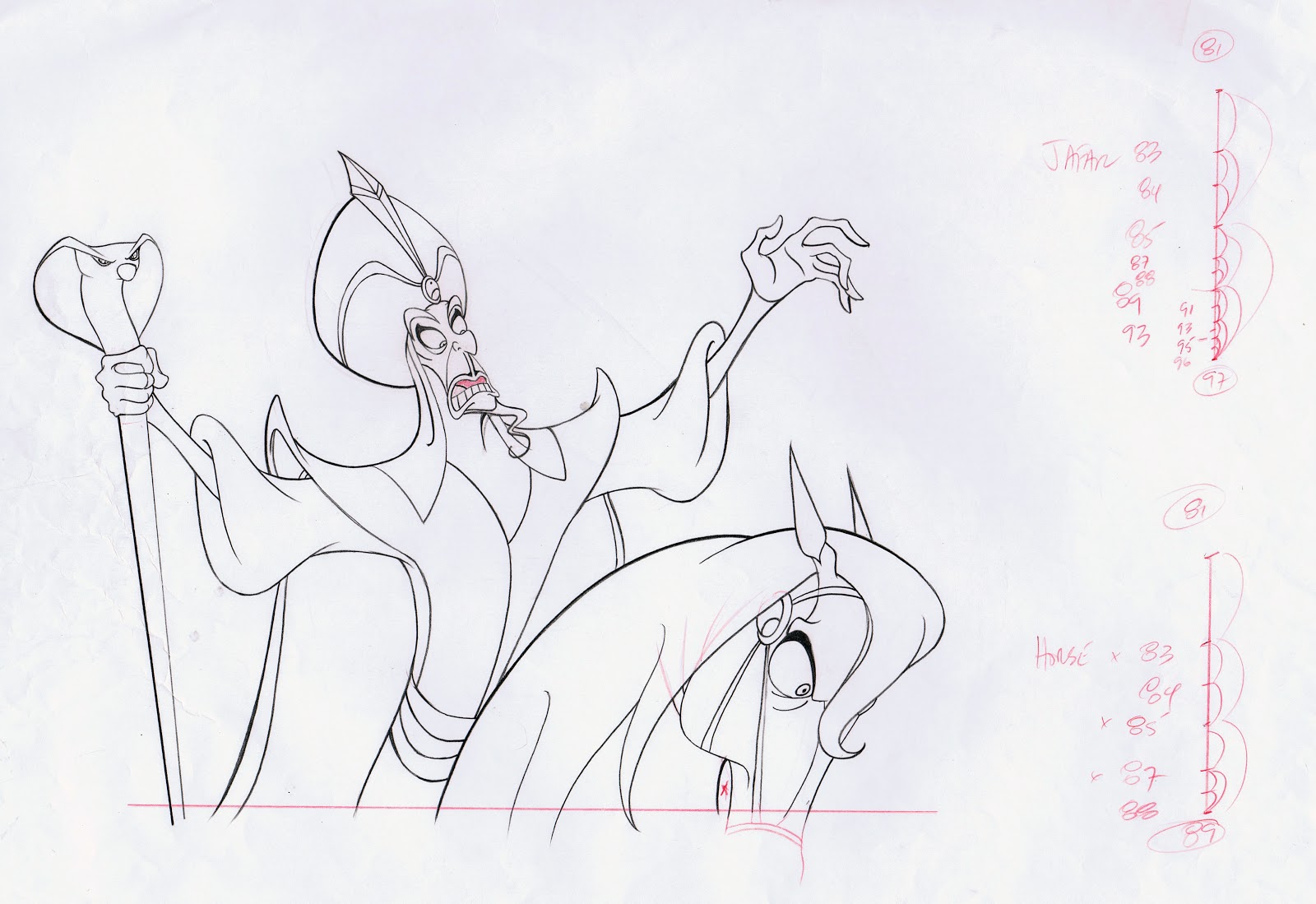
The Evolution of Jafar


I was thrilled when I got the assignment to supervise the animation of Jafar, the villain in the film Aladdin. I had just finished work on Gaston, who had to be handled with a certain amount of realism.
I remember thinking: Not with Jafar!
Here was a chance to design and animate a character who belonged in a graphically stylized world.
Animator Eric Goldberg had already done some incredible test animation of the Genie, which helped to set the style for character designs. Inspired by the fluid lines of famous caricaturist Al Hirschfeld combined with the voice of Robin Williams, Eric created a Genie for the ages and set the bar very high for the rest of us.
But how would I handle Jafar's personality against the uber entertaining Genie and the rest of the cast? Should I go along and give him plenty of lively gestures or should I downplay his acting and look for contrast instead?  
I found out the more I held back and showed him thinking and plotting, the more evil and interesting he became. Sure there were scenes when eccentric acting was called for such as when Jafar turns into a beggar. The attitudes here show a hunger for power as well as extreme frustration.
All those scenes were animated beautifully by Kathy Zielinski.
Other animators in the Jafar unit were Nik Ranieri, Ken Duncan, Ron Husband and Lou Dellarosa.

Many different design ideas were floating around early on, before animation began.


A fun drawing by designer/story artist Daan Jippes.


This sketch by director John Musker showed just the right attitude to go along with Jonathan Freeman's voice recordings. 


A couple of my early drawings with extra evil eyebrows. Didn't feel right though.


I order to loosen up I scribbled many facial expressions to explore the range of his facial features.
Setting Jafar's mouth very low on his face allowed me to create bizarre but interesting mouth shapes. 


My attempt to tie down some of those rough faces.


How realistic or how cartoony should his hands look like? I knew I wanted hands you wouldn't want to touch.


Premature cleanup studies. The right type of personality is emerging, but his face has way too many angles and planes. Too complicated to look at and not in line with the style of the film.


Jean Gillmore drew these expressive poses. 


I tried to minimize the line milage in the design. Still not stylized enough.


After one more pass I was comfortable with these animatable shapes.
This is the design directors Ron Clements and John Musker approved.


Clean up artist Kathy Baily creates the fine line look for the character.


An oversized drawing of Jafar with a cut out Iago provided by animator Will Finn.


I don't particularly enjoy drawing model sheets, it's all about measuring the components of the character and being consistent. They are important though because they explain the character "graphically" to your animation and clean up crew.


A cool design for Jafar's staff. We decided to close the snake's mouth though to save line mileage.
It probably saved the film's budget, too :)


A couple of my more or less typical roughs.


This is a clean up drawing from a scene that was cut from the movie 
Jafar is muttering the magic word to make the gigantic tiger head appear in the desert.
That magic word was the name of our layout supervisor: Rasoul Azadani


Jonathan Freeman voiced the character perfectly, He loved being Jafar, and I loved animating to his inspired vocal performances.