Tuesday, September 3, 2013

James Affleck Shepherd


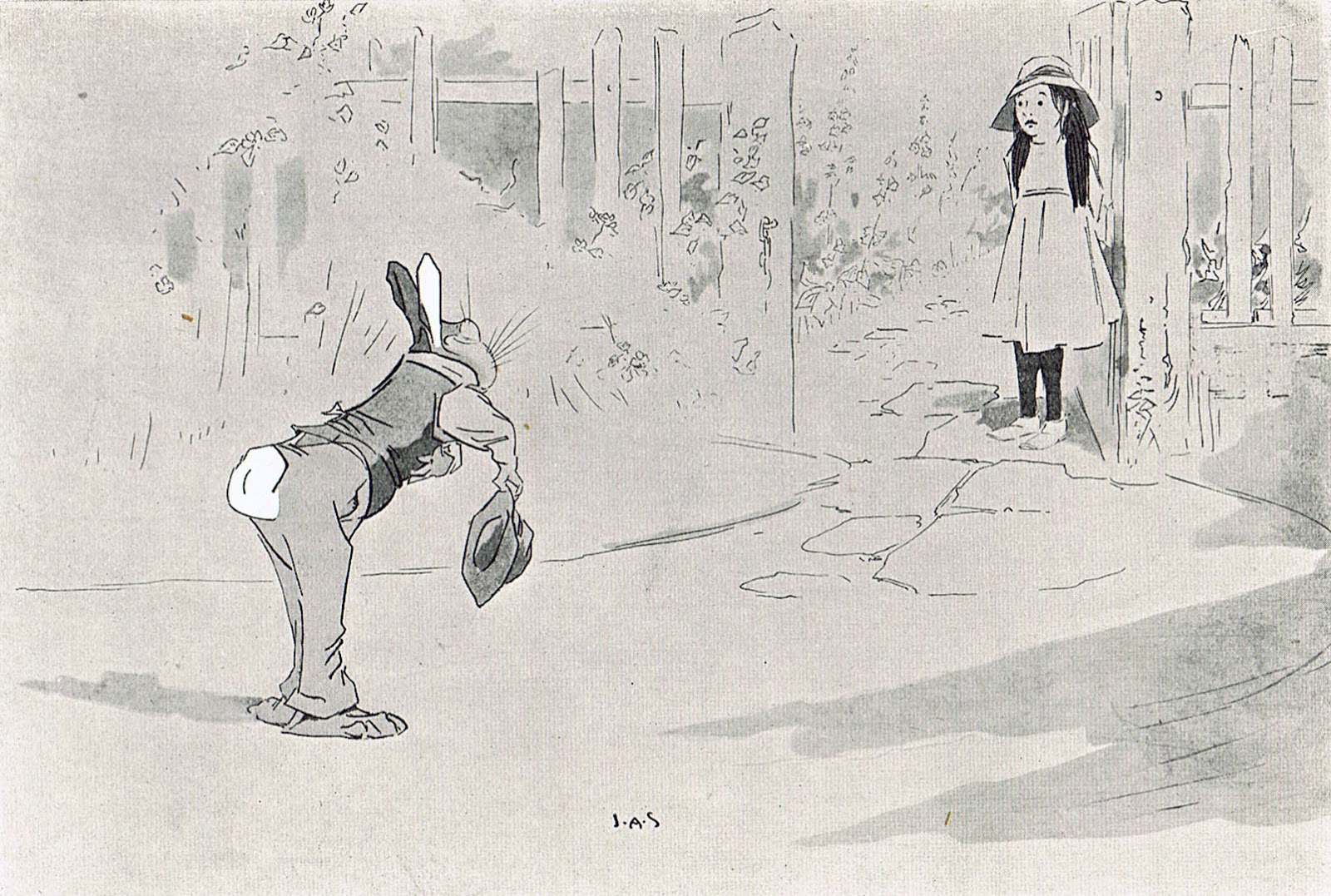
J. A. Shepherd is not as well known nowadays as he should be. 
I first came across his work during the production of Roger Rabbit in London, when animator Chuck Gammage showed me one of his illustrated books. It was called "Zig Zags at the Zoo" and was published in 1894. Shepherd caricatures animals beautifully, and he often depicts them in anthropomorphic ways. He has no trouble whatsoever mixing animal with human anatomy to create unique personality types.
Shepherd was born November 1866 in London. As an illustrator he published his cartoons in Punch and Strand Magazine.
The gorgeous images shown here are from the 1926 edition of Joel Chandler Harris' "Nights with Uncle Remus".  I find his approach very charming, but also sophisticated. Shepherd knew exactly how to simplify the appearance of animals to bring out their main characteristics. 
Like a pre-animation Milt Kahl.


That lion is just amazing! A completely plausible pose.


Every pose a gem in this fun composition!

Monday, September 2, 2013

"…You worry too much, old boy!"


Here is a very simple and effective scene with Robin Hood in the opening sequence of the film.
He responds to the bear Little John, who is concerned about the pursuits by the Sheriff of Nottingham. "Ah, come along, you worry too much, old boy!"
The animation reads beautifully because the action is broken up very clearly. Robin raises his arms and slides down the side of an oak tree to land in a sitting position, hands behind his head. To show his confidence as well as comfort level, he crosses his legs at the end of the scene. During this leg motion the rest of body is kept pretty still, so it doesn't interfere with the principal action.
Milt Kahl animated the character in this early sequence to establish his personality.
I like the final pose, it shows that Robin is utterly unconvinced that the Sheriff poses any threat.
As a matter of fact he is so relaxed, it looks like he is about to take a nap.


Little John is worried, Robin is calm. Remember what Frank Thomas said: "When you have two characters interacting, they better show contrasting emotions."

Friday, August 30, 2013

Jafar Clean Ups


A while ago I posted some of my rough animation of Jafar. When it came to cleaning up those rough key drawings on a new sheet of paper I tried to stay in touch with my clean up lead Kathy Bailey as much as possible. Especially on the first scenes we went back and forth on how the character should look in that nice calligraphic line that was called for to fit in with the style of the film. 
Looking at these sheets now after such a long time I am still pretty happy with how Kathy handled the character. Sometimes the clean up process can flatten out the drawings. Not here. Kathy's elegant lines show a subtle "thick and thin", something that was not easy to maintain for her follow up artists, the clean up inbetweeners.
This is a character that was a lot of fun to draw and to animate. The story material was very rich, too,  which made it easier to find decent performances.
I don't think there was an animation artist who didn't enjoy working on this film.


Wednesday, August 28, 2013

Alice giggles...


…and if you don't think this is the most adorable photo you've seen in a long time, I really can't help you.
It looks like Kathryn Beaumont is cracking up at something that happened on the set. I don't believe this is a photo stat image provided to the animators for live action reference.
Kathryn is standing on a mock up giant mushroom. This is the sequence for which Milt Kahl animated his first few scenes of Alice.
He recalled years later: " Yeah, that's a cute litte Alice I did there. Unfortunately for much of the picture (when other animators took over) she doesn't look like this, and I know I could have done those scenes a whole lot better !"

Here are few beautiful roughs from Milt's early Alice animation.


Monday, August 26, 2013

Bill Peet's Dumbo


A young Bill Peet sketches elephants at a circus, backstage around 1940.
He ended up doing story work on critically important personality sequences like those playful scenes with Dumbo and his mother. Bill Tytla saw the potential in these storyboards and turned them into animated gold. In the hands of lesser artists, emotional story material like this could have turned saccharine very quickly, but both men approached this assignment with such sincerity that you can't help but fall in love with these characters.


The circus moves during a rainstorm at night. I love this sketch, you can feel the elephant using its weight to push the tiger cage up the ramp on to the train.


Peet came up with the final character design for Dumbo, those are his drawings on the model sheet.


Bill Peet at work at the studio. It's fun to study all the research he assembled.
That's an early model sheet by J.P.Miller on his left.


Peet was brilliant at handling elephants in his story work. That's probably why he chose them so often as main characters in his many children's' books.