Friday, October 11, 2013

Disney in 1946


Here is a magazine article from Picture Post, March 23, 1946. The studio was in production on a variety of short films to be included in the feature length movie Make Mine Music.
The writing is very odd, the author keeps wondering wether Walt Disney can be considered to be an artist or not. There is some misinformation, too. 
Who knew that an animator draws every 10th drawing? And that in-betweeners are relatively unskilled?
Much more interesting are the photos here. On the page featuring the animators, you see Kimball working on the section called The Whale Who Wanted to Sing at the Met. Great drawings. To his left hangs an early model sheet of the Siamese Cats from Lady and the Tramp, a film that wouldn't be in theaters until almost a decade later. Ollie Johnston is credited as Disney's top animator, while Milt Kahl, in the last image, doesn't get mentioned at all. (I don't know why Ollie is drawing tortoises, but Milt is studying dance moves in preparation for animating the lead couple in The Martins And the Coys section).
It's always great to discover behind the scenes photos like these.


Wednesday, October 9, 2013

Trying too Hard


I drew these characters from The Black Cauldron in this this publicity still a zillion years ago.
And yes, I tried too hard to make them look good. There is way too much focus on details like hands, fabric folds and fur. 
The staging and overall compositions are pretty weak. Embarrassing, There is no flow in these poses, everything looks overly chiseled. 
The humans in the photo are director Ted Berman on the left, then producer Joe Hale and director Rick Rich. 

I did a little better in some of these pieces.
A model sheet of The Horned King, signed off by SEVEN people.


A development sketch of Taran facing the Witches of Morva. Could be much better, but at least the composition reads ok.


I am going to brag a little about this drawing, it shows a visual idea for the Horned King's henchmen.
Marc Davis came by the studio to see what this new, inexperienced crew was working on. I remember him walking down a hallway, storyboards with design work on each side. He stopped at this sketch and said: "That's a great drawing." 
What? Did I hear right? I swear I remember Marc's comment as if it was yesterday.


These are my key drawings for a scene with Dallben. He is talking to Taran and taking a few steps toward the boy. They don't look too shabby, and the animation isn't all that bad either. But when I saw it in color I realized that the motion was strobing, the scene should have been on one-s.


This animation thing sure is a learning process. 

Tuesday, October 8, 2013

Tony and Joe


Tony, the proprietor and Joe, the chef of the Italian restaurant in the Disney classic Lady and the Tramp are among the best human characters ever done at the studio. John Lounsbery was responsible for their charming and very expressive animation. He took full ownership of this fun couple of eccentric Italians, all of their footage is Lounsbery's.
Animating dialogue that has a foreign accent is always a treat for any animator, and Lounsbery took full advantage of the possibilities that this assignment presented. Tony and Joe not only sound Italian, they act Italian as well. Big, broad gestures that define the Italian spirit. Their faces show a marvelous range of squash and stretch, and you feel the elasticity of skin in motion.

Lounsbery got a little help from a couple of actors who provided live action reference.
Tony on the left is played by Disney veteran Don Barcley, the actor who does Joe is unknown to me. The final animation though hardly shows any traces of such reference, Lounsbery made these two characters his own.
As you can see, Pluto had to sit in for Lady and the Tramp.


A couple of lively rough drawings from Lounsbery's desk.


Look at these expressive hands. We know that Milt Kahl was a master of articulating hands in animation, but so was Lounsbery.


A great story sketch by Joe Rinaldi, full of character and mood.


This final cel and background art shows a very skillfully painted and lit scene.
The calendar on the wall by the Geronomie Noodle Co. could be an in house reference to co-director Clyde Geronimi.


Saturday, October 5, 2013

André Franquin


André Franquin is a genius and a giant in the world of European comics. 
Most of his beautiful work was published in the Spirou et Fantasio comic magazine.
I knew of his art as a kid when I started reading stories with some of his iconic characters like Gaston Lagaffe (behind him in the photo) and Marsupilami. To this day his unique drawing style continues to influence countless comic strip artists all over the world. 
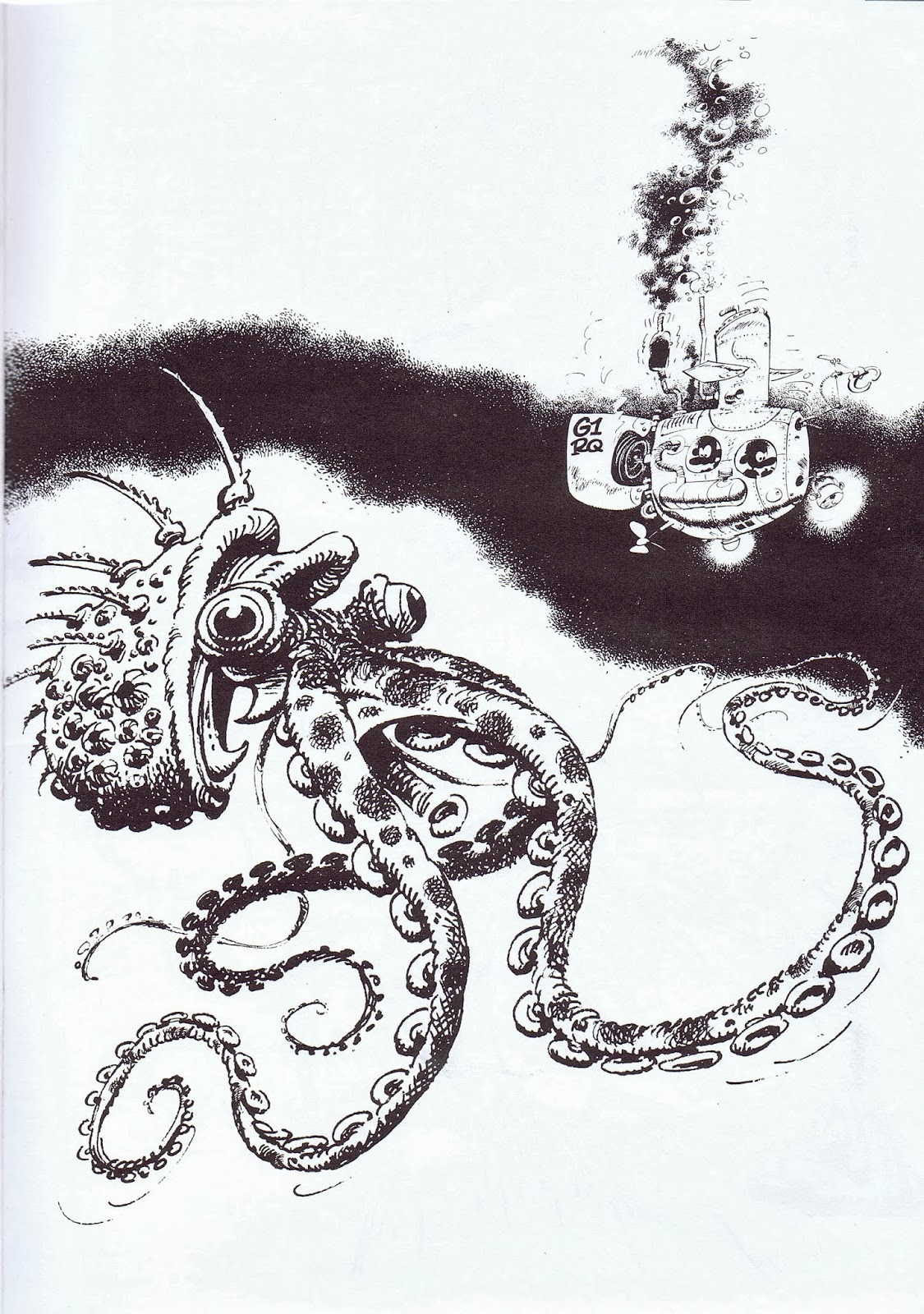
Franquin was Belgian, he was born in 1924 and died in 1997. He drew realistically very well, but his energetic, catooney and ultra appealing way of drawing is what made him famous. Here are just a few pages from one of his sketchbooks.


In the early late 1980s Disney was working on turning Marsupilami into a TV animation series (which did not turn out all that well). But in 1990 Franquin came to LA to visit Disney Studios. I remember getting a phone call in my office from our management. They asked me if I knew of an artist called André Franquin. He was being given a tour of the animation department at this moment. I almost fell off my chair. "Franquin is in the house" I yelled. "Frank who?" a colleague asked me. I ran down the hallway to meet this amazing artist. He was shy, soft-spoken, and he seemed somewhat surprised that a Disney animator knew of his work. Luckily I just happened to have the German edition of his famous "Idées Noires" ( Dark Thoughts, Alptraeume in German) in my office. I asked him to sign it, and he graciously added a drawing. Lucky me. 
The following pages are from Idées Noires.


All images © Franquin

Thursday, October 3, 2013

The Brave Engineer


This Disney short film from 1950 is a retelling of the popular story of legendary railroad engineer Casey Jones, who is determined to keep his train schedule despite many obstacles on the way.
One of those obstacles is a villain who ties up a beautiful girl on rail tracks. Of course Casey saves the damsel in distress in a swiftly manner, and all is well.
Milt Kahl animated this scene, and I came across this rough animation drawing (there are actually two drawings which I combined into one image), that had been separated from the rest of the scene. It's a beautiful dynamically staged sketch, which was also used in the composition of the film's poster. 
When you think of it, most of Milt's animation key drawings are worthy of a poster. 


Wednesday, October 2, 2013

A Visit to Woolie's Office...


…during the production of The Jungle Book.
I believe the person on the left is an employee, and the man on the right a visiting guest.
It's fun to look around and see what kind of stuff Woolie surrounded himself with that day. There are a few pieces that relate to the development of the film's villain Shere Khan.
Near the lower right corner of the photo is a model sheet of the wolf from the 1946 short Peter and the Wolf. John Lounsbery animated that character way back , and perhaps some of these poses and expressions served as an inspiration for Shere Khan. 
On the desk near Woolie's right hand lies a story sketch of the tiger by Vance Gerry, who boarded important sequences for the film.
Woolie is holding a great drawing of Shere Khan by Milt Kahl. It is worth taking a closer look at this sketch, it shows the tiger as he appears in his first scene of the film (except that the image was flopped in the final version, the character is walking toward screen left.)


Behind the group you can see some of Ken Anderson's concept drawings of Shere Khan on the wall. Above those hangs a small color sketch featuring Mowgli and Bagheeera in the jungle.


I wished there were many more behind the scenes photos that give us an insight into the daily life of the artists who produced these Disney classic films that have become American Folklore. 

Sunday, September 29, 2013

Geraldine Page is Madame Medusa


Frank Thomas considered her the best voice they ever had for an animated character. 
Animator Milt Kahl stated that he probably had more fun animating Madame Medusa than any other assignment at Disney. While working on the film he was also amazed to find out that a lot of her dialogue was only recorded once. Milt had been looking for an outtake of a certain line, but there weren't any. Many of her first and only readings became production dialogue instantly. 
Page had a strong instinct for who the character was and how eccentrically she should be played.
Milt said: "This actress was so good, she could make poorly written dialogue sound great!"
He watched some of her films to get an idea of her acting background, and he fond a particular acting moment useful for a scene he later animated. 
In the 1962 movie "Sweet Bird of Youth" Page is acting opposite Paul Newman. At one point Newman tries to get to the telephone she is holding. To keep him from getting closer, she kicks  him in the gut and pushes him away with her foot.
Medusa would repeat this moment when she tries to keep Penny away from the Teddy Bear, she grabbed earlier from the girl's arms. "Medusa kicks the little girl away with her boot, which is an awful thing to do and right in character," Milt explained.

A few years ago I had the he chance to listen to an old voice recording with Page as Medusa.
She started out by quietly asking the director a few questions, but then when it was time to record, she bursted her lines into the microphone as loud as she could, like: "PEEEEENNY DEAR, AUNTIE MEDUSA WANTS TO TALK TO YOUUUU!! Then very quietly to the director: "How was that?"

These are a few sketches Ken Anderson made while Geraldine Page was working on The Rescuers.


A pre-production design sketch by Milt Kahl, showing a sort of sensual quality.


To me this is the scariest drawing Milt did of Medusa. Her eyes, the way she points into camera, this woman means business.


Friday, September 27, 2013

Chicken Little 1943


This beautifully produced Disney short film takes some liberties from the original popular story in order to drive home its anti Nazi message. IMDb has this to say about the film:

"Produced as a propaganda short during WWII, warning audiences not to believe anti-American propaganda. Originally the film was to have had more direct references to the war: Foxy Loxy would have read from "Mein Kampf"; and the chicken's graves would have been marked by swastikas. But Walt Disney decided to keep the film generic so that it would not become dated after the war".

The film's concept is brilliant, and the animation is top notch. 
I don't know who drew the model sheets, but the animators used those exact designs, no adjustments were made.

Milt Kahl focused on the main character, who is playful, not very smart and likely to believe anything he is told.
Here is the rough model sheet for Chicken Little followed by Milt's design explorations.


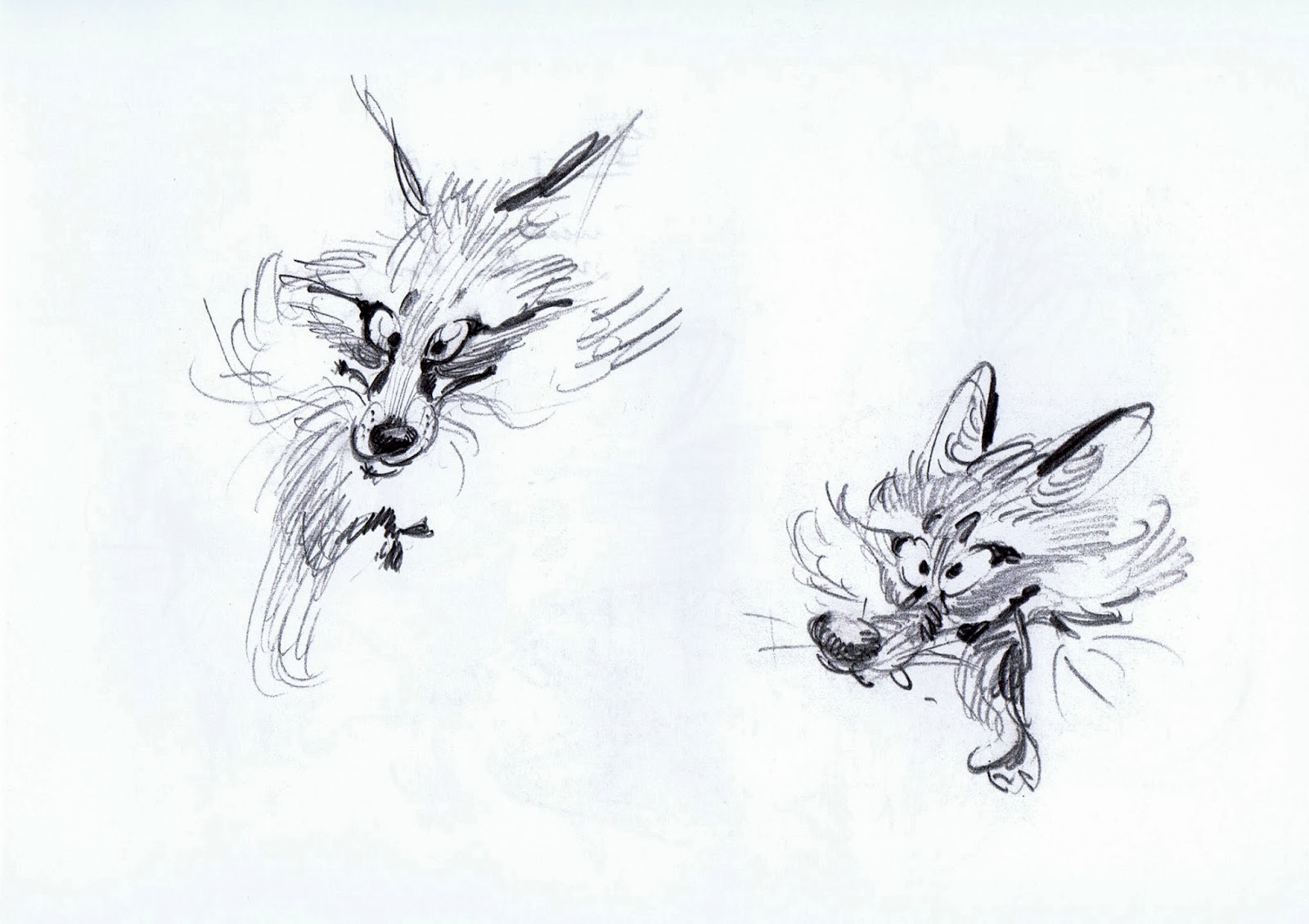
More character model sheets, including the villain Foxy Loxy, animated brilliantly by Ward Kimball.


A very brief version of the storyboard.


Watch the film right here:

You can purchase the complete Disney Wartime DVD set here: