Thursday, September 8, 2016

Fred Moore's Legacy


Yesterday was Fred Moore's birthday. As Marc Davis said once: "Fred WAS Disney drawing!"
Ollie Johnston talked often about how much he learned from him, while he was Fred's assistant and during the years that followed. Kimball, Frank Thomas and Milt Kahl had nothing but praise for Moore's work. No wonder Walt Disney sent most of his animators to see Fred, in hopes that some of the genius would rub off on to others. And it did. Because of his gutsy use of squash and stretch and his dimensional, appealing drawing style, Moore established what Disney characters (the cartoony ones) were made of: some kind of doughy, squishy substance, that is enormously fun to watch in animation.
I would say that his type of drawing and design influenced Disney's features from Snow White on, to Pinocchio, Fantasia and Dumbo.
By the time Bambi went into production Milt Kahl had taken over the role of the studio's drawing policeman.


Here is a "Happy Birthday, Fred Moore" post from a few years ago:

http://andreasdeja.blogspot.com/2011/09/happy-birthday-fred-moore.html


Tuesday, September 6, 2016

Milt Kahl Wire Sculptures Footage


These few scenes, showing Milt's wire sculptures with some dimension, were filmed at his home in Marin county. A little bit of the footage made it into the final 1/2 hour Disney Family Album episode, the rest are outtakes.
I wished the cameraman would have circled around the sculptures more, since that is the best way to show real depth. Nevertheless, these pieces are full of elegance and intelligent simplicity.
Just like in Milt's animation drawings, what he leaves out is as fascinating to watch as what he puts in.


Monday, September 5, 2016

Walt Disney Goes to Work...


Photographer Alfred Eisenstaedt spent at least one full day at Disney Studios sometime in 1953 to document Walt Disney in action. I just love the two pics above, as Walt is entering the animation building. His animators are still working on Lady & The Tramp, but he is off to a story meeting to review material for the next feature Sleeping Beauty. What a great shot below, I recognize director Wilfred Jackson, John Hench and  Frank Thomas among others. This is a real meeting, not staged, the photographer was a fly on the wall.
Some of these pics from Getty Images are low res, a few are high res.


That's Frank Thomas on the left, and story man Bill Peet on the right.


A great photo featuring Ken Anderson, background painters Thelma Witmer and Claude Coats, and also director Ham Luske.


Milt Kahl was not at the meeting, downstairs in his office he is going over John Lounsbery's work.
Here he is drawing the policeman outside the zoo in Lady & the Tramp.


I can only hope that over time more photos like these will surface that document the daily "routine" at Disney Studios. They provide a fascinating glimpse into just how these groundbreaking films were made.

Friday, September 2, 2016

Kahl Drawings for Sleeping Beauty


The rough sketch above is from one of my favorite Milt Kahl scenes. This is Seq. 13, Sc. 53.4, and the Disney draft says:
King Hubert gets angry - he is about to smash his crown. Prince Phillip grabs the crown and tries to calm his father.
Hubert: "No, no...you can't do this to me!...Give up the throne...the kingdom...for some... some nobody! By Harry, I won't have it! You're a prince and you're going to marry a princess!"
Phillip: "Now father, you're living in the past! This is the fourteenth century! Nowadays...
Hubert: "Nowadays I'm still the king and I command you to come to your senses..."

The scene is a little over 30 feet long. Hubert's anger outburst is beautifully animated, great poses, great timing. Phillip grabs the crown out of his father's hand just in time. I highly recommend studying the scene frame by frame.

The following three drawings by Milt were done for John Lounsbery scenes to make sure the character stays on model. Milt animated the first half of the kings' drinking sequence, Lounsbery drew the second half.


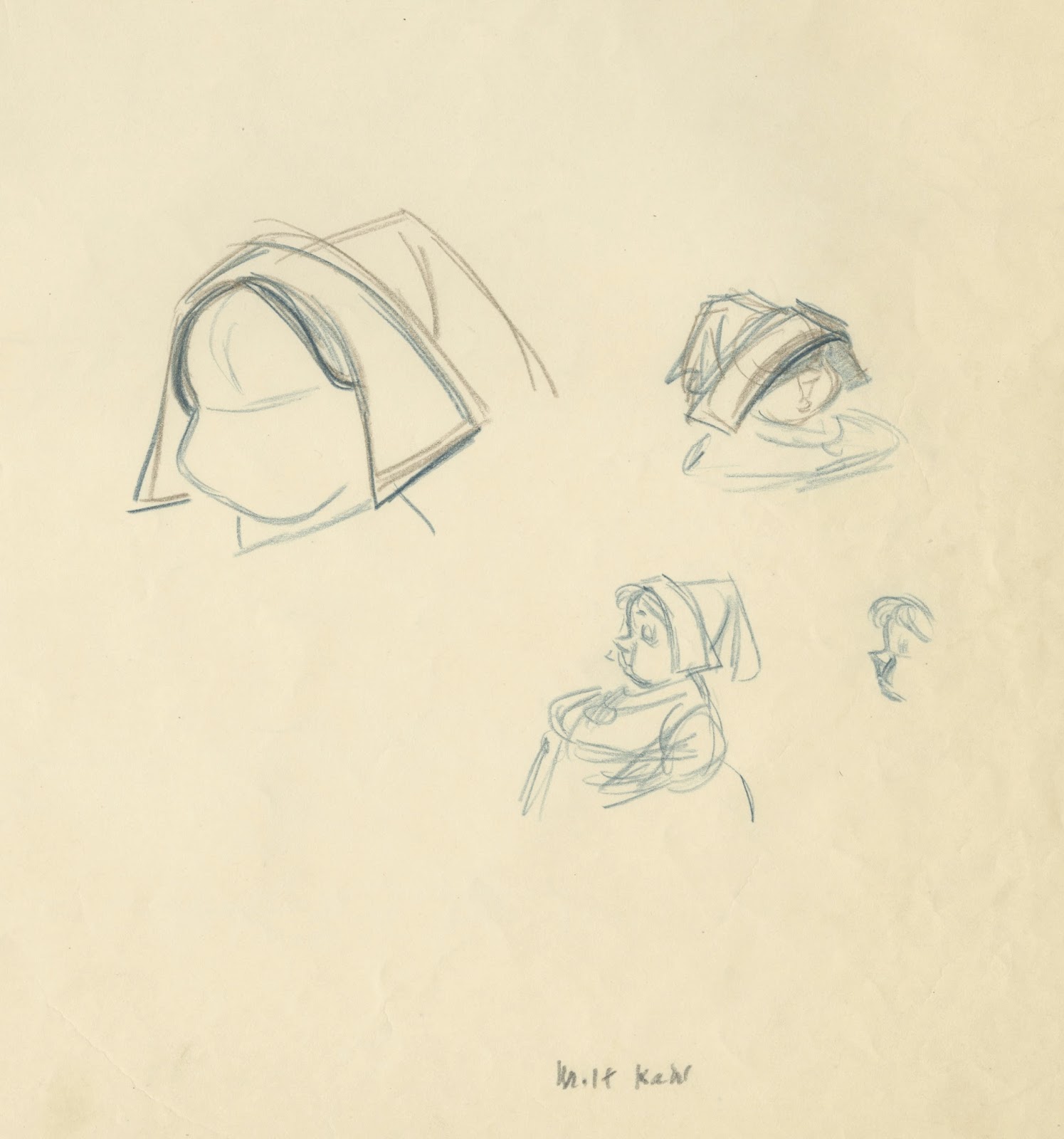
Milt didn't animate any scenes involving the three fairies, but he did sketch this hat treatment for Merryweather and gave it to Frank Thomas.


This is a rough in-between for an early scene that was cut from the movie. At that time Milt drew the Prince with a sharp nose tip.


Design ideas for Fauna. The sagging cheeks were later eliminated for a simpler facial appearance. Beautiful arrangement of shapes, but I do prefer Frank and Ollie's version of the character.


Tuesday, August 30, 2016

The Way Milt Kahl Draws


When you watch Milt draw some of his characters at the end of his episode from The Disney Family Album series you can't help but feel his intense concentration. He was interviewed and filmed in 1984 at home in his Condo, just north of San Francisco in Marin County. Milt hadn't drawn in several years, he left Disney in 1976. Nevertheless, full of self doubt feeling rusty, he gave in to the show's director Mike Bonifer and sketched in front of the camera.
The footage is of historical importance, because it shows Milt's unorthodox way of drawing. He throws in a light circle for the main mass of the character's head, but then goes straight for details.
The order in which he puts lines on paper is completely absurd. He finished drawing Pinocchio's head, before moving left to define his finger, which is on fire. The connecting arm was drawn in much later.

Milt's assistant Dave Michener told me that Milt stared at blank paper on his desk for a very long time before then quickly animating his scene. He literally saw poses projected on paper, which he then "traced".


Her is the link to The Disney Family Album Wikipedia page for more infos on all episodes:

https://en.wikipedia.org/wiki/Disney_Family_Album


Sunday, August 28, 2016

Rembrandt Bugatti II


It's been over four years since I put up a post on the great Rembrandt Bugatti. Time for another look at this unrivaled master of animal sculpture. I consider any of his sculpts a masterpiece. Who knows how his art would have evolved and how many more gems he might have created, had he not taken his life at the age of 31.

here is the link to my first post:

http://andreasdeja.blogspot.com/2012/02/rembrandt-bugatti.html


Bugatti was a master of the human form as well. Below, Reclining Athlete from 1907.


Friday, August 26, 2016

Polar Bear

I was told that these polar bear designs are the work of John Lounsbery. They don't show the type of line work I associate with Louns, but who knows?! It looks like these sketches were made sometime during the 1940s, possibly 1950s. In any case, the drawings are lovely, good caricature based on the real animal.


Talking about polar bears. You MUST watch David Attenborough's BBC production of "The Hunt".
Just like "Planet Earth", best wildlife documentary EVER. The photography is insane, the program's episodes cover all kinds of animals. Get the Bluray from Amazon! If you are serious about studying nature to influence your animation, The Hunt will leave you breathless. Here is a clip:


Wednesday, August 24, 2016

Eavesdropping


Two villains, one from the film Cinderella, the other one from Robin Hood. These two scenes have something in common, both characters are eavesdropping. Lucifer -animated by Ward Kimball- is pressing his ear against the Stepmother's bedroom door in hopes of hearing more orders for Cinderella, something he obviously enjoys.
The Sheriff of Nottingham's pose -by John Lounsbery (with a little help from Milt Kahl) - is almost identical, as he tries to listen in on a conversation between Friar Tuck and Otto. It is highly likely that they are talking about Prince John's taxes.
Both animators chose to flatten one side of their character's head, the one which is pressing against the hard surface of the door. To show soft material like fur reacting to a hard surface like this is very convincing and satisfying to see.
The pupils are looking upwards in anticipation of any revealing news.


Monday, August 22, 2016

The Walrus


I believe the character sketches on this pre-animation model sheet of the Walrus from Alice in Wonderland are by Joe Rinaldi. They are terrific and scream out to be animated.
However there is one thing that's been puzzling me: How come that the animal specific tusks were left out in the design?
It's almost like drawing an elephant without a trunk, or a cow without an utter. By omitting the tusks the character ends up looking a bit more generic, this could be a Disney version of a bear or a dog.
When you look at the guy below, you can see what I am talking about.


John Tenniel's original illustrations for the Alice books show an anthropomorphic walrus whose design is definitely based on a real one.


A couple of production cels, showing Disney's high standards when it comes to character colors.


Ward Kimball animated most if not all of the Walrus' scenes. Here he runs away from the Carpenter, who just found out that his buddy ate all the oysters. "The time has come..."
This is your typical cartoon take off. The character is running in place in anticipation of the  actual get away. Yet Kimball manages to add a lot of personality to this boisterous movement.