For your viewing pleasure, a short story illustrated by Sullivant. The humor is charming, but beware, there is a cruel ending. As usual, every pose of the animals is a gem. Look at the pushed smile of the elephant, the tiger dancing and the giraffe standing on her head. Cartoony poses with real anatomy.
I had just flown over to London to join the crew who produced the animation for "Who Framed Roger Rabbit". A taxi took me from Heathrow right to the studio in Camden, the north of London.
I left my luggage in the lobby, and was shown around the new studio set up.
By the time I got to say Hello to Dick Williams, there was little time for small talk.
He had a scene for me to get started on, right then and there. So forget about your jet lag and dive in.
Most everybody was animating on the Maroon Cartoon for the opening of the film.
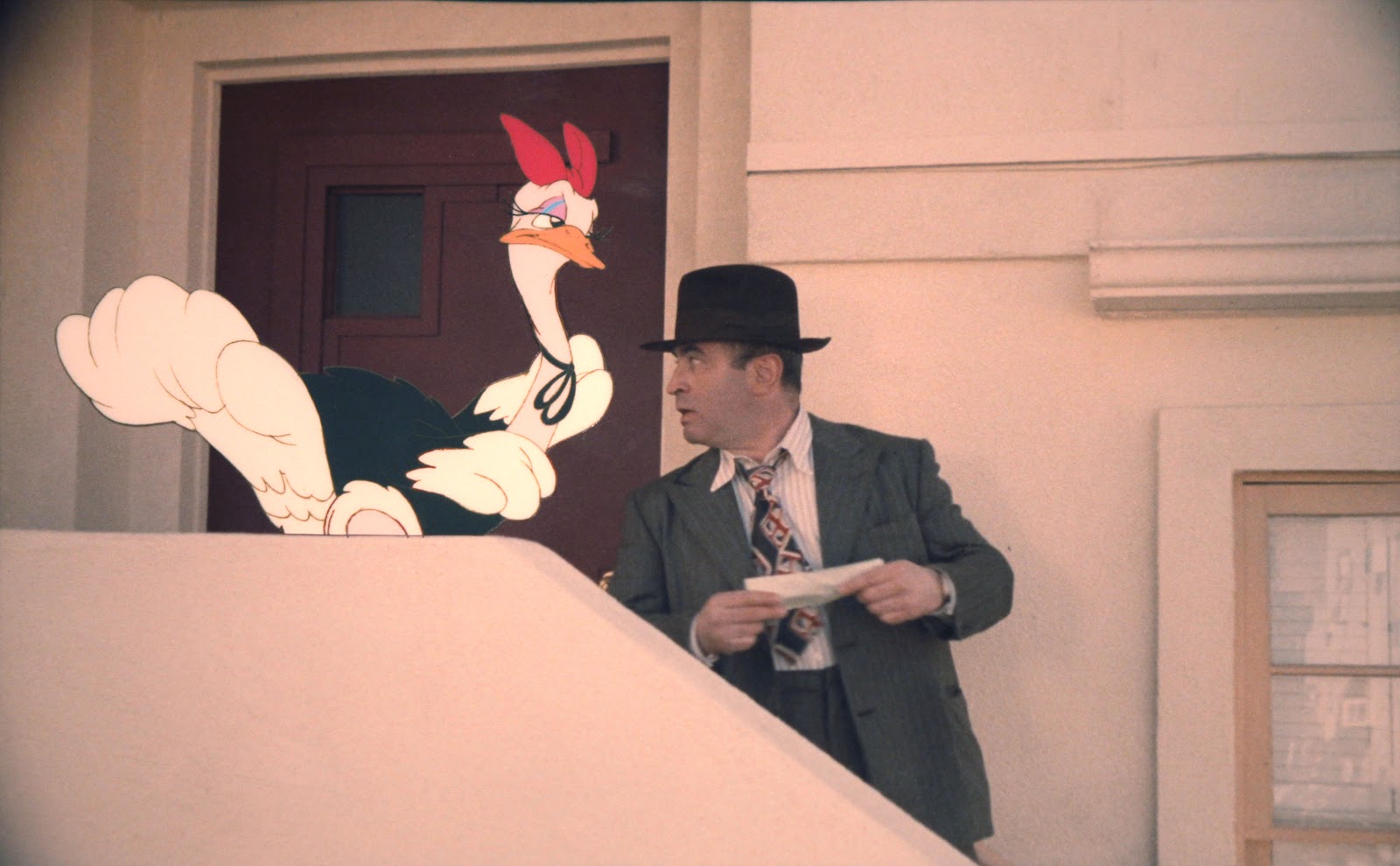
But Dick wanted me to do the scene with Bob Hoskins walking out of an office, passing a Fantasia ostrich as he moves downstairs. Dick said something like: "You're the Disney guy, it'll be great."
"Great" I thought, for Pete's sake, I had never done animation combined with live action before, what if it turns out awful?
I was given a huge box with photo stats of the whole scene. When I studied them I noticed of course that the camera was in constant motion.
HOW ON EARTH AM I GOING TO PUT THE BIRD INTO THIS?? I remember my mind started to panic.
Then, a bit of relief, I noticed that you wouldn't see the ostrich's legs, they were covered up in the live action. That meant potential foot slippage wasn't an issue here. Sigh….
Anyway, after analyzing the ostrich from old model sheets and thumb nailing the action, I just animated the character straight ahead on two's. I based it on the camera move and the perspective as best as I could.
Dick Williams liked the rough animation and thought the little attitude gesture on top of the stairs was fun. He only suggested a small change. The ostrich should look screen right at the start, then screen left, it would make it more interesting. An easy fix. I added the jumping frog with more confidence, and the scene was sold!!
I was so relieved, I felt like a million bucks.
Later on this turned out to be the first animation/live action scene in color that got sent from ILM, after they did the final compositing, including highlights, shadows etc.
It looked sooo cool, everybody was thrilled.
But we had a long road ahead of us to finish the movie.
Here are a few character studies and thumbnails, done before animation.
This is a cel set on a photo print, no tones on the character here.
There's no way this is going to be a brief post, I have too much good material of this character to share with you. The "King Louie" sequence in Jungle Book is one of my favorites.
I love the opening Multiplane truck toward the Ancient Ruins accompanied by atmospheric jungle rythms. The first handful of scenes with King Louie were animated by Eric Cleworth, who in my opinion did stronger work on the elephants.
Milt Kahl's comes in when Louie picks up Mowgli from the floor. As the song begins Frank Thomas takes over. Both animators go back and forth throughout the sequence, until the end when John Lounsbery animates the dance number with Baloo and Louie.
Louis Prima's slightly hoarse voice is just perfect for the character. The Sherman Brothers' song "I wanna be like You" gave Milt and Frank a lot of material to create his eccentric personality.
One thing I've been wondering about is why one detail, very typical of male Orangutans, is missing in the character design. They do have these unique skin flaps for cheeks, and neither Bill Peet, Ken Anderson nor Milt Kahl ever played with drawing those on Louie's face, during the design stage.
I assume that they considered them an unappealing feature and therefor left them out.
This is what I am talking about.
Here is how Bill Peet envisioned King Louie early on in production.
Milt Kahl finalized the character design
Milt's sense for personality and inventive expressions is off the charts. There is something unique in every key drawing. The second one, looking up inside the mouth leaves me speechless.
And the acting is really good, too.
Here he is animating the scene where Louie is about to "feed" Mowgli a banana.
I wished I had a photo of Frank Thomas working on King Louie.
Frank's drawings aren't nearly as refined as Milt's, but the animation is sensational. There is amazing rhythm going through the character's body with beautiful overlapping action of his belly and fur.
I have most drawings from the following two scenes, and I promise to pencil test them soon.
Just got back from a party, where I saw Marc Davis' wife Alice again. She looked great and was in good spirits.
So I thought I would post one of her husband's drawings, a sketch that I think qualifies as fine art.
I remember Alice giving it to me as a Christmas gift a few years ago. I know…lucky me!!
When I first visited the home of Marc and Alice Davis years ago I was literally overwhelmed.
Marc's art was (and still is) all over the house. Oil paintings, lithographs, watercolors…you name it, beautiful drawings and paintings done in a variety of techniques.
I remember asking Marc : " How can you animate Tinker Bell at the studio, then come home, and do Fine Art?"
His response was: " Well, I consider myself an artist first. As an animator I express myself in acting and graphic motion, as a painter I use different mediums to make a statement."
This sketch of a bull shows animation, realism with some abstractions, but most of all a thorough understanding of anatomy. Just stunning!
Last year I had the chance to purchase a few original sketches from the estate of Wilhelm M. Busch in Germany.
I was sent a disc with images of many works depicting circus scenes. Large oversized drawings that would be up for sale.
It was pure torture to select just a few, all of them were breathtaking.
These are works done on the spot at the circus, either during rehearsals or performances. (most likely during the 60ies or 70ies)
Busch didn't care about making pretty drawings here, to capture the essence of the moment was the most important thing. There is thorough observation and an honest truth in them, that makes it easy for the viewer to relive those moments.
Busch captured these "Kodak" moments in his head, then put them down on paper, a few strokes within seconds.
Fascinating what is left out, only the most essential lines define an animal like the marvellous leopard.