Sunday, April 15, 2012

"No Carrots!"


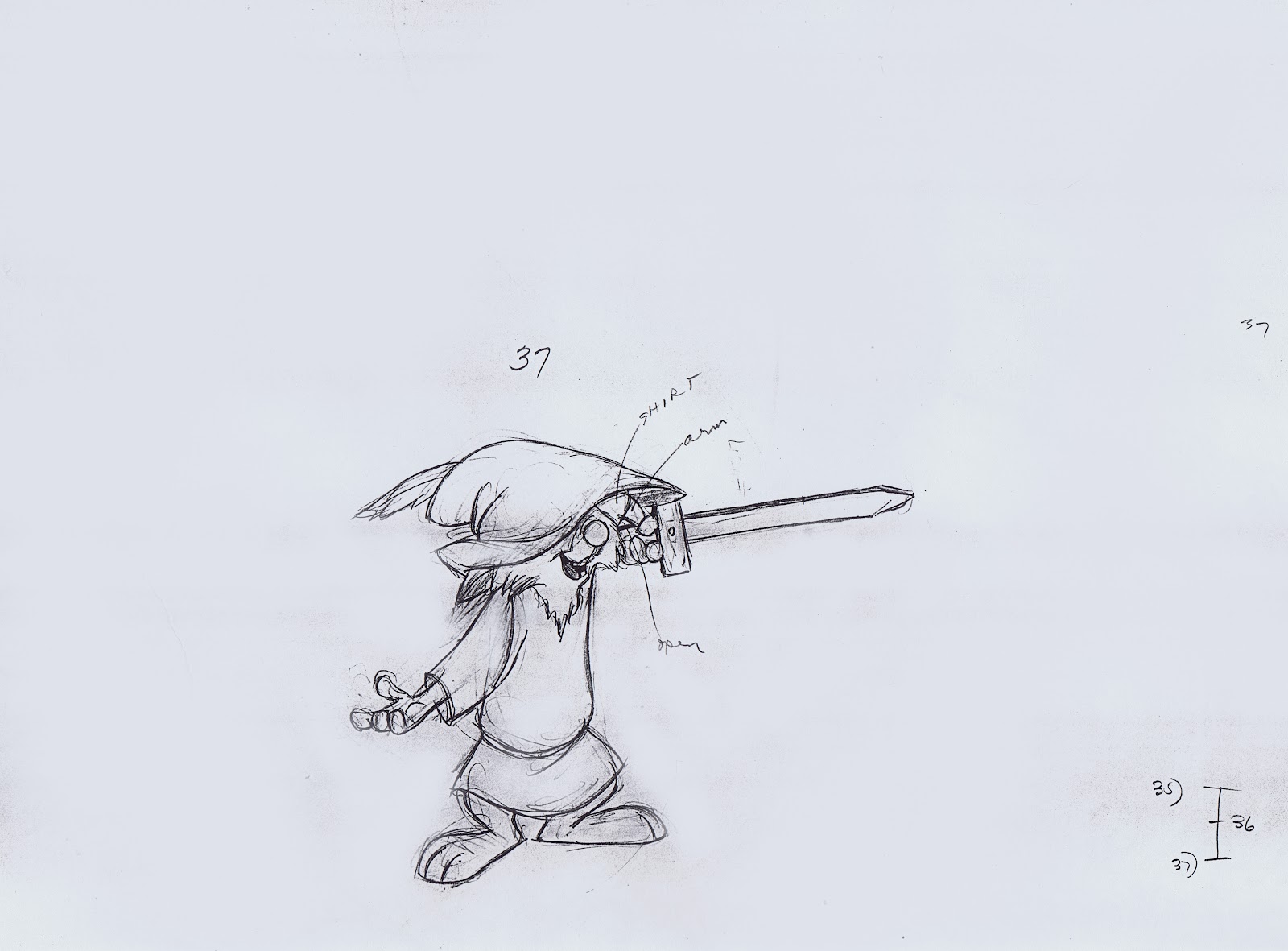
This scene proves that Milt Kahl was capable of animating most subtle and realistic acting extremely well. 
Prince Phillip has just fallen off his horse Samson into the water, and he is not amused. The previously promised carrots for Samson are not going to be handed out.

Some of you might know that Milt absolutely despised working on the prince. During one of our get togethers I asked him, how he could do such a beautiful job on a character he loathes.
To my best recollection he said: "Well, the character needs to be in the picture, I didn't like the assignment, but you do the best you can."
That's saying something about Milt's work ethics. Whatever goes into a Disney film needs to be top notch. 
The clarity in this scene is awesome. Phillip recovers from the fall, moving forward toward the horse. After Samson picks up his hat he splashes him and then says his line within a final pose. That way dialogue and the subtle raise of his eyebrows read beautifully.
By the way, this is rough animation, which was still traced in clean up for the inkers.

I can guarantee you, this is by far Milt's least favorite assignments out of all the characters he ever animated. Yet…there is absolutely no sign of frustration or lowering standards. Just look at those drawings!
When talking about high standards Milt said: " You owe it to yourself and the medium!".

Those are important words to remember!!!


PS. Blog reader XAV created a pencil test with these drawings. Check it out:
https://vimeo.com/40482016


Saturday, April 14, 2012

Dopey

This is a Fred Moore staging sketch, showing Sneezy (I think) interacting with Snow White.
Here we see Fred's version of the girl, more cartoony than the final model, which of course is much more realistic. It makes you wonder if the animators could have gotten the same emotional range out for the character, using a design like this one.
Come to think of it, this Snow White drawing could very well be a caricature of an employee at the studio. In any case, Fred Moore drew the leading lady very much like one of his famous "Freddy Girls".


Fred set the look for all of the dwarfs and animated many scenes with them, as a group and in single close ups. 
His tour de force character is Dopey, who along with the other six, underwent quite a graphic change, as he developed.
Just compare the early model sheet, already beautifully drawn and full of character, with the finalized design. What an astonishing improvement in appeal.

Dopey turned out to be a real "scene stealer" in Walt Disney's first animated feature.


Tuesday, April 10, 2012

Robin Hood Roughs

More of Milt Kahl's work for "Robin Hood".
The first sheet shows designs for Maid Marion and Lady Cluck before animation began.
The drawings look like they are just about to "click", meaning they are waiting to be animated in order to establish that perfect Kahl look.
The following Milt roughs were done for an Ollie Johnston segment of the film, the last part of the archery tournament.
Maid Marion seeking comfort from Lady Cluck presents a staging challenge, and Milt's sense for clear silhouette and pleasing shapes combined with the proper emotion helped make this a better scene.
The last image with Robin and Marion could have been problematic in terms of believability.
After all it shows two anthropomorphic foxes being in love. Again Milt's subtle draughtsmanship and sense for appeal prevent this from being a corny situation.


Sunday, April 8, 2012

Skippy & Co.

A little late as an "Easter Post",  but I hope you will enjoy these drawings of Skippy, his sisters and friend Toby Turtle from "Robin Hood".
Milt Kahl drew these development sketches based on character concepts by Ken Anderson. At first glance they look like typical Disney formula designs from the 1960ies and 70ies.
But the magic is in the subtle proportions, especially in the faces. The older bunny sister is particularly appealing with her slightly elongated upper muzzle. Without Milt's touch these characters might have looked overly cute and generic.
Actually a lot of scenes in the film, animated by a variety of animators, don't look this good. The acting is ok, but they lack the charm and appeal you see here. 
Then again, everybody knows that Milt's designs were often tough to follow.

The sequencial drawings are from a Kahl scene, they show how he brakes down a fun bunny hop.


Wednesday, April 4, 2012

Steinlen


That's animator Eric Larson in this beautiful vintage photo, taken around 1938 or 1939, during production of "Pinocchio"
Eric is working on Figaro, the cat. As you can see, he surrounds himself with all kinds of cat related inspirational material. There are magazine articles with photos of cats pinned to the cork board, and he has early as well as final model sheets of the character to reference from.
Next to his exposure sheet you see a book titled Steinlen.

Theophile Steinlen (1859-1923) was a Swiss born French Art Nouveau painter.
When you google his name, you'll find a great number of his stunning drawings and paintings. Many of these works are depicting house cats in carefully observed poses. A variety of French magazines of the time published Steinlen's humorous illustrated stories that show continuity like a comic strip. He was a real master of the "feline form".

Even though Figaro is drawn in a cartoony style, his motion is based on real cats. 
I am sure Eric got a lot out of studying Steinlen's sketches, like the ones below.


Sunday, April 1, 2012

Experimental Bambi

This is a scene by Milt Kahl which doesn't appear in the final movie "Bambi".
It looks to me like the scene was either cut from the film, or it was just a piece of test animation, done before actual production began.
I created this pencil test a few years ago and showed it at the Academy's tribute to Milt Kahl. There were a bunch of in-betweens missing, so I drew those based on the key drawings' charts.
When I watched the pencil test for the first time, I wasn't sure if the timing is 100% accurate. There was no exposure sheet to go by, so I just timed the drawings based on their numbers.
I do know though that occasionally (especially in the old days) the numbers don't always give you the final timing. In other words, drawings numbered on ones could be exposed for two frames for the final scene.
Also, it seems to me that Bambi is interacting with some other character, possibly a few bunnies.

Still, even just like this it is a gorgeous piece of animation to look at, done when Milt Kahl was about 30 years old.
There is full knowledge and control over the motion range of a fawn's body. And Milt knew how to combine that with the emotions of a little kid.
Animated gold!