Wednesday, October 10, 2012

Action-Reaction


I don't think I could have found a better drawing than this one to illustrate the point of action and reaction. And this is a one that Milt Kahl trashed, because in his mind something needed to be changed, which called for redrawing the poses.

Toward the end of The Rescuers Medusa is kicking Snoops in order to keep him away from the diamond. This is magnificently staged. From Medusa's shoulder all the way down to her right foot, one continuous line !! Her hands are holding the diamond up high in the opposite direction of Snoops. The idea being, you can't have this, it's mine!
Snoops reaction is very simple to read as well. Head, arms and legs, they all face forward to support the backward kick. What a drawing, sophisticated simplicity!

A little later in the film, Penny gets a hold of her teddy bear with the diamond in it. Medusa and Snoops are trying to stop each other from catching up with Penny.
Here Snoops has just grabbed Medusa's legs, as he is hitting the floor, his legs still up in the air.
Medusa's upper body reacts in a big upward stretch before falling down flat. 
All this action follows typical animation rules of overlap, weight and squash and stretch.
But it is just presented in a such a brilliant way.

It's fun to study the key drawings of the entire scene below.
I love the way Snoop's water balloon belly reacts when Medusa steps on it.


Monday, October 8, 2012

Four Mouseketeers


This is the year when some of Animation's Royalty turn one hundred years old.
Chuck Jones, Frank Thomas and Ollie Johnston, who will be 100 this Halloween.
Marc Davis will hit this mark next year, and Ward Kimball in 2014.
For this Disney Magazine photo shoot these four got together in December of 1997 at the local Tam O'Shanter restaurant. What a rowdy bunch!! 
I wonder if they ever had the chance to meet up again after that day.

The Tam opened in 1922, and it was one of Walt Disney's favorite restaurants.
And I can see why. It has the authentic charm of a Scottish Highland's Inn. And the food is very good, too.
During a recent visit there a waitress pointed out to me what used to be Walt's reserved table.
Who says LA has no history?

©Disney

Saturday, October 6, 2012

Animated Energy


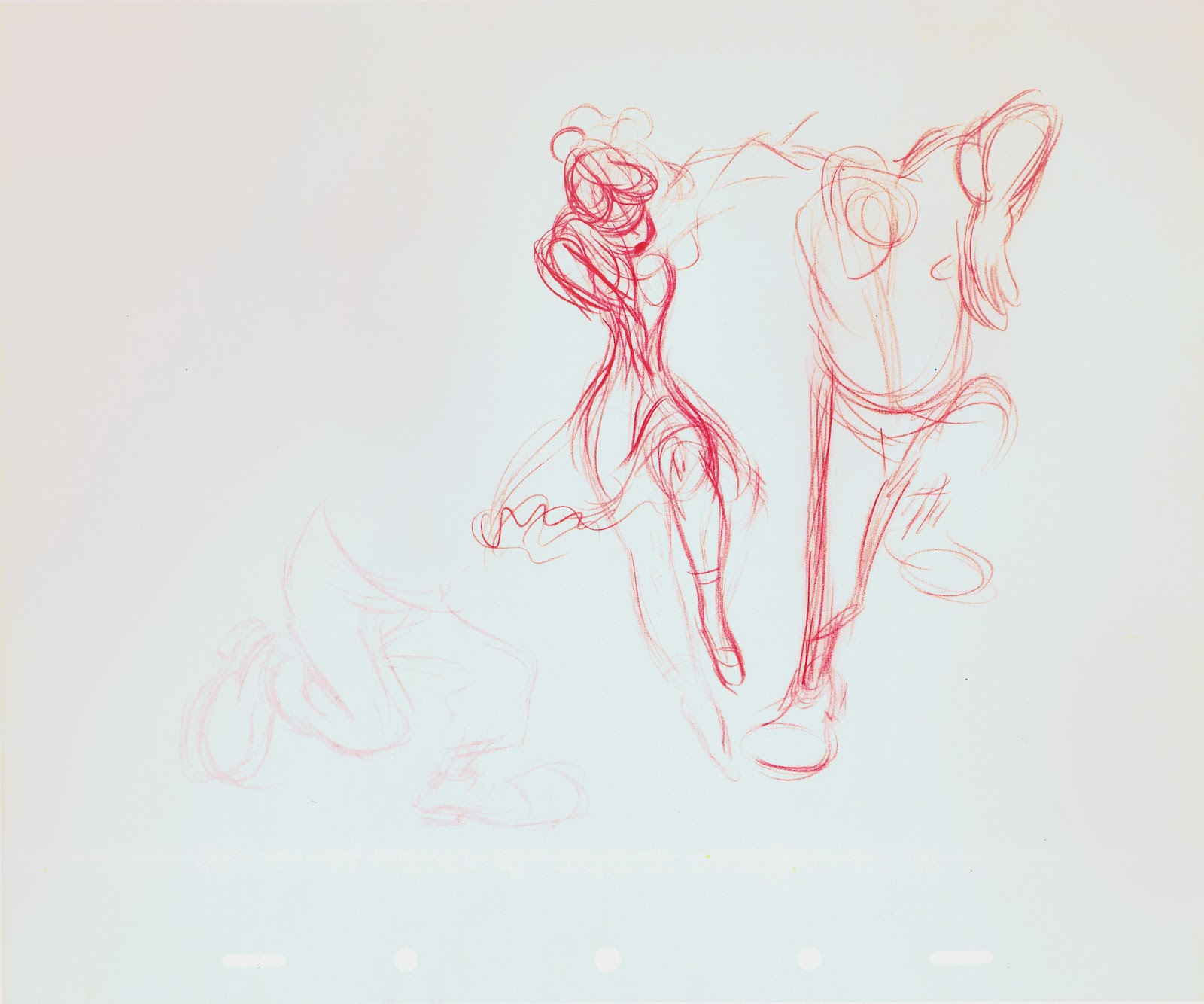
These animation roughs by Milt Kahl are from The Martins and the Coys section in the feature "Make Mine Music'" from 1946.
I find the exuberance and vitality in these dance poses infectious, when I look at them.
The characters are Grace Martin and Henry Coy, and they are in the middle of their spirited wedding barn-dance.
(You won't find this section on the edited DVD, released years ago.)

The animation is not based on live action here, the characters' cartoony design didn't require it.
And yet there is an elegance and clarity even at this first pass rough stage. 
The sheets are not numbered, which indicates that they haven't been timed out. The final animation probably differs a little from these exploratory sketches.
Pure joy !


In a different scene wedding guests join in the folk dance.
Look at how the two main characters make eye contact in the second sketch!


The hilarious square-dance caller as a rough and as a clean up drawing.
I love the fact that at times his head almost disappears in his oversized collar.


You can see on this cel that during these fast dance moves the inking wasn't always spot on. Watched in motion though everything looks terrific !


Friday, October 5, 2012

The King and The Royal Lackey


One more post about characters from Cinderella.
As I mentioned before, Milt Kahl designed and supervised the animation of the King.
I didn't know until recently that this character as well as the Duke were voiced by the same actor, Luis Van Rooten. 
That's amazing to me since they both sound so differently, and in terms of acting one is mostly aggressive, the other one reactive. Just as amazing as Jim Cummings, who has been voicing Winnie the Pooh and Tigger for a while.

Here are a few original drawings that show Milt's animation process. At first his rough pass, loose unfinished sketches in color pencil. The emotion and acting is explored at this stage.
It's interesting to me that the character's pupils are not drawn in yet, this is somewhat typical for Milt's first pass. Eye direction is something very important even in this early stage of the process, I myself would need to indicate pupils here.
But when Milt ties his drawings down in pencil, like the third image, pupils are very clearly and unmistakably placed in the eyes.


More examples of Milt's tied down animation roughs.


The Lackey's final design was set by Kahl as well. This first sheet though was drawn by a story artist (?), it shows a certain comedic type in rough form, but more refinement is necessary for animation. Milt of course used those ideas and in trying to plus the entertainment he emphasized the Lackey's overhanging upper lip and  his oversized coat.
Ollie Johnston made the character his own and animated him beautifully, as he is trying his best to fit the glass slipper on the ugly stepsisters.


Wednesday, October 3, 2012

Cinderella


I believe that Cinderella is the most challenging Disney heroine in terms of draughtsmanship. There is no graphic style here "to hang your hat on". She is just a subtle, realistic and very beautiful concept of a young woman. You would have to be so careful defining her face. Eyes, nose and mouth need to be placed within exact proportions or she would look like a different person. The nose alone is drawn with a minimum of lines. If not positioned perfectly those facial features would float around the face in animation.
That's why I am astonished that Cinderella looks so consistently appealing throughout the film, there is no off model scene that I can recall. Quite the accomplishment considering the short production schedule.
That's actress Ilene Woods in the photo with Marc Davis. Ilene almost whispered Cinderella's dialogue, which gave the title character such a nice, warm fairy tale quality.

First up a "doodle sheet" that shows Marc exploring Cinderella's face as a sculpture in three dimensions.


Here are a couple of animation drawings by Marc. This is careful, sensitive perfection. 


These are copies of Marc's animation keys from the scene when Cinderella has just been transformed and given her knock out dress for the ball. "Look, glass slippers!"
The folds in her dress needed special attention. If the material felt too light, she'd be wearing a paper dress, if too heavy, the dress would move as if made out of thick carpet.


Eric Larson animated a lot of key scenes with Cinderella, including this one, where she admires the dress the animals made for her. These are Eric's animation roughs.


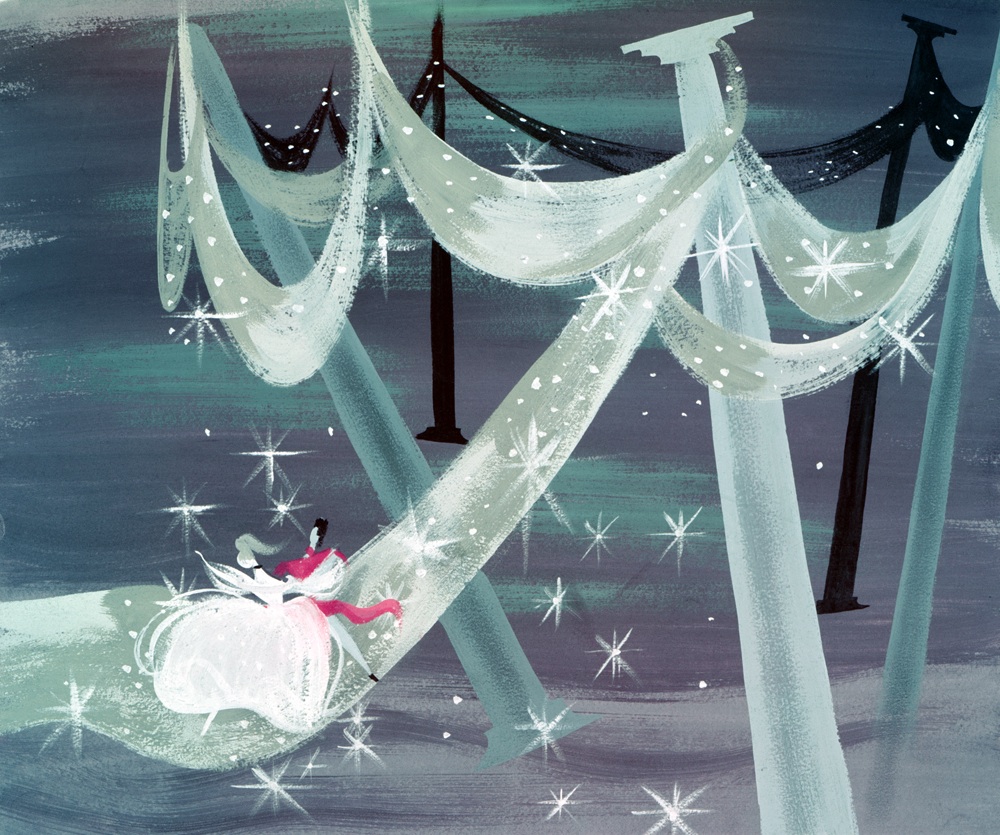
Last not least a few of Mary Blair's stunning concept paintings for the "falling in love'" sequence. 
All this stuff would be very corny, even back in 1950, but the artists believed in this story and its characters, and their work shows sincerity.