Tuesday, May 6, 2014

Busch Horses


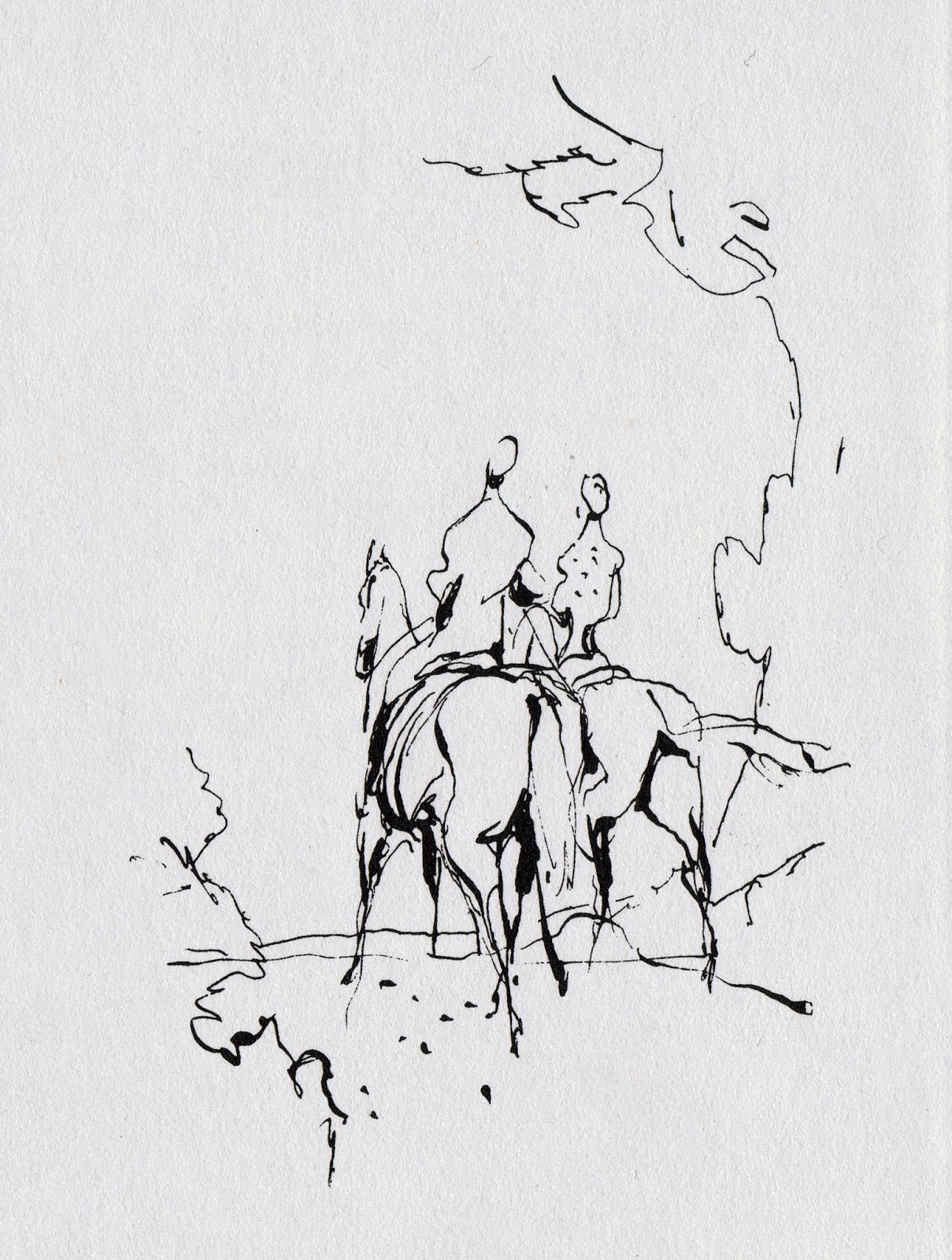
Wilhelm M. Busch was good at drawing anything, but his illustrations depicting horses show the artist’s special connection with the animal. The reason could be the fact that horses are readily available drawing subjects in Germany. At the races, sporting events and at farms.
These book illustrations date back to 1977 for the edition of “Reitvorschrift fuer eine Geliebte” (Riding Rules for a Lover)…odd title.
Every one of these pen and ink/brush images is a gem. So inspiring. Refreshingly formula-free.
Just thorough observation, knowledge and emotion!

I did one wire sculpture of a horse and a rider a while back…I’ve got to do another one.


Monday, May 5, 2014

Character Relationships


Staging personalities together in a way that brings out their personalities is a quality Frank Thomas was very good at. He knew well that having contrasting attitudes among characters helps to create interesting situations. Playing them off each other brings out their emotions and identities.
Frank’s characters always come off as sincere, real types, because they are based on actual life observation. No tricks, no formulas…instead his animation reminds everyone of somebody they encountered in their lives.
Above, Fauna and Merryweather contemplate the idea of raising Princess Aurora secretly in the forest. Fauna adores the idea while Merryweather has her doubts. 

In this drawing from the unproduced short film The Laughing Gauchito Frank faced the challenge of having the main character act with himself in a mirror. This becomes more of a technical challenge, since the reflection moves exactly like the Gauchito, just in a different perspective (a problem that obviously doesn’t exist in today’s CG animation).


Ichabod Crane dances with Katrina. Frank explores various staging ideas that show Ichabod’s pursuit and Katrina’s willingness to play along. 


A pirate on Hook’s ship threatens Smee. The pirate’s force dominates this situation, while Smee is portrayed as intimidated and helpless.


Here Captain Hook corners Smee, a great visual for action and reaction. 


In this little doodle Jock and Lady share a moment in which either one is interested in the other's thoughts. They both lean toward one another to examine what’s on the other’s character’s mind.
Jock seems to offer comfort, and Lady is willing to accept it.


The Three Fairies have just sent Aurora into the forest to pick more berries. Now that she is gone they immediately go on with their business to prepare for a surprise birthday party. Flora is leading the way (right in character), while Merryweather closes the door.


Pongo has just picked up Lucky, who was shivering in the cold snow. He has no problem carrying the little pup, who is helpless and limp as a flower sack.


Easy to read attitudes in this character composition. Wart is flabbergasted toward the affection this strange girl squirrel is showcasing. I love her little arms holding on to Wart, and keeping him from moving away (temporarily).


King Louie shows ape like behavior when examining Mowgli’s head for any kind of insects. The boy naturally is annoyed and tries to free himself. A great scene, Frank did every single drawing for it.


Baloo takes a liking to Mowgli, who has not yet accepted the bear as an ally. Eventually he comes around, which is part of the joy of The Jungle Book.


Here is the link to an earlier post on this subject:

Saturday, May 3, 2014

Sleeping Beauty's Lackey


The character designs for the film Sleeping Beauty are highly inventive and groundbreaking. Other studios had already experimented with short films that looked very different and modern. These productions showed limited movements with their flat, graphic characters. 
Disney’s first experiments, using break-away, contemporary designs, go back to 1954’s Toot, Whistle, Plunk and Boom.
But Sleeping Beauty was the first animated feature in which Disney character development and acting were combined with fully animated stylized personalities. 
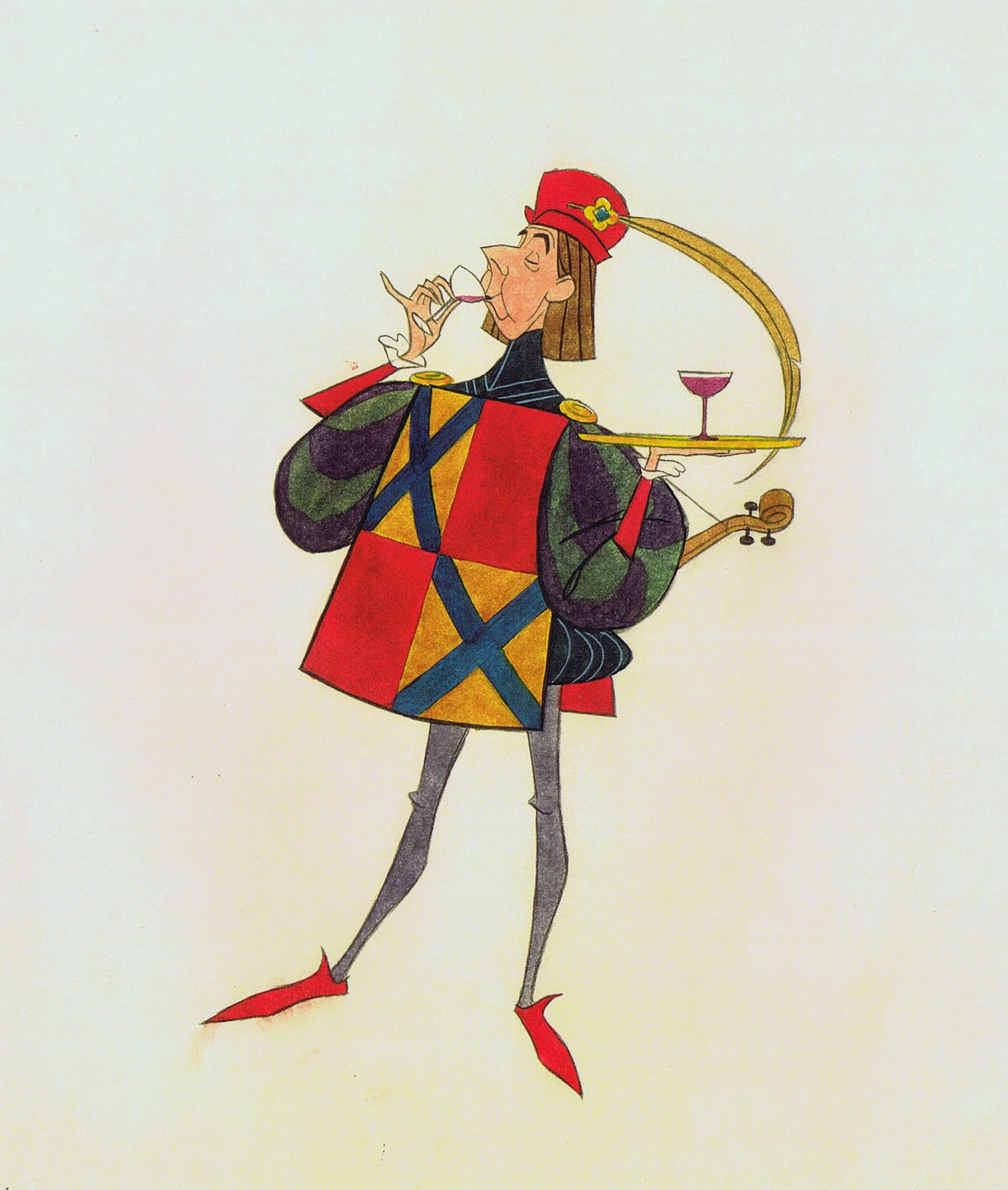
The Lackey has only a small role, but his few scenes are extremely well executed. 
You have a very skinny character who’s costume adds bulk and contrast. The design sketch above is by Milt Kahl, who animated most of the personality scenes.
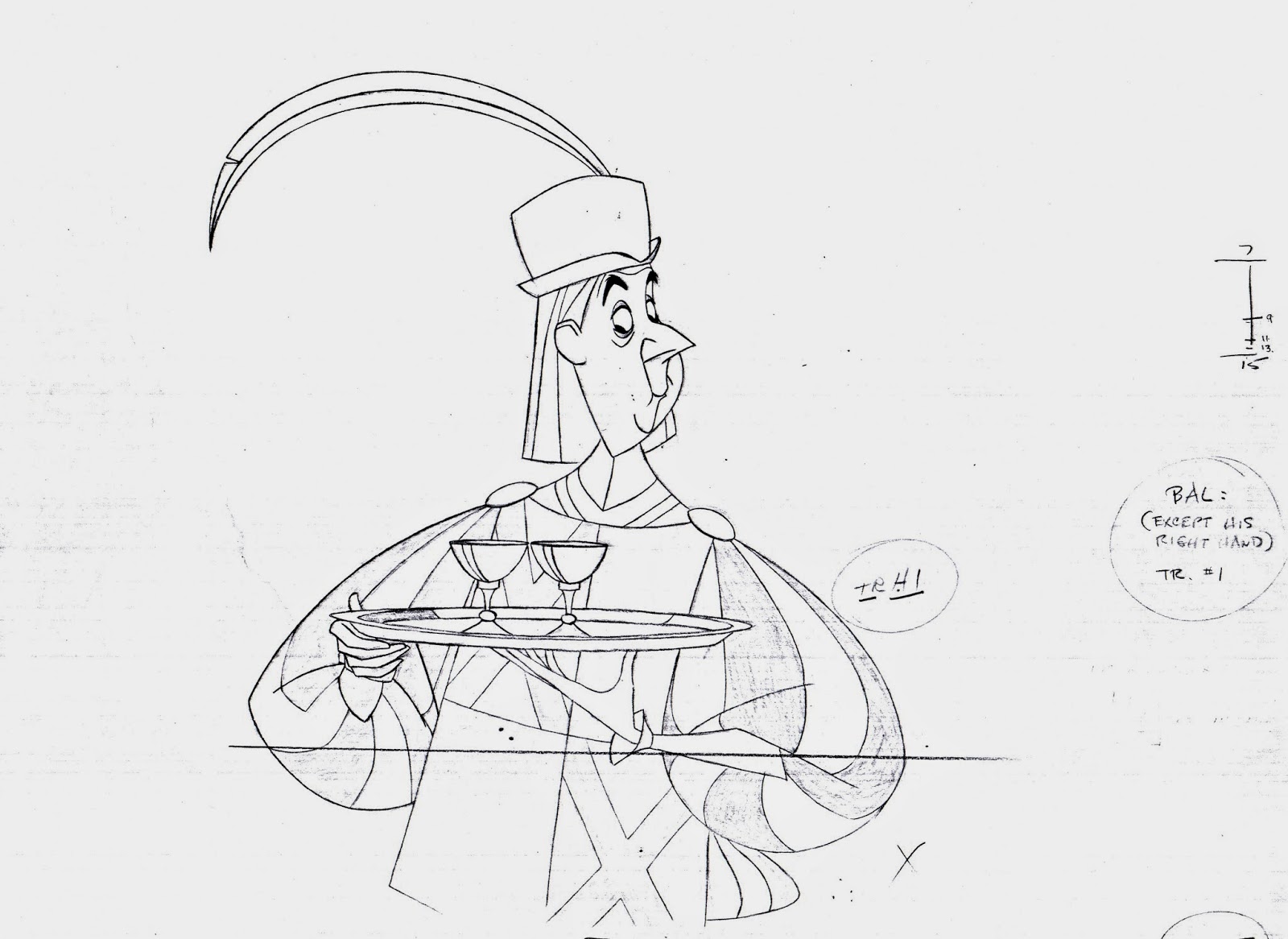
Here are a few rough keys from his introductory scene. 
King Hubert has just called for the wine, and the Lackey rushes in with a bottle and two glasses on a tray. I love the way Milt animated him running as he almost looses control of his hold on the tray.


Another great Kahl scene in which the Lackey performs a secretive wine tasting.
He carefully checks on the two kings who are busy in conversation. Feeling unobserved, he lifts up a glass for a sip. He immediately is interrupted by King Hubert’s boisterous voice and quickly places the glass back on the tray. His final expression shows an attempt to cover up guilt of having done something against protocol. 
Just look at the graphic power in these drawings.


John Sibley also animated a few scenes, no doubt under Milt’s supervision.
This is one of John’s rough key drawings.


Wednesday, April 30, 2014

Pinocchio comes to Life


Here once again are a couple of panels (I call them updated storyboards) from the film Pinocchio that demonstrate how the Blue Fairy brings him to life. These are snapshots from the original 35 mm pencil tests, which Walt would review during sweatbox sessions. Some images show key drawings, others are in-betweens (they usually look a little cleaner), there are rough animation drawings and occasionally clean ups. I think these prints are beautiful and insightful documents of how the animation on this film progressed.
Animator Jack Campbell drew the Blue Fairy, Berny Wolf did Jiminy Cricket (surprise!), and Ollie Johnston animated Pinoke’s first scenes, followed by Milt Kahl. A Golden Age of character animation indeed.
The panels need to be viewed next to each other.


On a different note:
The Marc Davis exhibition at the Walt Disney Family Museum looks great, and the Mary Blair show is extraordinary! You are really missing out big time if you don’t see these breathtaking exhibits. They represent a couple of jewels in the treasure chest, that is the Walt Disney Family Museum.

Monday, April 28, 2014

Marc Davis at the Walt Disney Family Museum


I am off to the Walt Disney Family Museum in San Francisco for the opening of the Marc Davis exhibit, Leading Ladies and Femmes Fatales: The Art of Marc Davis.
Marc’s expertise in developing and animating female characters will be the theme of this this show:


The photo montage above is a book cover design that I came up with while still at the studio, when I was exploring the idea of doing a single book on each of the Nine Old Men.

I encourage everyone to visit the fabulous museum and see Marc’s original art up close.
The exhibit covers his incredible talent as an animator, as a  designer of iconic Disney theme park rides and as a modern fine artist. 

As I mentioned before, the wonderful Mary Blair exhibit is still ongoing as well, so now is the perfect time to to see the work of both artists.
Here are a few reminders that demonstrate Marc Davis’s talents as an animator of female characters.


A photo from the early 1990s at Marc’s and Alice’s home. Wonderful times!


Sunday, April 27, 2014

Disney Articles


Not so many years ago there were hardly any books available relating to animation. Today of course every new animated feature comes with its own book on The Making of.
Back then magazine articles were the only source of information about new projects from Disney, and occasionally photos took you behind the scenes of the studio. There was nothing more exciting than finding out about the next project from Walt Disney Productions.