Saturday, January 9, 2016

A Moment of Truth


I left Walt Disney Animation exactly five years ago.
This moment makes me reflect on my early days at the studio, which was then called Walt Disney Productions. You can't tell from the photo (taken by Hans Bacher), but I was thrilled beyond belief that Disney had actually hired me. We were still working in Walt's original Burbank Studio, and even though retired, most of the Nine Old Men were still around. They would come in for the occasional lecture, Eric Larson still worked on a daily basis as head of the training program.
Believe me, I knew I was one lucky guy. I remember Christmas time at the studio. Before our holiday break, there was an impromptu eggnog gathering in layout artist Don Griffith's office. Woolie Reitherman stopped by, as well as Art Stevens and other senior artists.

The photo shows a guy who really didn't know what he was doing at the time. But as I mentioned, I was super excited.


That's my buddy Phil Nibbelink, who along with layout artist Guy Vasilovich created one of the best sequences in the film, when the Gwythaint monsters kidnap the pig Hen Wen.


The movie did have some fantastic special effects. That particular unit did not show the inexperience evident in the the work by the character animators.


So here it is, the final footage chart. I had been on the film longer than most animators and ended up doing a chunk of work. No wonder management was kind to me. 
So whatever you don't like about The Black Cauldron, I probably have something to do with. All I can say is that this was my "learning" project, I made a lot of mistakes, but by the end of production I felt like I was able to take baby steps as far as animating. 


The numbers indicate feet of film. One foot and a half is ONE second of film.

Thursday, January 7, 2016

Kaa


Milt Kahl is showing some guests the scene he is working on for The Jungle Book. Kaa, the python, has a strangle hold on Mowgli and is about to devour him. Luckily Bagheera, the panther, interrupts the situation just in time.
Kaa is a fascinating character. I will never be able to figure out how Walt Disney thought that the voice of Winnie the Pooh would be perfect for a villainous snake as well. I suppose actor Sterling Holloway was able to slip into just about any role and be convincing.
What's also interesting about Kaa is the fact that the snake's design changed. In this early sequence the eyes are smaller and are drawn streamlined on top of the head.


When Kaa returns later on in the movie, the snout is larger, and so are the eyes. These are Milt's drawings as well. Unfortunately I never thought of asking him about the subtle change in design .


Going back, here is the starting point in terms of design, a story sketch by Bill Peet.


According to Frank and Ollie's book The Illusion of Life several artists contributed to the visual development of the snake. I recognize Ken Anderson and Milt at the very end.


More of Milt's drawings. What a great rough sketch with Kaa and Mowgli.


Frank Thomas animated the later sequence, when Kaa tries again to hypnotize Mowgli in hopes for a meal. Shere Khan interrogating the snake is of course Milt's sequence.


Story sketches by Vance Gerry with the help of Floyd Norman, a new and upcoming story artist.
The central color sketch is by Ken Anderson.

A Frank Thomas rough animation drawing. Mowgli tries to free himself from Kaa's body.


As all characters in The Jungle Book, their acting and relationships to other personalities is what makes the film. So little story, but sooo many entertaining situations. Still my favorite. 

Tuesday, January 5, 2016

The Queen of Hearts, from Mary to Frank


 I have always loved Mary Blair's depictions of the Queen of Hearts for the film Alice in Wonderland.
A grotesque, brash, bossy and even dangerous monarch. Because of her stylized pre production imagery Mary went all out to portray this eccentric Queen with broad but effective brushstrokes.
ans as usual, her color choices for the character's environments were brilliant.
To quote Marc Davis: " Mary knew color better than Matisse." She had a way of putting colors together that surprised everybody, colors that you thought wouldn't work together.


Animator Frank Thomas took some of Mary's ideas, but transformed the character into a slightly more dimensional universe, in order to fit with the rest of the  cast. The essence of the Queen's personality remained the same, Frank just needed a bit more realism to portray her over the top performances in a believable way.
To me both graphic approaches helped to define this villainess and helped to establish her overbearing, but funny character traits.


A rough animated scene with the queen of Hearts showcasing an abrupt emotional outburst is featured in my new book on The Nine Old Men.

Saturday, January 2, 2016

"My precious Pets..."


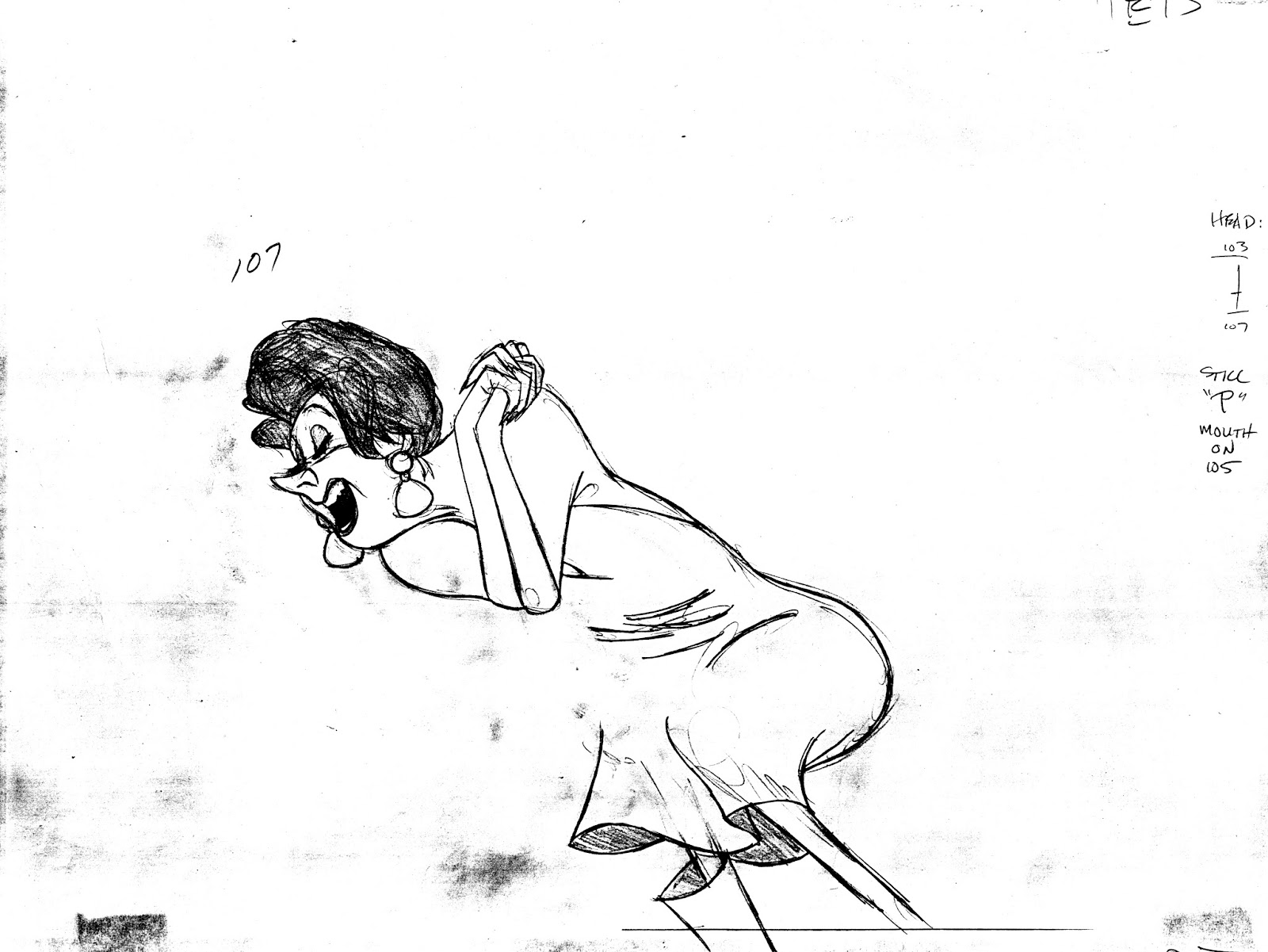
Milt Kahl had a way of challenging himself when animating his final character, Madame Medusa for the film The Rescuers. Acting and drawing are not based on live action reference, all of this comes out of Milt's head.
After throwing her boot at Snoops, Medusa turns her attention to her alligators, Nero and Brutus.
Her mood swings from anger to affection. Snoops failed her, but the alligators are still in her favor.
The action that follows is vintage Milt. Medusa throws the boot back to Snoops, during which  Milt breaks her arm for one frame on #18 in order to support the action.
When she turns to he alligators, Milt had a certain final pose in mind. And this is what's so cool:
Her elbows connect first, then the palms of her hands, and finally the interlocking of her fingers.
Great stuff!


Monday, December 28, 2015

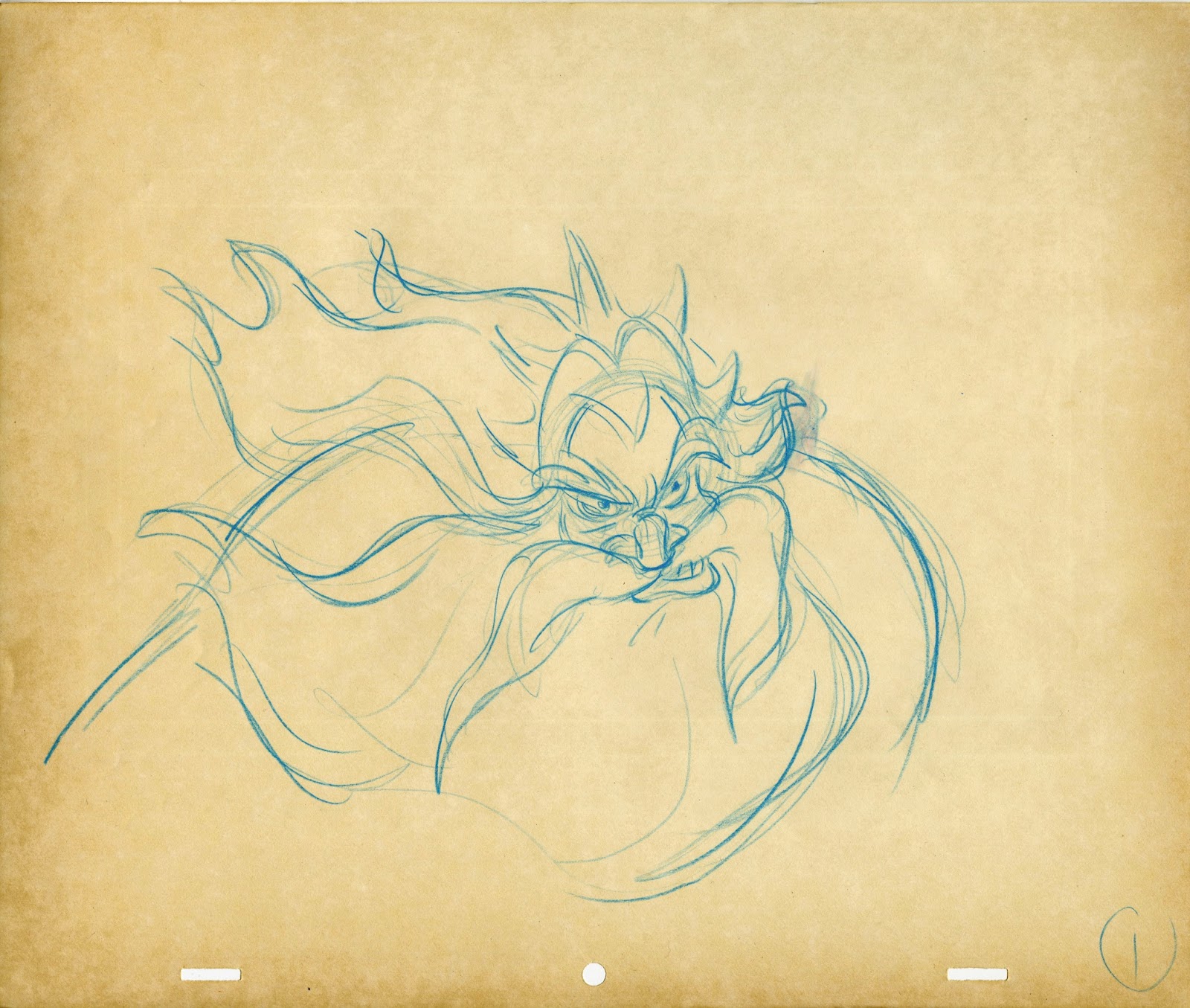
King Triton


I just realized that during my years of blogging I haven't posted anything yet on King Triton from The Little Mermaid. Actually I didn't think I had kept any such material, so to my surprise a bunch of first pass rough animation scenes just surfaced in a far corner of my archive. 
In this scene Triton is pretty darn mad at Ariel, who seems to be smitten by this human guy. His dialogue goes: "(Humans are) spineless, savage, harpooning fish eaters..."
It was fun to animate, because his emotions are very strong here. One thing I remember having just figured out was how to treat Triton's hair and beard. Earlier my first scene with him showed his hair resting on his back and shoulders, and that just didn't look like an under water scene at all. 
In order to achieve that effect, hair needs to float as it reacts to under water currents.

These are the key drawings from the scene, but I did do all of the in-betweens as well. I recall in those days we had either very few or possibly no rough in-betweeners, a cost cutting measure.
I never felt comfortable though "selling" my rough animation as a pose test, which looks like a slide show version of your scene, with missing in-betweens. So I ended up doing my own assistant work, which really didn't take very long since these drawings were loose and sketchy. 
For these scans I pushed the contrast a little, the lines on the 12 field paper are a very light blue. It is freakish to see that the paper has aged, but this stuff is now a few decades old...crazy!
Ahhh...the good old days...but actually they are still good, since I am still doing this sort of work.


One thing that puzzles me about this scene is that I didn't draw my precise graphite lines on top of each pose as per my usual work method. Instead I used new sheets of paper and tied down the character in a clean manner, so my clean up assistants would have an easier time doing their work.


Saturday, December 26, 2015

From Story Sketch to Final Frame


I talked about this scene before from Lady and the Tramp. Tramp, the salesman, is trying to convince the Beaver at the zoo how useful Lady's muzzle would be as a genuine log puller.
I just came across the story sketch,  animator Milt Kahl used as a springboard for his animated performance. Amazing to see that the idea for the characters' staging remains the same, just much improved.
The fact that the Beaver's body ends up in the air, held by his tail, adds a nice comic touch. And again Milt finds a way to connect both characters graphically by streamlining Tramp's pose and lowering his rear body.
I am always fascinated to find out how inspirational the story sketches were to the animators and how much they changed to make the scene their own.
I'll post another example shortly from Bedknobs and Broomsticks...different situation, the animator had to start almost from scratch because of a weak story sketch.