Tuesday, April 26, 2022

Visual Development


Imagine as a Disney animator looking at these terrific development visuals for an upcoming feature! How can you not get super excited, you just want to get to work! The Dance of the Hours from Fantasia is one of the best things ever animated. If you worked on this short, you can practically retire because this piece represents a high for the medium that would not be repeated. 

An extraordinary layout for the 1958 short film Paul Bunyan. I never cared for the animation much, but the look, the graphic world the artists created is stunning.  


This piece from 101 Dalmatians makes me laugh, because it represents an artistic hangover. The crew had just finished Sleeping Beauty and was gearing up for a new film set in a contemporary style. What they couldn't shake yet were square and round tree shapes. If you take the park bench out of the picture, you'd expect Aurora walking through the scenery talking to birds. 


A pretty development sketch for The Jungle Book. Walt Disney asked for light, fun settings, instead of a dark mysterious jungle. This color sketch looks pretty light to me. 


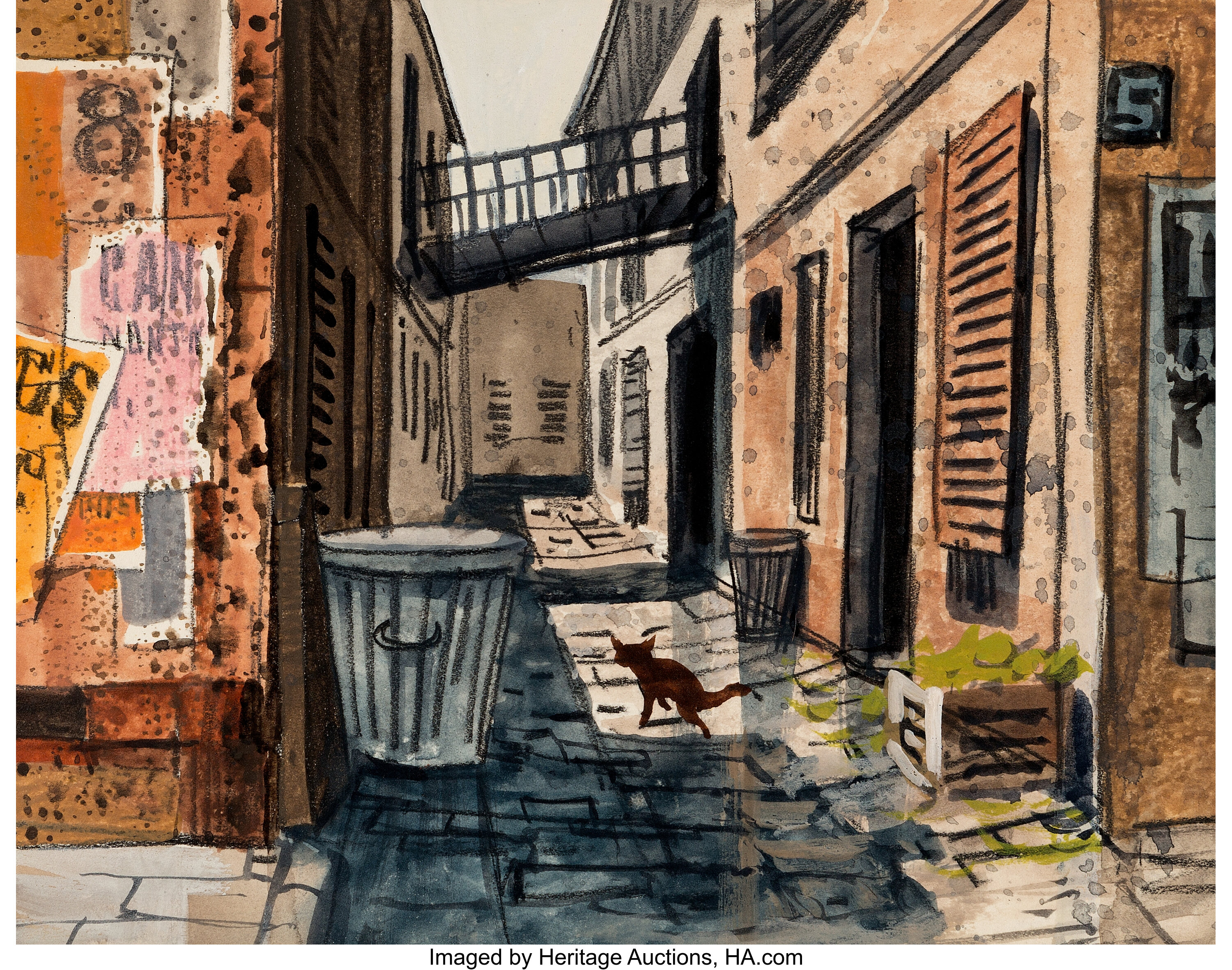
A back alley setting for The Aristocats. My educated guess: this is the work of the great Vance Gerry.


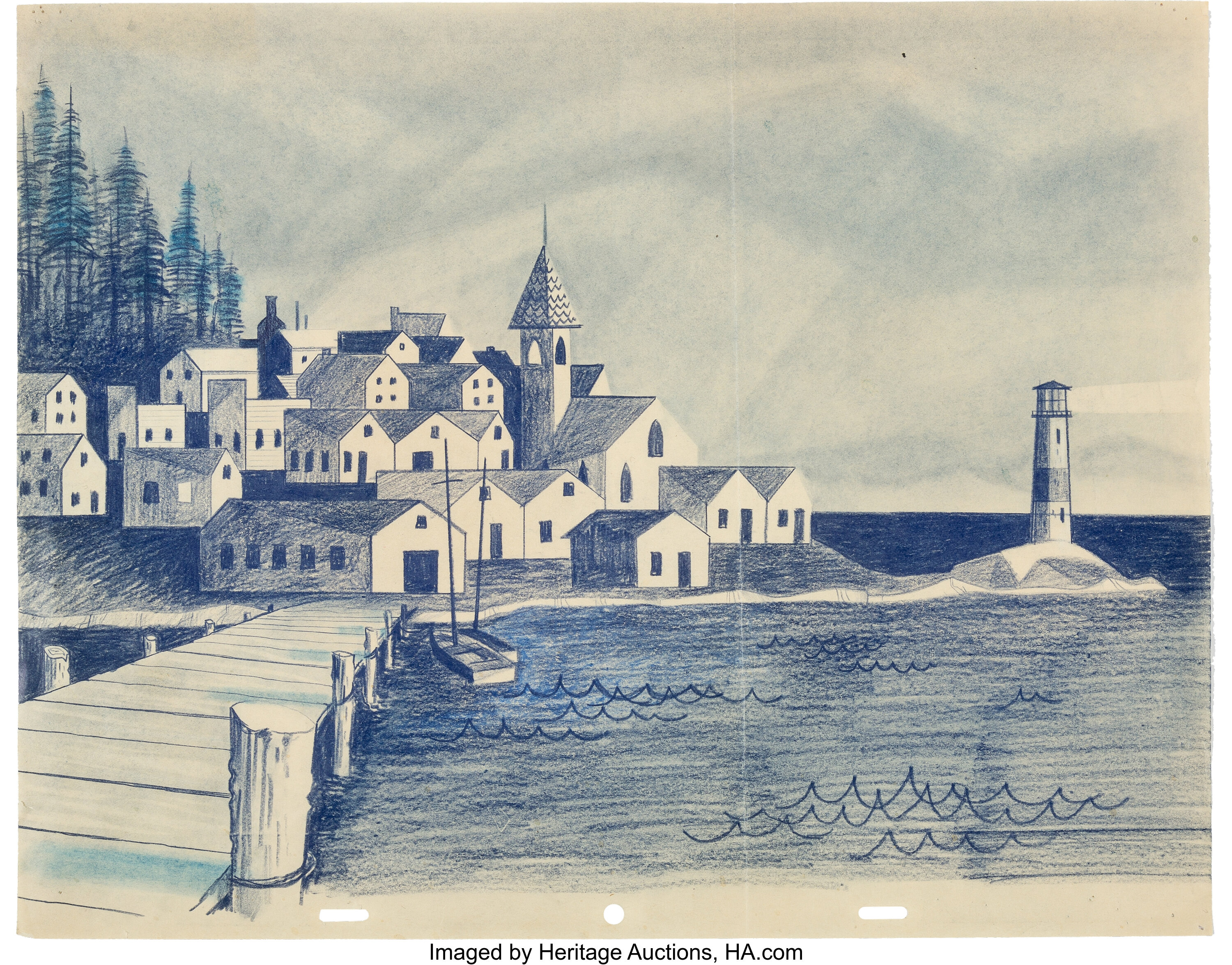
This one is close to home. The Snow Queen was going to be our next animated feature after the 2011 film Winnie the Pooh. Paul Felix had developed extraordinary settings for the project, we could not wait to get started. Bette Middler had been asked to voice the title character... then the shoe dropped. The CG shoe. The film ended up with a one word title...and the rest is history.


 Would I have lobbied for the Bette Midler character...of course!!


Wednesday, April 20, 2022

Disney in 1978


In 1978 concept artist Mel Shaw was working on several potential future animation projects. Among them Catfish Bend, The Little Broomstick, Musicana and The Black Cauldron. At that time The New York Times interviewed a few of Walt's artists regarding the state if the art form called Disney Animation. Its future seemed  uncertain, there was a need for new talent as the old folks were retiring. I was lucky to get hired by Walt Disney Productions two years later. 

Here is the article from the Times. I did my best to correct a few grammatical errors which were the result of a digitized online version of the actual newspaper page. 

LOS ANGELES “THE BLACK CAULDRON” Walt Disney's $15 million animated film scheduled for 1980 — is four years behind schedule. It will not be completed until Christmas, 1984, because the new crop of young animators the studio has spent six years acquiring are not yet competent to handle its complexities. “The Black Cauldron,” which is based on Lloyd Alexander's interpretations of medieval Welsh mythology, will be replaced in 1980 by a simpler and easier movie about animal friendship, “The Fox and the Hound.”

At the same time that Disney's young animators are floundering in waters still too deep for them, classic Disney animation is enjoying a surprising artistic and box‐office renaissance.

The re‐release of Disney's 1967 “The Jungle Book,” is bringing the studio $14 million, $2 million more than the picture made when it was first released 11 years ago. And the studio's last animated film, “The Rescuers,” is outdrawing “Star Wars” in Paris, as an adult cult film in Western Europe, it has earned $45 million for the studio, and has recently become the largest grossing picture of all time in West Germany.

Mickey Mouse Turning 50

Next November Mickey Mouse will be 50 years old, having first appeared in “Steamboat Willie” on Nov. 18, 1928. The empire he founded is robust. Disneyland and Disneyworld have been successful beyond even the dreams of Walt Disney who — against all advice — borrowed against his studio to build them. Last year the company earned $82 million on 'sales of $629.8 million. During the first nine months of this year the studio has had record revenues of $499,388,000 and record net in come of $60,915,000.

But the last Mickey Mouse cartoon was made in 1953; and only ‐two of the nine young men who cut their artistic teeth on “Snow White” in 1938 are still at the studio.

“We never get old, never die, never retire,” said 73‐year‐old Eric Larson. “We accepted that and the studio accepted it. They never looked beyond us. “

“We thought we were always going to be 21 years old,” said Ward Kimball, who retired in 1973. “We thought we would always be putting goldfish in the bottled drinking water, balancing cups of water on the light fixtures, changing the labels on cans of sauerkraut juice. We were 21 years old, Walt was 30, leading the pack. Working there was more fun than any job I could ever imagine.

Pompousness ‘Rewarded’

“I worked the first two weeks for nothing and then got $15 a week. There was no pay for overtime and no air conditioning.

We stripped to the waist in the summer and if a guy was taking himself too seriously we'd stick a flutter pad under his seat so he'd make rude noise when he sat down. There were 180 people at the studio, including the night watchman and the janitors. Today, it's a corporate structure, large and complicated place.”


Walt Disney called them his nine old men: Les Clark, Marc Davis, Ollie Johnston, Milt Kahl, Mr. Kimball, Mr. Larson, John Lounsbery, Wolfgang Reitherman and Frank Thomas.

“The Rescuers,” exactly 40 years after “Snow White,” is the last film to bear their stamp. Mr. Lounsbery directed “The Rescuers.” Mr. Thomas and Mr. Johnston animated the mice—Bernard and Miss‐ Bianca — in the months before their retirement. Mr. Kahl drew the villainous Medusa and her 2 alligators and also retired.

Talent‐ Search Is Unproductive

When his nine old men really became old. Walt Disney was dead; and his studio was unprepared. A talent search begun by Mr. Larson in 1972 has brought surprisingly meager results.

“We'd like (to add) 30 good animators,” he said. He has looked at thousands of portfolios and tried out 100 young animators in the last six years. Of those, 35 remain; and only 16 are in animation. “When someone is hired, you can't tell how good he'll be,” Mr. Larson said. “ Animation is limited only by imagination and the ability to draw what you can imagine.

“People come with master's degrees in art and they can't draw worth damn. Art teachers are interested in static figure drawing. We deal with weight, action, movement. You have to be able to draw the relationship of character's coat to the rest of his body or the relationship of his cuffs to the rest of his coat.”

Conception of Space Vital

“A person can show you drawings that knock you out,” said Mr. Kimball, “but he may not have a conception of movement, may not be able to put something in a space. And there are more choices today. A lot of young animators don't want to work here, don't want to knuckle down to the training required of Disney animators.”

Disney has its own reservoir in the animation school it has set up at the California Institute of the Arts to teach the Disney style of animation. Yet, out of 19 portfolios from Cal Arts this year, Mr. Larson found only two good. “And three more are passable.” The special skills required in animation mean that, in the movie business, where nepotism is a way of life, there is almost never a second‐generation animator. Mr. Larson can think of only one, John Kimball, Ward Kimball's son.


Disney's Death a Blow

The death of Walt Disney in 1966 was a special blow to his animators. Movies — regarded as the most collaborative of arts — seem a hermit's paradise next to the number of people required to create the 129,000 drawings used in an animated feature. “Walt had such an ego, he was so tremendous, that he could weld us into a team,” Mr. Larsbn said. “It's a big problem for these new people to become a cog in a team effort. They want to be in ‘the industry,’ not at this particular studio. There was a loyalty to this particular place. And I'm not sure we can renew it.”

“I don't think there has ever been an artistic medium that requires as many people,” said Mr. Reitherman, who is directing “The Fox and the Hound.”

“It's definitely a team sport. But how do you train a young animator? A feature film is very expensive. ‘The Fox and the Hound’ will cost $8.5 million. And it's four years of pregnancy before it's finished. We used to make 24 shorts a year. We don't have that way to train people anymore.”

Shorts Were Great School

“I was at the studio five years before Walt made his first feature,” said, Ward Kimball. “We made six or seven minute shorts. What a great school to break in new animators. You could see your work on the screen in weeks.”

Today, shorts lose money. The last Disney cartoon was “Winnie the Pooh and Tigger Too” in 1974. Partly to give the young animators some experience, the studio is now making a 25‐minute animated short, “The Small One,” which will be released next Christmas. The director of “The Small One” is 39year‐old Don Bluth, the most highly regarded of the next generation of Disney animators.

Then the younger animators will face a New‐style Disney film, “The Black Cauldron,” requiring a whole new generation of animators (with more sophisticated characters than) the happy dog and cheerful fox of “The Fox and the Hound. The Black cauldron, is a kettle that has the ability to bring the dead to life and is guarded by three witches who can interchange themselves.

“As far as drawing is concerned, entertainment is concerned, background and layout and effects are concerned, that's terribly challenging staging,” Mr. Larson said.

“The picture also has a boy hero and a girl heroine. As soon as you start working with human figures, you let the audience compare their movements with the movements of a real person the same size. Animals and’ caricature figures like Medusa are much easier.”

What makes it all so difficult is that, beyond technical competence, there is something more important to men who speak of animation as magic rather than skill. “Animating isn't moving things,” said Mr. Larson. “It's trying to make them live.”

“Shere Khan in The Jungle Book’ didn't really look like George Sanders, the actor who was his voice,” Mr. Reitherman said. “But he had the imperious attitude, the arrogance. He was the essence of George Sanders; Eva Gabor said the tiger was more like her husband George Sanders, than Sanders (himself).

“I retired,” said Ward Kimball, “because I was beginning to get bored. Maybe subliminally I missed Walt. Without him, things weren't fun anymore.


Monday, April 18, 2022

Raven Studies


I am not entirely sure if Marc Davis drew these analytical bird studies. They do show a sense for observation and research that reminds me of Marc's anatomical explorations. But the writing on these sheets isn't his. 
Nevertheless this kind of work is so necessary in order to animate an animal convincingly. When you are at the point where you know the real structure of a creature, then you can go to town and animate, caricature and exaggerate. 
Eric Larson did some nice cartoony bird animation on Sasha from Peter and the Wolf. Ollie Johnston animated Orville in The Rescuers beautifully. He also drew key scenes with Archimedes for The Sword in the Stone. My favorite Disney bird animation is by Milt Kahl on The Jungle Book. The way he brought those four vultures to life is mind boggling.  

There are a few non personality birds scenes in MUSHKA. Effects animator Daniel Ernesto took care of those beautifully. 


Wednesday, April 13, 2022

A Visit from Darleen Carr


Some of you might have heard the news that the next grand exhibition at the Walt Disney Family Museum will be: Walt Disney's THE JUNGLE BOOK, Making a Masterpiece. I had the honor of guest curating, and the show will open this summer. More details to come. 

Recently the lovely Darleen Carr stopped by for an interview about her experience of working on the 1967 animated film. Darleen sang the beautiful song "My Own Home" as the character of the Indian Girl. 

It has been a great joy to help put together this extraordinary exhibit...you all have to come and visit!

The catalogue is available for pre-order at Amazon.

And here is the link to a previous post about the "Jungle Girl":

https://andreasdeja.blogspot.com/2012/01/jungle-girl.html


Monday, April 4, 2022

Busch Catalogue


I just purchased this beautiful booklet with drawings by Wilhelm M. Busch. It is a mini catalogue for a 1984 exhibition of some of his circus sketches. Busch drew this gorgeous original sketch right across from the title page. I'd love to frame this little masterpiece...but, it's in a book.


Thursday, March 31, 2022

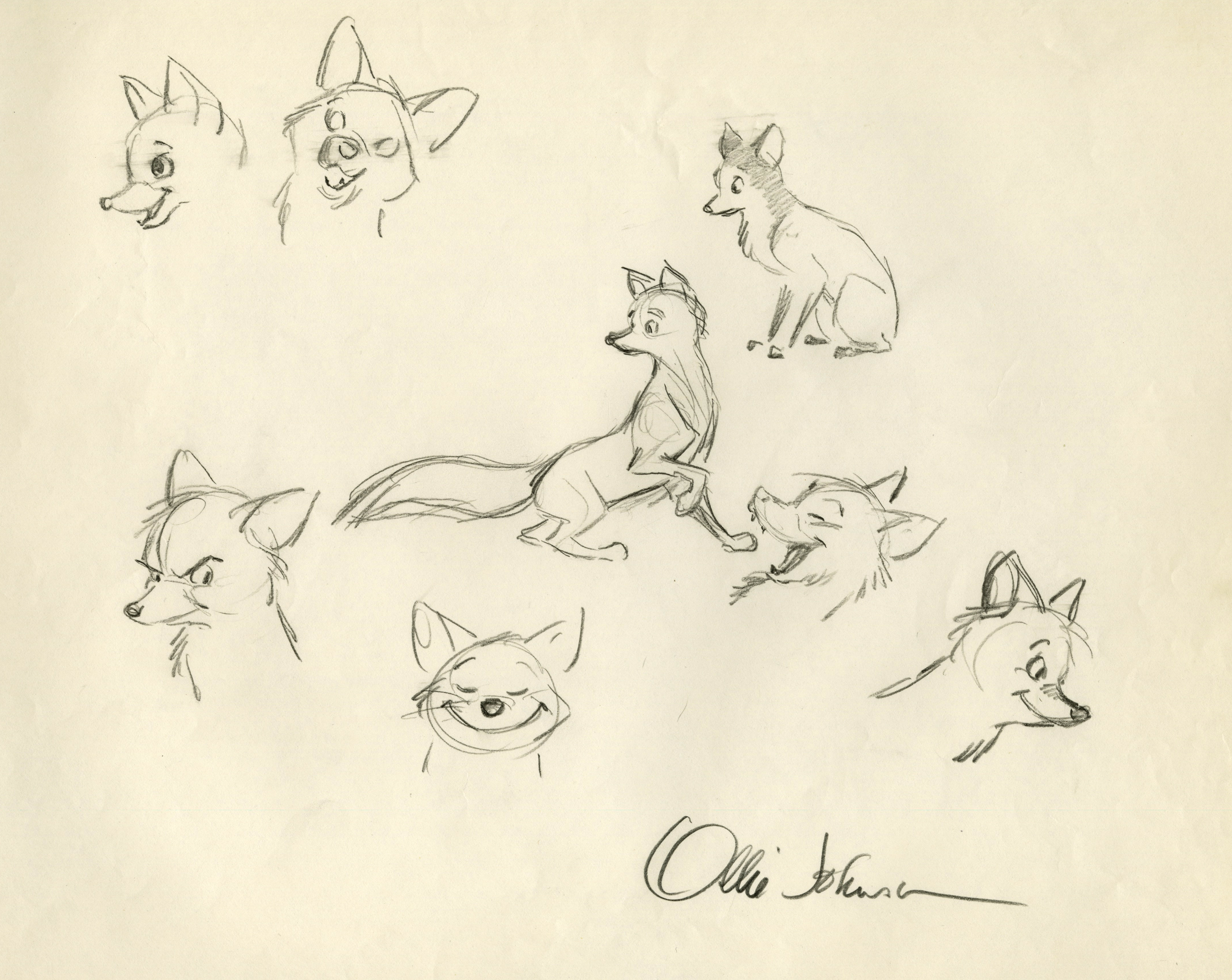
Doodles for The Fox & The Hound


These are various sketches by Ollie Johnston for his final animated film The Fox & the Hound (1981). I remember him saying that at the time his drawing hand wasn't steady anymore. Even more impressive when you look at these doodles, still full of life and personality.


Saturday, March 26, 2022

Ollie's Thumbnail Sketches

I am not sure if Ollie Johnston thumbnailed his story- and staging continuity for all of his animated sequences. But he sure did a lot of this kind of scene planing for the film Robin Hood.  Ollie animated most scenes with Prince John and his sidekick Sir Hiss. 

In these sketches Prince John is being strangled from the back by Little John, who forces the prince to order the release of Robin Hood. Lady Kluck is reinforcing the order in scene 351. The following sheet shows Ollie's final character staging for that scene. 

What beautiful drawings!


Wednesday, March 23, 2022

Another Milt Kahl Birthday

Milt Kahl was born on March 22, 1909. 

He is one of a few giants in the animation industry. At Disney he set a standard for excellence in drawing that would be unique to that studio. As Dick Williams used to say: "Milt transformed the medium". And Brad Bird pointed out that without Milt's extraordinary sense for design, Disney films would look style-less. Eric Larson told me: "We all learned from Milt, even though on occasion I disagreed with him."

Eric's disagreements would often center around acting choices, or the fact that Milt's designs were too difficult to follow. This opinion was shared by others.

Nevertheless we have to be grateful that Milt Kahl's stubborn insistence on top quality imagery elevated each project he worked on. Take Ludwig Van Drake for example. Marc Davis was originally asked to develop this new character for Disney TV shows. One of the old-timers told me that at the time Marc tried a few things...unsuccessfully. It wasn't until Milt came in and took over the assignment that Van Drake became a top notch design and personality. 

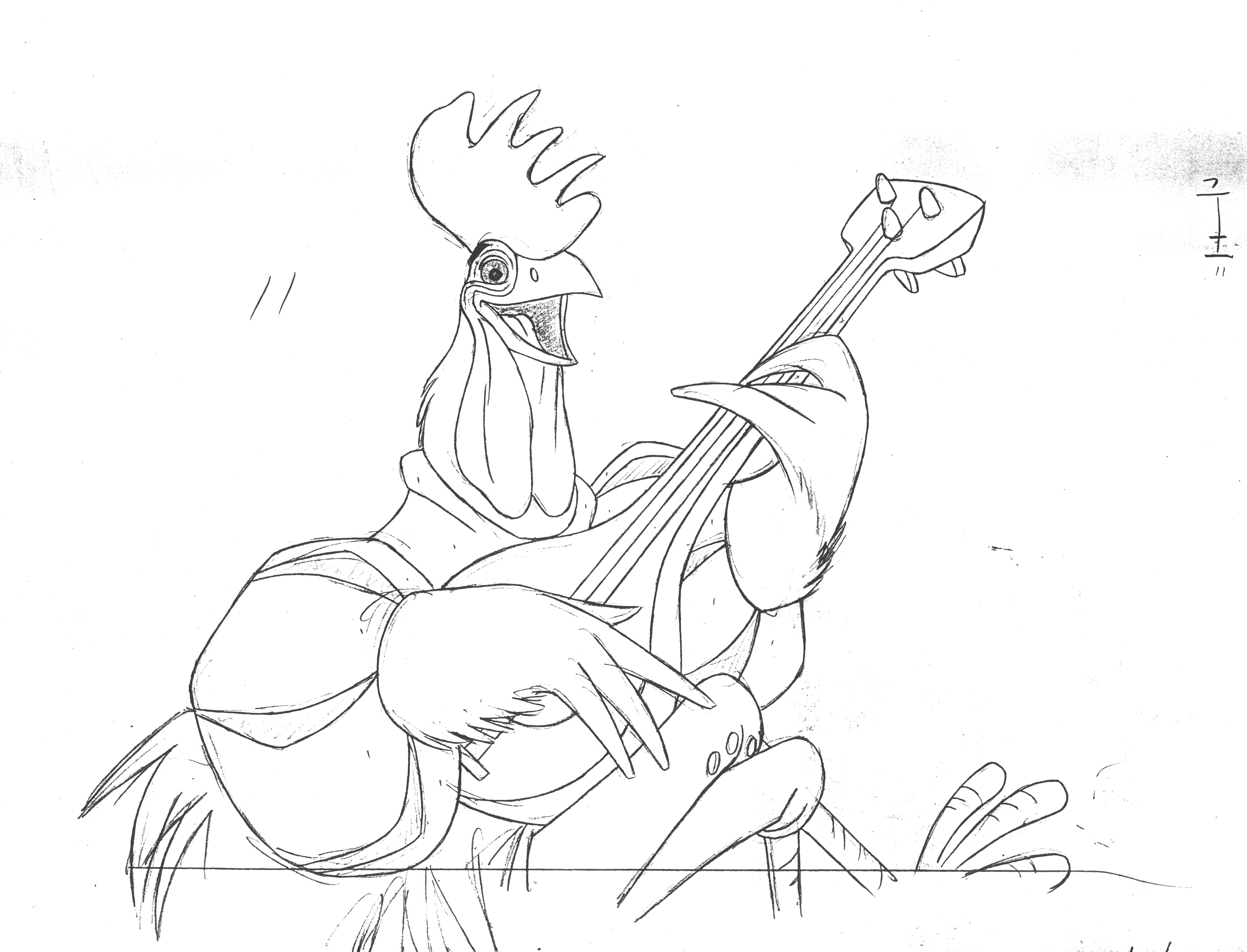
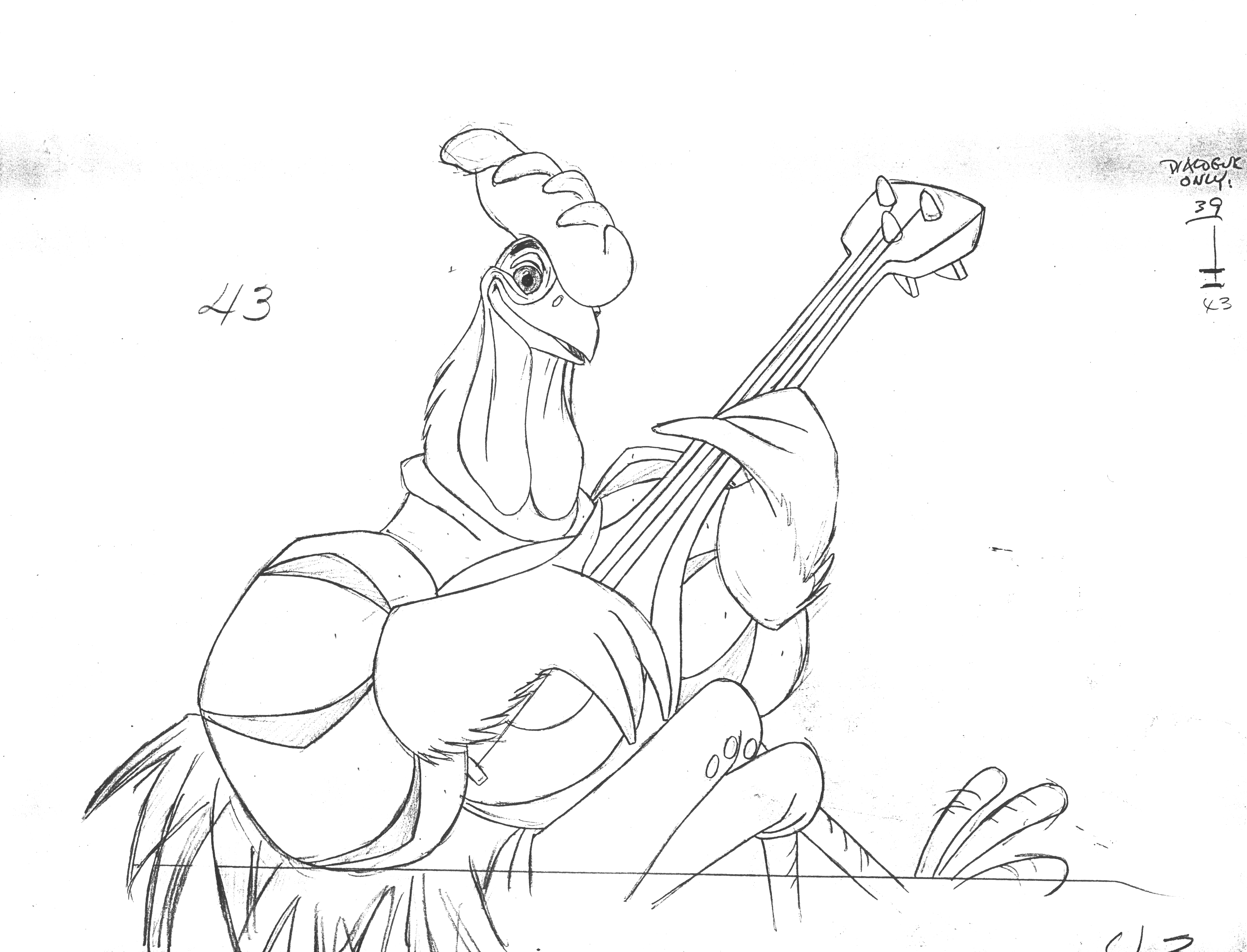
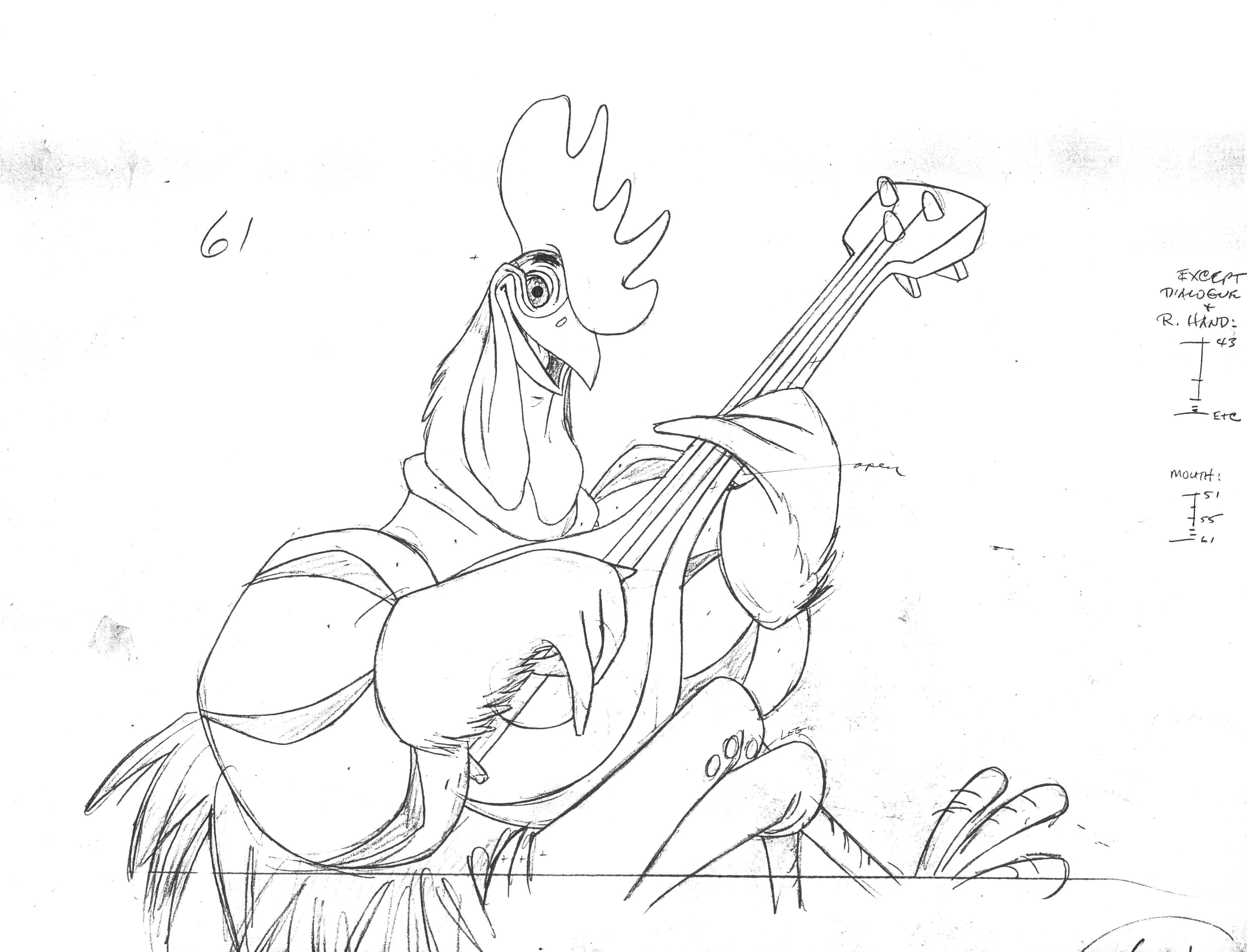
Here are copies of key drawings featuring Alan-A-Dale from Robin Hood. The rooster casually introduces the film's story: "Oh incidentally, I'm Alan-A-Dale, a minstrel. That's an early day folksinger. And my job is to...tell it like it is...or was...or whatever." 

What a beautiful idea to have one of the instrument's strings break during his delivery (That string is on a different drawing level.) It gives the rooster a chance to react while continuing his remarks. Great drawing...and great acting.


For Milt's character designs of Alan-A-Dale go to this post from a few years ago:

https://andreasdeja.blogspot.com/2011/09/allan-dale.html


Monday, March 21, 2022

A Lilo Story


I don't think I have ever told this story before. It is a bit personal. But to me it was also kind of revelatory when it happened. 
In 1999 I  was working on the character of Lilo at Disney's animation studio in Orlando/Florida. One evening an acquaintance of mine from LA was visiting, and he asked me to join him for dinner at a Disney World restaurant. At one point during dinner he asked me what I was animating at the moment. I started to describe the sequence pictured here. Nani and Lilo are having a moment in a hammock at night after Nani had gotten fired from her job. Lilo doesn't understand what her sister is trying to tell her. The two of them would not stay together anymore, because the next morning child services would take Lilo. Nani had failed to be a guardian of her little sister. (She was drawn by the great Stephane Sainte-Foi.)
The scene I had just finished animating was when Lilo wobbles from one side of the hammock toward Nani to comfort her. I kid you not when I admit that I got all teary eyed just talking about this moment in the film. My mind went..wowowo..hang on here, this has never happened before when talking about my work. What the heck?

I reflected on this later on and realized that this (fictitious) little character had gotten a hold of me emotionally. And this was the kind of footage you animate from an internal place, almost with tears in your eyes. 

What the heck?


Tuesday, March 15, 2022

Styling The Sword in the Stone


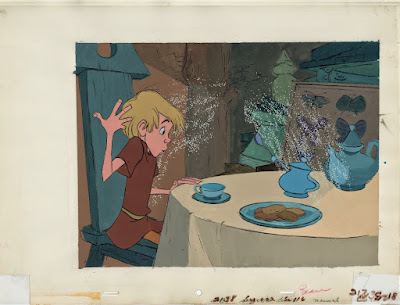
Here is an interesting experimental pre-production cel set up for one of the early scenes from Sword in the Stone. The photo shows a lot of cel reflections, but it still makes for some fascinating study.
The color styling is more monochromatic here than in the final version of the film. Wart's character drawing was done by Milt Kahl. His face is more caricatured, particularly the nose. "Walt didn't like the nose, he made me change it" Milt explained to me during one of my visits. 
As I mentioned before, I much prefer this early design, it has more personality. 
Look at these beautiful sketches Milt came up with before he started animation. 


The sequence -like the whole film- had more color variety, based on Walt Peregoy's design concepts. 


Walt Disney was never happy with this kind of color styling, he much preferred a more muted approach. The following feature film The Jungle Book would be painted without xerox lines as part of the background styling. Although the graphic look did resurface in the Winnie the Pooh featurettes as well as the full length productions of The Aristocats and Robin Hood.  


By the way, watch The Sword in the Stone on Amazon Prime. It will cost you a few dollars to purchase the film, but it's worth it. Amazon offers a pristine 4:3 presentation, unrestored. It looks incredible!!

Saturday, March 12, 2022

A Milt Kahl "Book Illustration"


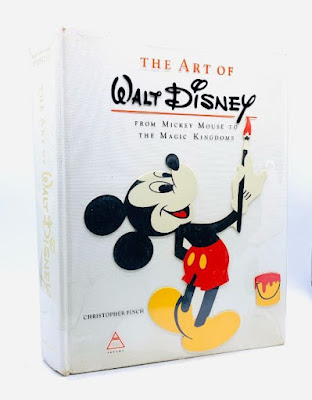
Just recently a copy of Christopher Finch's 1973 book The Art of Walt Disney was offered at an auction in the UK. I love this book. Beautiful oversized reproductions of vintage animation artwork. 

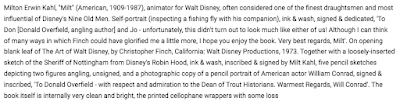
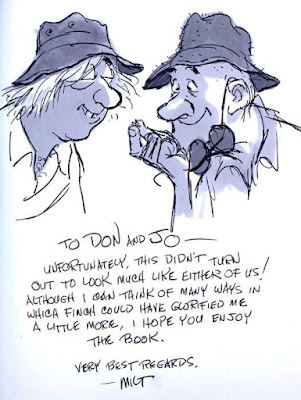
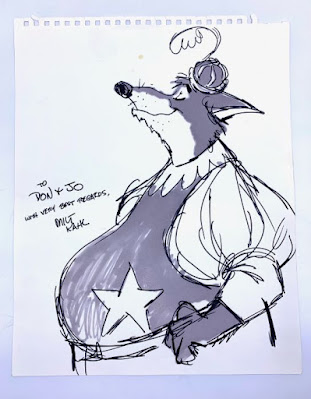
What makes this edition special are the original drawings that came with it. Milt personalized the book with a sketch of himself and a fishing buddy. Here is what the auction house said about this item:


The most interesting aspect here is the fact that Milt refers to author Christopher Finch for not giving him a proper tribute, not "glorifying him" enough. A great artist revealing his bruised ego. 


Milt's photo and section in the book:


Infos about Donald Overfield:

Donald Overfield is a world-recognised authority on the history of flyfishing and its many varied participants down the ages. A well-known contributor and illustrator to the angling journals of this country, America and Scandinavia, author of Famous Flies and their Originators and the man chosen to update the Courtney Williams classic A Dictionary of Trout Flies, he is in the unique position to assess the greatness of G.E.M. Skues and his contribution to the history of flyfishing.
Overfield is a member of the Flyfishers' Club of London, Skues' haunt for fifty-six years, also international director of the Flyfishers Foundation of America and a member of the advisory board of the American Fly Tyers Round Table. He can usually be found, rod in hand, wandering the streams of his native East Yorkshire, when he tears himself away from his Warwickshire study and his continuing investigations into the craft of flyfishing and the artificial fly.