Tuesday, July 24, 2012

Drawing challenges


Part of the breathtaking quality of Classic Disney Animation is the fact that many animators didn't shy away from incorporating beautiful, but tough to draw angles of their characters into the scenes.
This takes enormous drawing expertise and good judgment in terms of when these potentially awkward looking views of the character are called for. 
Milt Kahl was accused by some of  searching for tough angles in order to show off his draughtsmanship. And yet most animators got endless help from Milt, who strengthend the look and feel of their scenes. 
"Why bother and kill yourself by trying to make those difficult head tilts look good, when you can animate the scene in a much simpler way?" This was the attitude of some animators, who indeed got their acting across without dealing with drawing challenges.
The thing is that you add such a great range by having the occasional 3/4 rear view or an extreme up or down shot on your character. It gives the animation rich texture.

Her are just a few examples of what I am talking about.


This 3/4 rear view drawing of Bull from "Lady & the Tramp" is extraordinary. It looks like John Lounsbery didn't even struggle getting this to look right. The only facial parts visible are the nose, a cheek and the jaw. I love those neck folds on his back. A very dimensional pose and so full of character.


Frank Thomas drew this pose of Lady looking back over her shoulder. By blocking in the head's components, he maintains control over the subtle up shot. Final subtleties and appeal might not be there yet, but it would take little time to add those to this solid sketch.


Here Frank has it all worked out in detail. Fauna's expression shows heartfelt sorrow for Aurora's misfortune. The look up toward the other Fairies emphasizes her emotion beautifully. This is the kind of drawing that can make you cry if you look at it long enough.


Shere Khan is about to turn his head and ask Kaa, the snake, his next question about Mowgli during this interrogation. This is a spectacular angle to start the head turn from.
The tiger's head and body are very complex in draughsmanship. The style is graphic, but nothing looks flat. The stripes add a lot of volume, and there is depth in the most subtle things like his eyelid.


This pose of Merryweather has a lot of life. Her upper body is drawn from a 3/4 rear view, her lower body, still a back view, is about to move into profile. The bend in her spine is what gives it movement. 
I think Frank did some of his best animation on this character.


There isn't an angle Milt couldn't draw with Medusa. And I have no idea why her legs come off looking so interesting, without any calfs.
Her inventive design and pose are simplified to perfection, and correct perspective is applied everywhere. 


Tony is anticipating a big gesture by raising his head and his arms. Upshots like this one are tricky. Is the nose tilted up enough to show nostrils? Or are you going to cheat a little and stay with just the shape of the nose?
Everything looks pretty broad here, but Lounsbery didn't forget subtleties.
I like the definition of the "U" mouth, the lower lip is partly covering the open mouth, which adds dimension.


Maleficent is an animated fashion drawing  (though not quite pret-a-porter).
This is an amazing pose. She is somewhat exhausted here, about to sit down, after her altercation with the goons. "A disgrace to the forces of evil!"
The perspective of the head is just beautiful. Look how the shape of the eyebrows helps define that angle as well as her mood.


I believe Eric Cleworth animated this scene of the dragon in "Sleeping Beauty".
Obviously no live action reference here. The animator figured out this 3/4 rear up shot by himself. The indication of shoulder blades visually connecting the arms to the body works really well.
What a great silhouette.


This is a clean up study by Iwao Takamoto. Aurora's head is just beyond profile, turned toward camera. You just see the far eyelash, which gives her facial angle some depth.
And the near eyelash curves around the eyeball perfectly. Iwao knew subtleties,
he was a master designer.


Ali Gator is anticipating the hippo ballerina's "landing". 
This is an outstanding pose drawn from a 3/4 rear view. The body stretch is so strong, while maintaining the solid anatomy of the animal. Great positioning of the arms, and I love how sharply the tail bends when it makes contact with the floor.


Fred Moore drew this Minnie, crying hysterically because she burnt a batch of 
cookies. A potentially difficult up shot , drawn effortlessly.


A couple of key drawings of Robin Hood by Milt Kahl. A head up shot with a broad mouth shape and a down shot. Both complex, but very appealing. 
His hat is not an easy thing to turn and animate.
Robin goes through a few model changes in the film, I'll have more on that later.


Friday, July 20, 2012

How Does a Dalmatian Gulp?


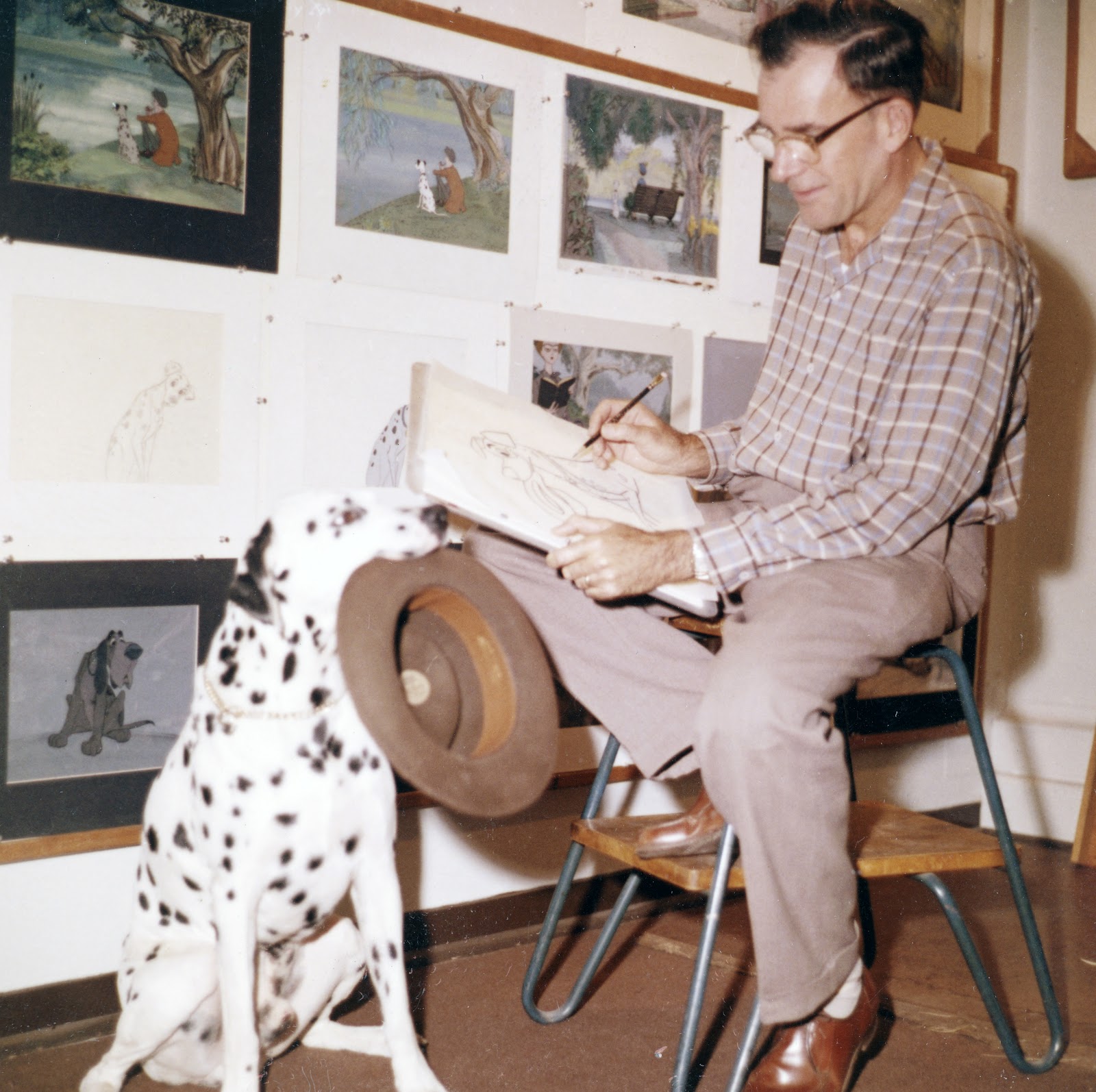
That's the question Frank Thomas asked himself when he analyzed certain expressions for a scene with Pongo. 
The following drawings are pre-animation exploratory sketches. As usual Frank researched every aspect of the scene in detail.
The acting called for something that dogs don't do, a gulp. Pongo is gathering some courage here, he has spotted Perdita in the park. Now he is determined to meet her and also have Roger meet Anita.
Putting such a subtle human gesture on to a dog's face is not an easy task. 
But this is the kind of acting Frank excels at, and the end result is completely believable as well as entertaining. 


Wednesday, July 18, 2012

Fergy's Honest John


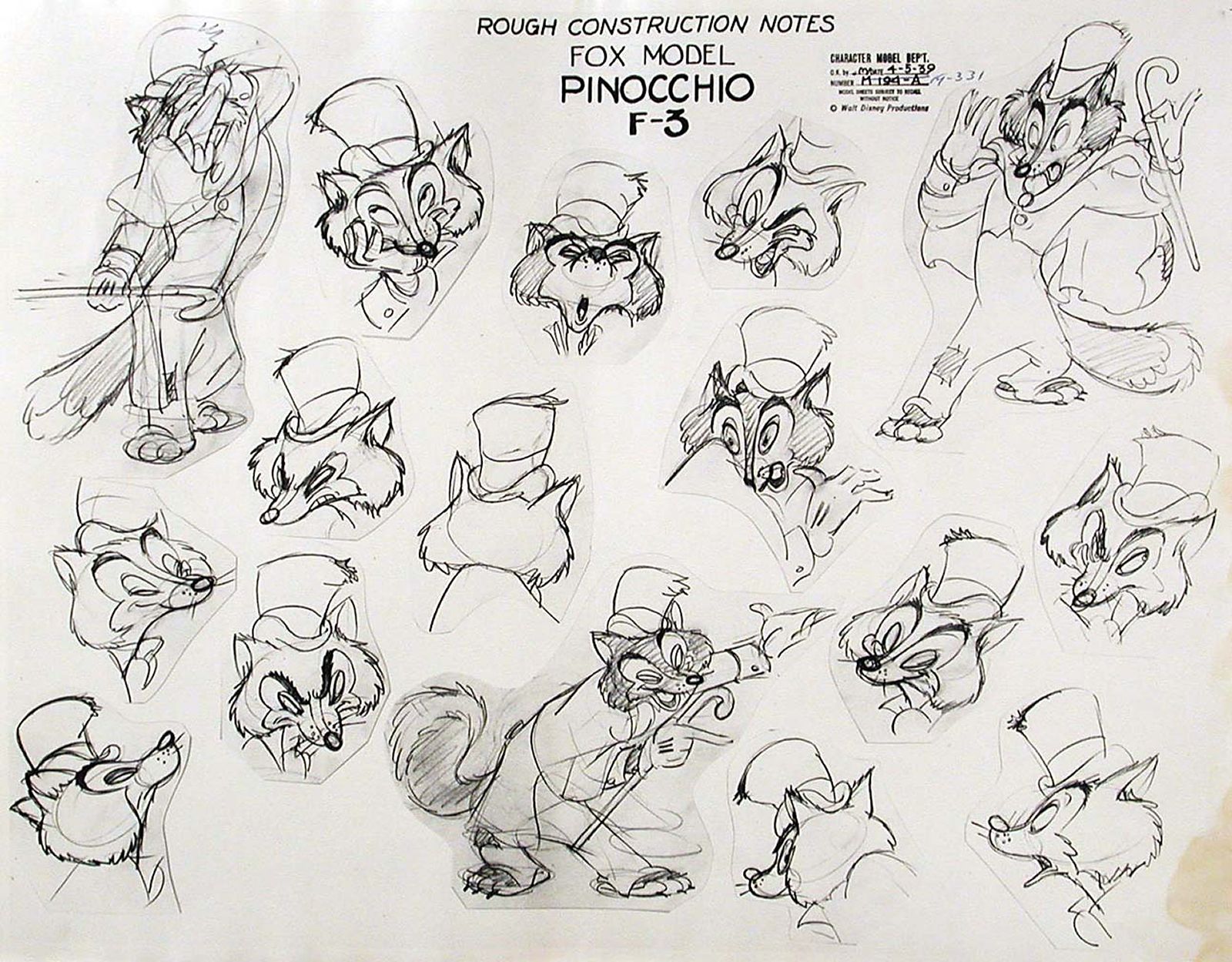
Honest John (or J. Worthington Foulfellow) is one of my all time favorite animated characters.
Rich personality -the used car salesman type-, great design and outstanding acting.
Norm Ferguson supervised the animation on him, he had some help from a young John Lounsbery.
Fergy, as he was called around the studio, was an intuitive animator. Walt Disney liked the loose quality in his animation and in his drawings, and he encouraged other animators to take this approach. He was also a very fast animator. And because Fergy was not thinking about doing "pretty drawings" the poses he came up with for the fox are dynamic, inventive and so right in character. There is a theatrical Vaudeville quality to them, which is why the animation reads so clearly on the screen.
To me it looks like Fergy intergraded strong straight lines into his work even before Milt Kahl used them as a means of simplifying and strengthening a drawing.

The first sketch is pre-production, followed by rough animation keys and a couple of model sheets.
Fergy died way too young in 1957 at the age of 55.


Sunday, July 15, 2012

Girls Talk too Much


At least Peter Pan thinks so when he meets Wendy in the opening sequence of the movie. Wendy herself is pretty excited to see Peter Pan, and so she chatters away.
Milt Kahl was the supervising animator of the title character. I am pretty sure that this particular scene was done without any live action reference, it just looks like Milt pulled it out of his head.
There is a beautiful balance of realism and cartoony expressions, something not easy to do!
The clean up drawings were done over the original roughs on the same sheet of paper.  Since Milt was the authority on how to draw his characters, why change anything?

The following pencil sequence has animation from a variety of animators.
Peter: Kahl, Harvey Toombs, Eric Larson
Wendy: Hal Ambro, Ken O'Brian, Eric Larson, Harvey Toombs, Kahl
Tinker Bell: Marc Davis, Les Clark

Even though many animators worked on these few characters, there really aren't  any off model scenes. Kudos to the 1950ies Disney clean up crew.
Just pencil lines on paper, no color, creating the kind of magic that…..makes you feel happy!


Friday, July 13, 2012

The Animated Animator


Way back on Beauty & the Beast I was told that some of Gaston's  gestures and expressions look like me (of all the characters!!).
The truth is that an animator can't help but inject some of his or her own physical characteristics into the character. Sometimes this is intentional (when studying yourself in the mirror), other times it is not.
Disney story man Vance Gerry told me once that he thinks that all of Milt Kahl's characters have Milt's eyes. Ever so slightly cross-eyed, they look like they are up to no good. I think Vance has a point.

The following frame grabs show Frank Thomas as he explains animation principles during a TV show from the 1980ies. What an expressive face, Frank could have been a great live actor.
I couldn't help myself and searched for (Thomas') animation drawings that somewhat reflect Frank's grimaces.


Thursday, July 12, 2012

Simplicissimus


I know, it sounds like one of those magic words from Bedknobs & Broomsticks.

Simplicissimus was a satirical German weekly magazine, that ran from 1896 until 1967, with a hiatus from 1944-1954. 
Many famous graphic artists contributed stunning illustrations with themes that commented on social/political issues of the times. You might have heard of Heinrich Kley, George Grosz and Kaethe Kollwitz, but other contributors were artists like the incredible Karl Arnold, Olaf Gulbransson and Edward Thoeny.
I just love looking at this kind of art. Whenever I am designing characters, and I catch myself falling back on to old formulas, I look at pages from Simplicissimus. The types of people represented in the illustrations are so rich in character, the designs are super inventive…no formulas here!
And do you know who else referred to these artists and admired them ? Our friend Joe Grant  from Disney. He collected the magazines when they were issued way back. I had many conversations with Joe about these graphic gems, we both found them very inspiring.

I am not including any text or commentary, just look at the quality of drawing, caricature and staging.
There are plenty of formulaic animated characters populating the screens today. I'd love to see inspired alternatives, wether they are based on a source like this one or any other graphic style, it's time to break the mold. An exciting prospect!

 Bruno Paul 1906

Olaf Gulbransson 1909

 Rudolf Wilke 1908

 Olaf Gulbransson 1908

 G. Hertting 1910

 Karl Arnold 1911

 Olaf Gulbransson 1905

 Blix 1907

 Olaf Gulbransson 1916

 Olaf Gulbransson 1916

 Karl Arnold 1924

 E. Thoeny 1920

 Karl Arnold 1921

 Karl Arnold 1922

 Olaf Gulbransson 1923

 Karl Arnold 1927

 Herbert Marxem 1929

 Karl Arnold 1930

Karl Arnold 1930