Saturday, May 24, 2014

Baloo and Mowgli


Here are rough animation drawings from a couple of Milt Kahl scenes from The Jungle Book.
The first one precedes this shot from a recent post:

Baloo pushes Bagheera away from him and starts talking about King Louie’s monkey’s: “They ambushed me!…”
Milt always gets amazing mouth shapes in any of his dialogue scenes, whether it is a human character or an animal. He knows the configuration of the mouth unit so well that he is able to believably draw any shape that a specific sound calls for.


Earlier in the film Mowgli received a friendly smack from Baloo, which resulted in a cartwheel that came to a stop at a dead tree trunk. Mowgli finds himself in the most awkward upside down position, before trying to straighten himself out.
Milt comes up with a great solution for turning the boy upright again. It required a few potentially complicated drawings, but because of his insane knowledge of anatomy he makes it look easy and beautiful. 


Thursday, May 22, 2014

Studying Francois Boucher


Years ago I became fascinated with painters and sculptures from the Baroque and Rococo period.
In those times the human figure was depicted in dynamic poses, and in motion. 
Francois Boucher (1703 - 1770) was one of the artists whose work I started to take a closer look at.
Here’s what Wikipedia says about him:
Boucher was a French painter in the Rococo Style. He is known for his idyllic and voluptuous paintings on classical themes, decorative allegories, and pastoral scenes. He was perhaps the most decorative artist of the 18th century.

I just enjoyed analyzing his lively compositions of mostly women and cupids. And I think I learned a little about how to twist parts of the human body to avoid rigid poses, and to make figures look alive.

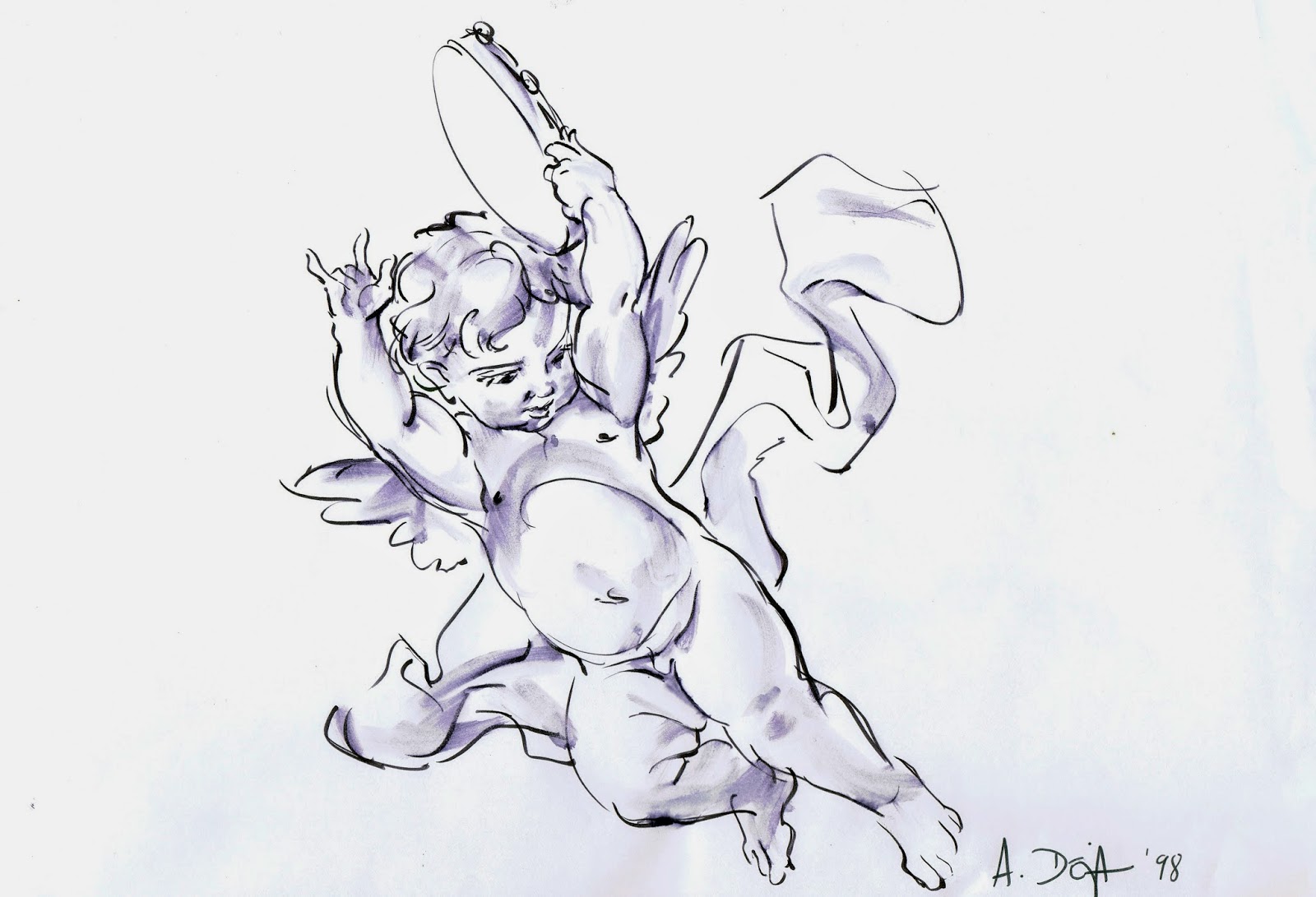
The sketch above of a cupid is a detail study from this painting, called The Muse Euterpe.


I have a coffee table book on Boucher’s art and life, and going through the pages I tried to imagine what a sketch might have looked like in preparation for certain paintings. So I decided to use his “Birth of Venus” to work backwards, and create a drawn study based on the image.
To start out I bought two oversized thick, white watercolor panels and decided to age them. I took them outside and poured coffee and tea on them, then I beat them up a little with garden tools.
It was fun to see how the white paper turned brown, with strains all over it. I think it’s what you call antiquing.
Then I sketched the composition with brown charcoal, before adding dark and light washes to give the figures some form. In the end I touched up a few lines with a brown brush pen.

Here’s what I came up with, a Boucher broken in two. Each panel is 5' x 3', 4"


The actual painting.


Tuesday, May 20, 2014

Xerox


When you study Disney cels from the Xerox years, from 1960 until The Rescuers, it’s amazing to see how much of the animator’s rough drawing was left untouched and made it to the screen. Particularly scenes by Milt Kahl, but also some by Frank, Ollie, Eric Larson and Lounsbery maintained that wonderful unfinished, sketchy look. Some people in the audience might find these loose drawings less pleasant to look at than the previous inked cels, but I am not one of them. The rougher the better!
It’s like seeing the animator’s personal handwriting in motion. Even though Disney had the best clean up artists as well as inkers in the business, when replacing a sketchy line with one thin contour, you are bound to loose some of the drawing’s liveliness. 
Milt said:” It’s too bad that Xerox happened so late in life. I was talking to Walt on Peter Pan and said, why don’t we just reproduce the animators’ roughs. But he responded, no, no, you want that nice, fine line around the characters. He eventually changed his mind though.” 
I believe Walt had no choice but to accept the Xerox process, since inking contributed to the ever growing production budgets. Moviegoers in those days embraced the new look and accepted the idea that rough drawings could become engaging characters and tell a compelling story.

When the studio produced The Rescuers, it was Milt again who championed the use of a Xerox line, this time in grey, which softened the drawings somewhat. 
I still prefer a black loose line around the characters though. If the drawing is good, why not commit to it and be bold with it?!

The cel above was signed by Milt during my first get together with him. 
The other ones are from his scenes as well ,and show his wonderful uncompromised line work.


Sunday, May 18, 2014

Deer Development


This post focuses on the different stages that were involved in the design of deer characters for animation, particularly young adult Bambi. To get the artists ready for a film that featured characters with unprecedented realism in drawing and movement, special anatomy classes were held, so the animators would get to know the body of deer inside and out.
In the photo above you can spot story artist Mel Shaw in the middle of the back row, and on the left are animators Retta Scott and Frank Thomas.
After many thorough studies of the animals, it took a while to come up with animatable designs that could communicate true animal behavior as well as human feelings. 
It seems that three artists were responsible for this successful evolution.

Bernard Garbutt had a way of simplifying the appearance of deer and discover natural and dynamic poses. His animals don’t talk, but they present a terrific base to build personalities on.


Marc Davis studied graceful realistic movement, before adding human expressions while storyboarding particular sequences for the film.


Milt Kahl gave the final look to all deer characters, including adolescent Bambi. He ended up animating most of his personality scenes, including the section where Bambi meets Feline as an adult. As usual, the anatomy in his drawings feels rock solid while offering possibilities for unrealistic, even cartoony animation. Milt’s animation of Bambi following Feline through the clouds has nothing to do with realistic deer motion, but it interprets instead the dreamlike state of falling in love. 


A great doodle sheet, Milt explores proper animation anatomy in detail.


Thursday, May 15, 2014

Scar in Entertainment Weekly


What a pleasant surprise! I was recently going through the pages of the magazine Entertainment Weekly when I came across this article on animated villains. The write up referres to the upcoming release of Disney’s live action film “Maleficent”. Cruella takes center stage, as she should.
I have to tell you, it feels mighty good that a character I animated years ago still seems relevant to audiences and critics. And he is written about among such distinguished company!
Made my “entertainment” week.

I found these throw-away ruffs in my inventory, most of them from the sequence when Scar sets up young Simba before the wildebeast stampede.

I still remember listening to Jeremy Iron’s voice recordings, thinking: Wow…this is gold! I better not screw this up.


Wednesday, May 14, 2014

Downsized


After Cruella and the Baduns crash their cars during a chase, we see the characters stranded in the snow among automotive wreckage. Cruella yells at Jasper and Horace, and blames them for this embarrassing outcome.
The scene is fielded as a long shot, we see the tiny trio stuck in a wintery landscape. Before animation began, the smart decision was made to draw the characters full size on 16 field paper. Later the artwork would be reduced with the help of the Xerox process.
This is Cruella’s last scene in the film, and animator Marc Davis wanted to be sure that he could articulate her frustration in a thorough way, without being tide down to a teeny drawing size.
It is a beautiful piece of animation, full of comic rage and defeat. So, in a way it’s a shame that we can’t see all the subtleties Marc put into the scene as far as drawing and acting.
Still, the framing works great for the film’s continuity, and presents an effective final blow to Cruella’s nasty ambitions. 
Here is the line drawing of the scene, followed by the much larger sized character drawings.
What a great pose for Cruella! Marc was on fire with this character.


Monday, May 12, 2014

Baloo brags about fighting the Monkeys


Milt Kahl only animated a handful of scenes with Baloo from The Jungle Book.
After King Louie’s monkeys kidnap Mowgli, they trip the bear who subsequently falls down a steep hillside. At this point the only thing he can do is to call for Bagheera.
The panther arrives at the hill’s edge to find Baloo bragging theatrically about what a fight he put up with the monkeys: “(They ambushed me…) thousands of ’em. I jabbed with my left, then I swung with a right, and then…”
During the dialogue he gets on his feet and acts out the dramatic battle in order to convince Bagheera that he fought tooth and nail in an attempt to protect the boy. 

Milt drew a heavier Baloo than Ollie did. (Frank Thomas also drew him big with long arms).
I remember Milt saying: “What’s so difficult about drawing a bear? You just have to make sure that his ass is big enough!”
Dave Michener, who did assistant work for Milt on Jungle Book, gave me these copies of the scene’s key poses. Dave had asked his boss how to interpret some of Baloo’s fists, since they were often just indicated as a circle without much definition. 
“You go figure it out!” Milt replied. He didn’t feel like dealing with a minor drawing issue right then and there.

It really is a great scene. Baloo moves with a lot of weight, and his broad arm swings define real space.