Monday, October 26, 2015
Jungle Book Thumbnails
I really don't know who drew these small thumbnail sketches for The Jungle Book. They might have been done for the original, darker story treatment, based on Bill Peet's concepts. The rhino Rocky shows up in one of the images, a character Milt Kahl was about to start animation on, before Walt suggested to remove Rocky from the film.
It is interesting to see how certain situations were either restaged or entirely cut from the final version while others reflect scenes we know from the movie.
These original pages were offered at auction a while ago, I kept scans of some of the sketches.
Beautiful stuff!
Saturday, October 24, 2015
Goofy
Some fun Goofy material.
The beautiful watercolor illustrations above were published in Good Housekeeping Magazine.
The quality of the art in this page as well as in many other ones, based on Disney short films of the time, is outstanding. The characters were in their prime, in areas like animation, comics and illustration.
The following clean up drawings from the 1936 short Moving Day show animator Art Babbit's insight into the personality of Goofy. In this scene he is interacting with a piano which shows considerable personality. It refuses to get moved into the new home, and Goofy tries hard to meet this challenge.
No dialogue here just good old vaudeville pantomime. I wouldn't call these drawings refined or sophisticated, but the overall poses are very strong, and they communicate Goofy's state of mind in very entertaining ways.

A cel followed by a couple of rough animation drawings from the 1937 short Clock Cleaners.
It's interesting to see how loosely the animators worked when dealing with comedic action scenes.
A few pages from the How to Draw Goofy booklet, which used to be sold at Disneyland.
I never realized that Goofy had become a fashion trend setter. Those slipped down pants are back in style today.
I've always loved seeing sequential poses in Disney publications. What makes the Goofy run unusual and specific has to do with pose # 2. The knee moves way up with the foot dragging, toes pointing backwards, before snapping in to a forward position. This is an "out of the ordinary drawing" which breaks up the regularity of a normal run.
I had the pleasure of animating scenes involving Goofy for The Prince and the Pauper, and more recently for How to Hook up your Home Theatre, a short I am very fond of. It was always fun to get assigned to classic Disney short characters and try to give them a little Encore in life.
Some images, Heritage Auctions:
http://www.ha.com/c/search-results.zx?N=793+794+791+792+1893+1577+2088+0&chkNotSold=0&Ntk=SI_Titles&Nty=1&Ntt=animation+art&ic=homepage-search-071713
Wednesday, October 21, 2015
Aladdin Buddies
Two friends of mine are currently part of the the enormously popular universe of Aladdin "On Stage".
Jonathan Freeman is the first and only actor who voiced a Disney animated villain and then went on to portray the role on stage.
I loooved animating to Jonathan's voice, and he is dynamite in the Broadway show. If you anywhere near New York, treat yourself to a fantastic evening.
John and Adam Jacobs (Aladdin) in rehearsal.
A different, non Disney production of Aladdin is happening right now in Paris. My friend Alexis Loizon plays the title character. Here is a group shot with the main cast, Alexis is the one with the six pac abs....in case you wondered.
Our Disney connection is actually Beauty and the Beast. Alexis played a forceful French Gaston in the Disney stage production of La Belle et La Bete.
I am thrilled that he will also appear in Disney's upcoming live action movie Beauty and the Beast, not as Gaston though. Stay tuned!
Alexis getting ready to hit the stage.
Tuesday, October 20, 2015
Eric Larson Art
It looks like Eric Larson is being handed what might be a ring from Disney Studio Chief Ron Miller to celebrate an anniversary during Eric's long career as an animator and teacher.
His first feature assignment on a feature film were those very labor intense scenes showing often large animal groups in Snow White.
It is interesting to see that in this drawing all animals are on the same sheet of paper. This means that none of the critters ever came to a stop (which would require a separate sheet to show them in a held position). But doing it like this certainly made it easier to orchestrate the overall motion of the group.
Scenes like this one -based on live action- needed to be scrutinized very carefully, or your characters would float on the screen. Look at how many times Eric altered the follow through on Cinderella's dress.
Great silhouette on these two rough drawings.
From one of my favorite sequences, Cinderella is pleading with the Stepmother, who is firing off orders and insults from her bed.
Eric animated many scenes during the opening sequence from Alice in Wonderland.
A couple of key drawings from a Peter Pan scene, in which Milt Kahl probably had a hand in as far as drawing the character on model.
This still is a publicity set up, but Eric did animate the complicated multiplane scenes featuring Peter Pan and The Darling children as they fly over London toward Neverland.
Peg became one of Eric's signature characters. A flawless performance in the Dog Pound sequence!
Some drawings come from Howard Lowery's auction website:
http://auction.howardlowery.com/Home.taf
Sunday, October 18, 2015
How rough, how clean?
Young pencil animators often wonder about the nature of their drawing style. Am I drawing too clean, am I loosing life in my animation? Or do I draw too rough, does my work still communicate? Eric Larson told us way back the REAL answer has to do with clarity. Eric didn't care that much about your drawing style as long as you got across your ideas CLEARLY.
In other words, can an audience understand and appreciate your work?
Here is a look at vintage Disney examples that show a range of approaches.
In the early days at Disney a loose quality in drawing was encouraged by Walt himself, because it allowed the animators to work more spontaneously and intuitively. It seemed that loose drawings captured the spirit of life more than clean, tight renderings.
It's important to point out that vivid (even multiple) THIN lines were king, since the final representation of the characters would be done in one fine line, no THICK AND THIN.
There is looseness but great clarity in Fred Moore's work. A drawing like this one would be pretty easy to clean up. Look at how Fred treated Doc's pupils. they are outside the eye unit in order to exaggerate the upward eye direction.
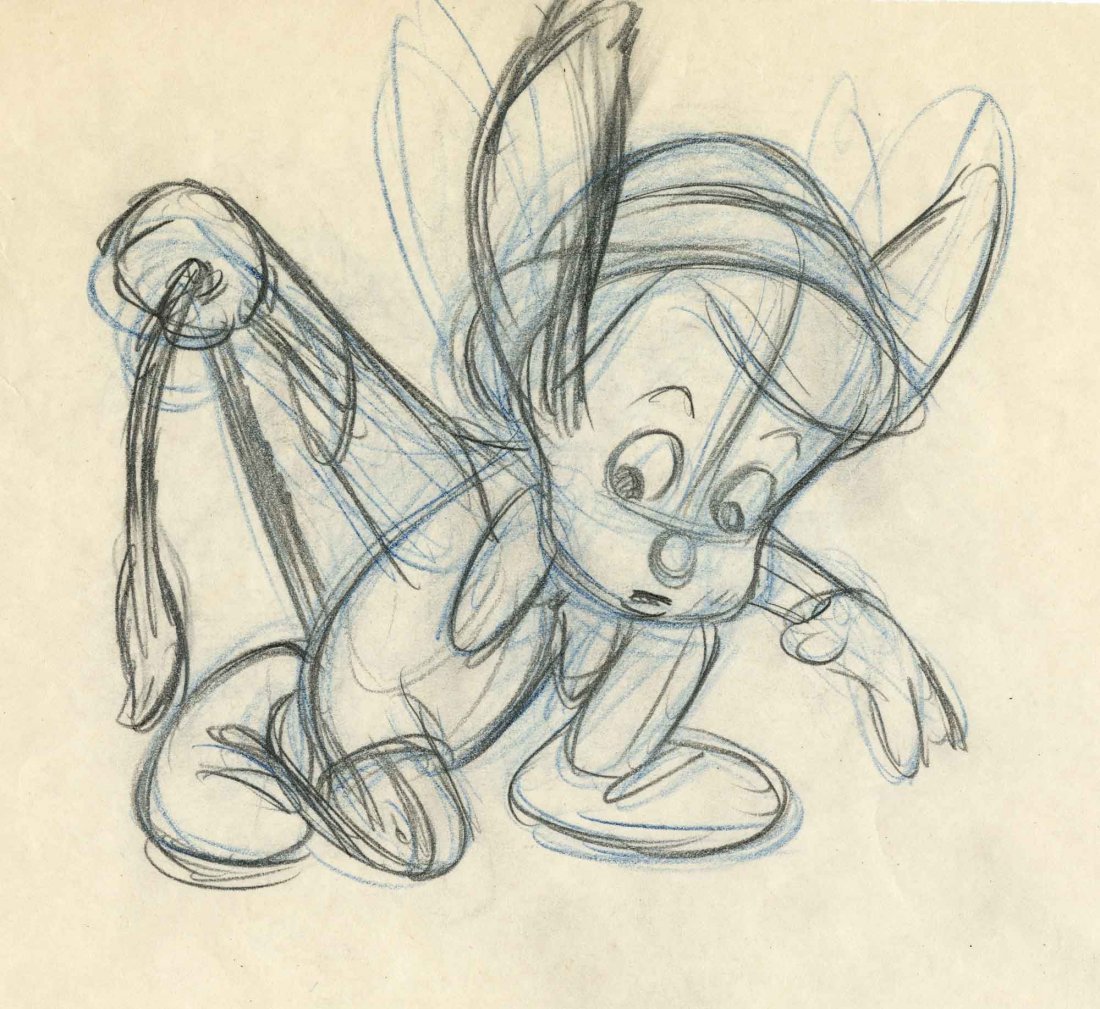
A drawing from one of Milt Kahl's early experimental scenes for Pinocchio. All the body volumes are drawn in a scribbly but perfect way. Only the hands might need a little investigation by an assistant.
In later years Milt would become obsessed with the depiction of hands.
A Frank Thomas rough of Pinoke just before he jumps into the ocean in search of Monstro, the whale. The line work is similar to Milt's, loose, but controlled.
Preston Blair added shading to the belly of Fantasia's hippo. This made for a cool looking pencil test, but the darker tones would have to be be ignored by clean up and the inkers.
Beautiful rough of Rat from wind in the Willows. A very scribbly animation drawing by Milt Kahl, but a competent assistant shouldn't have any problems defining these lines in a clean way. The volumes are perfect in this strong pose, only a few details on his outfit need some attention.
Eric Larson animated this scene, in which Cinderella dreams about attending the royal ball. Working with live action reference can be tricky, but Eric always distilled a believable (graphic) performance from the footage.
During fast action scenes Milt would occasionally leave out facial details, knowing full well that his competent assistant could take care of those things.
This animation drawing (probably by Cliff Nordberg) shows some color pencil under drawing, but the final graphite lines are pretty exact.
A surprisingly clean rough by animator Woolie Reitherman. The acting is pretty broad here, but Woolie didn't leave anything to interpretation. By this time (the 1950s) animators knew that very rough drawings could lead to misinterpretation of their work by clean up artists.
Drawings like this one by Milt would not be redrawn, instead his assistant (on The Rescuers, Stan Green) would just erase construction lines, before the scene went straight to Xerox.
Wednesday, October 14, 2015
The G#+x!! Prince
As I said before, Milt Kahl despised an assignment like a Prince character. As a young animator on Snow White he animated complex scenes involving all the forest animals surrounding the title character. "But I also got stuck with the clean up job on the Prince" he stated in an interview. The fact is that Milt drew over tracings of photo stats and therefor is credited with animating the Prince as well. In the drawing below Milt only focused on defining the Prince's head, the overall roto tracings were done by an assistant.
To my knowledge, Milt had nothing to do with Prince Charming in Cinderella. He was animated by Eric Larson, who confessed to some of us newcomers that he felt kind of embarrassed about the stiffness in his performance.
Milt ended up designing Prince Phillip for Sleeping Beauty, and he animated all of his personality scenes. This prince had a little more screen time as well as potential for better acting than his predecessors. It is amazing to see how clean his "rough" animation drawings are. The cel inkers could have worked off Milt's fine lines, but the Disney system at that time still had clean up artists trace these already precise drawings on to a new sheet of paper.
The action scenes were handled by other animators like Ken Hultgren. But Milt felt he still needed a hand in the final depiction of Phillip, as the great drawing below demonstrates.
One of very few close up scenes given to Prince Phillip.
More on Prince Phillip here:
http://andreasdeja.blogspot.com/2012/04/no-carrots.html
Subscribe to:
Posts (Atom)