Thursday, January 14, 2016

Brian Bedford


Tony award winning actor Brian Bedford, who provided the voice for Disney's Robin Hood has died.
Bedford was a classical Tony award winning actor, who performed on stages in the UK, the US and Canada. His film roles include The Grand Prix, 1966, and Nixon, 1995.
A few years ago, during an interview, he admitted that to audiences he is mostly known for Robin Hood.
Milt Kahl, who struggled with the design for the character, nevertheless liked the debonair quality in Bedford's voice. (The studio originally had cast Tommy Steele for the part, but for some reason it didn't work out.)
Someone tweeted today about Robin Hood: The only cartoon character many people admit to having a crush on.
I so wished Milt was still alive to comment on this phenomenon. I can hear his boisterous laugh.
But when you think of it, what an achievement...

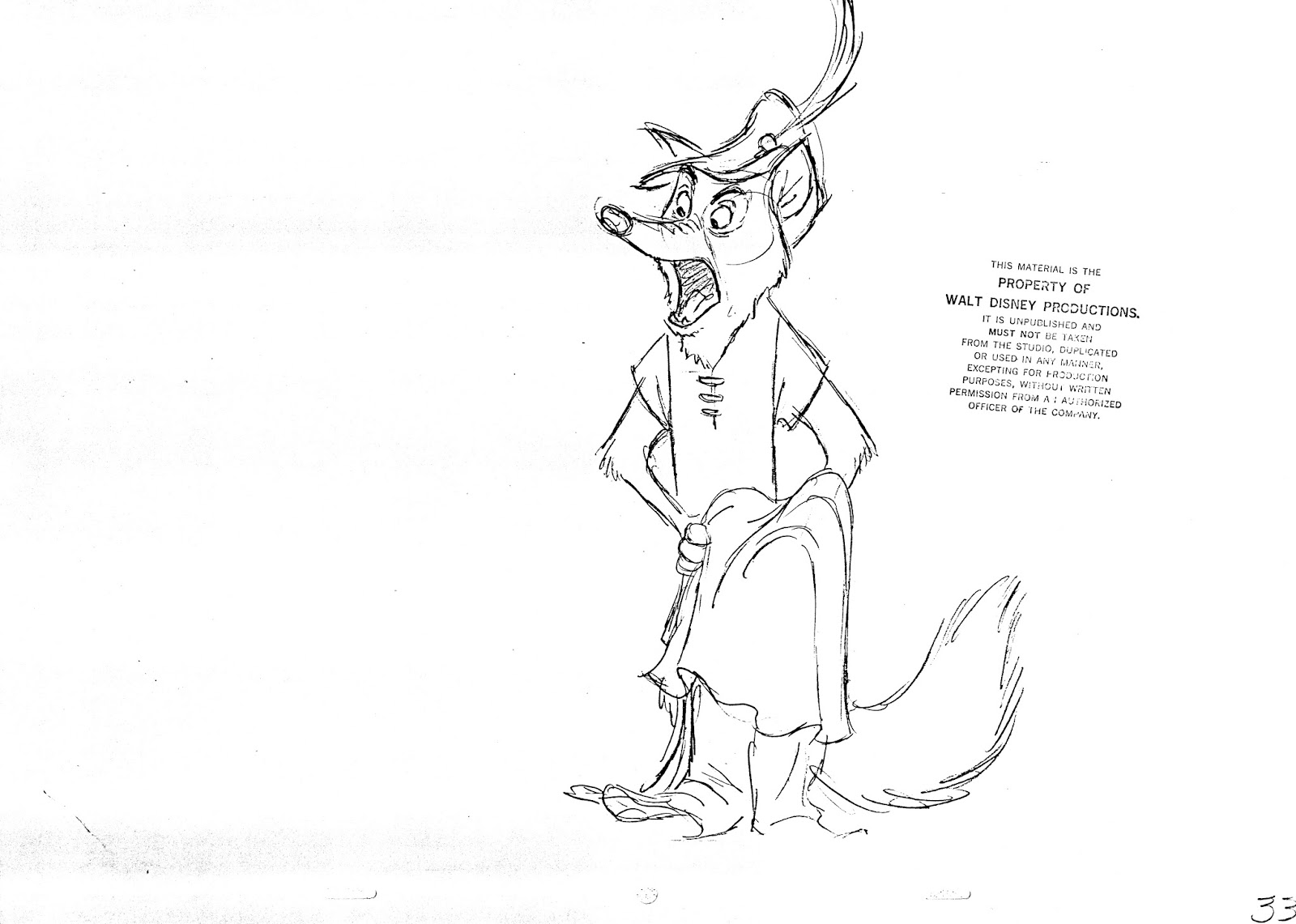
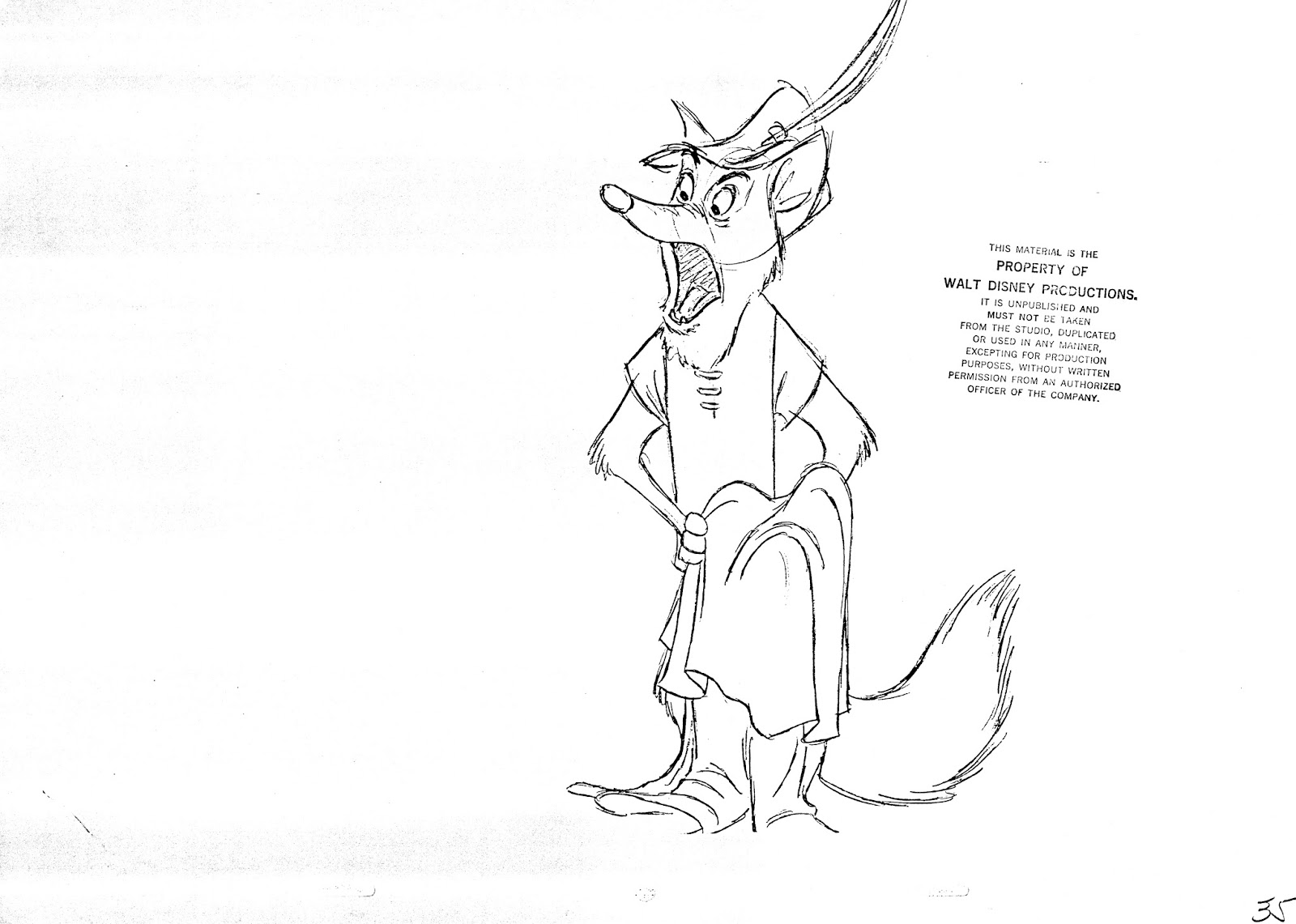
This scene shows an early, long nosed version of the character. Only a few scenes like this one were re-drawn and altered to represent a shorter nosed fox. But as usual, Milt's strive for superior graphic design is incredible. The way paws function as hands, the feeling for loose fabric and the ability to draw the head from any angle beautifully.
This is part one of a long scene. Robin is reacting to a comment from Little John: Why don't you stop moaning and moping around...just marry the girl!
His response in this scene:
Marry her? You just don't walk up to a girl, hand her a bouquet and say: Hey, remember me, we were kids together, will you marry me? No...it just isn't done that way.

I'll post the rest of the scene if you are interested.


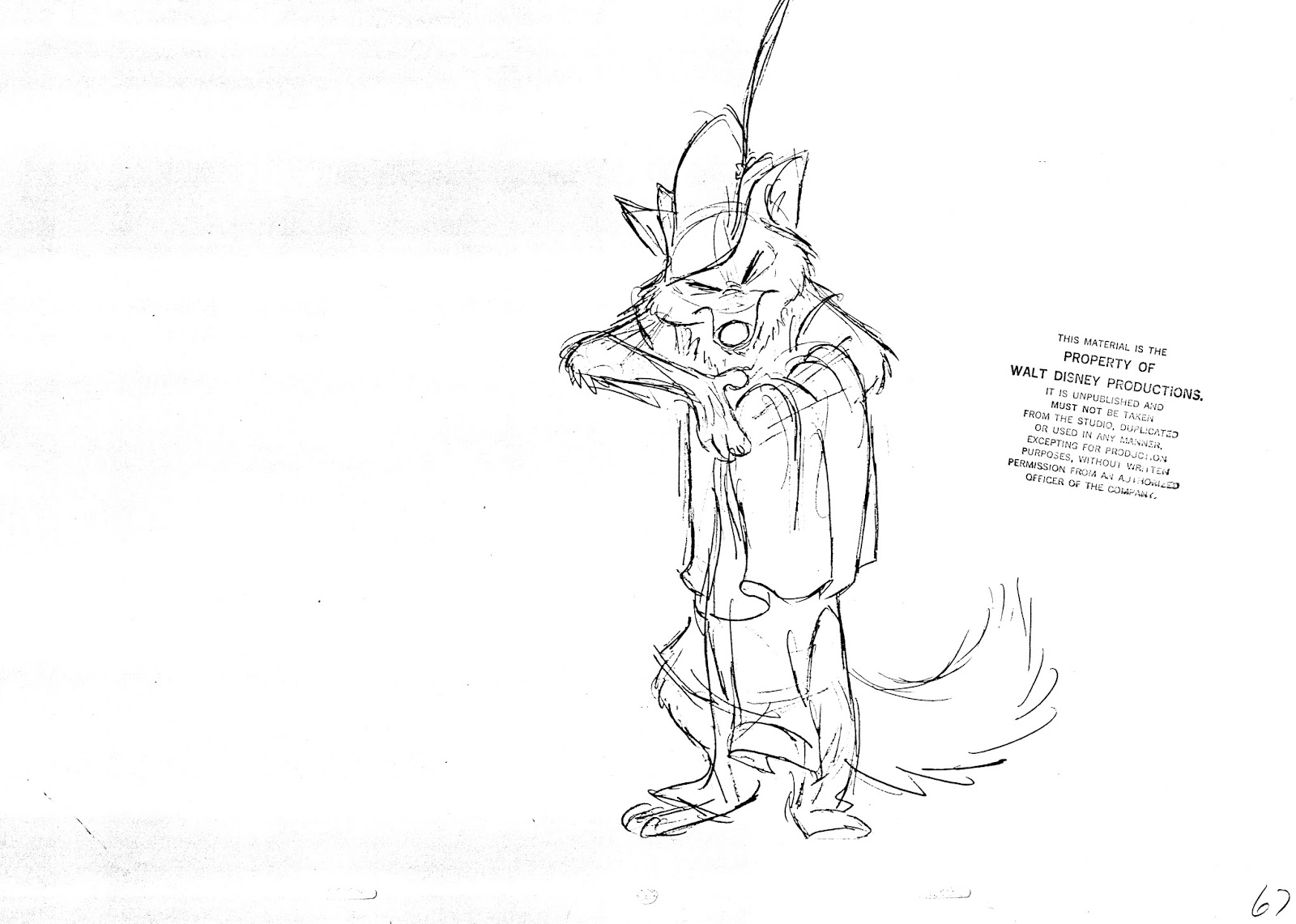
Here are some of Milt's thumbnail sketches in preparation for the scene


If you'd like to see Milt talk about Robin Hood, go to this previous post, which includes a strange interview.

http://andreasdeja.blogspot.com/2012/11/milt-kahl-talks-robin-hood.html

Tuesday, January 12, 2016

Fritz Hug Prints


More art from Swiss animal artist extraordinaire, Fritz Hug. I love his stuff.
His compositions are always great, and each sketch or illustration showcases a pose that is so typical and unique for this particular animal. Look at the skin flap on these elephants that starts at the knee and stretches all the way to the rib cage. Amazing observation.
Most of these drawings are actually high end prints offered on ebay. They are not cheap for a good reason, this guy is amazing!
He always pushes the contrast between thick and thin body parts, but more importantly, his love for all animals comes through in every image.


Here is the link to my first post on Fritz Hug, but if you type his name on my blog search, there is plenty more:

http://andreasdeja.blogspot.com/2011/11/fritz-hug.html


Sunday, January 10, 2016

Stepmother Reference

I am always fascinated to find out how Disney animators used live action reference for their animated scenes. Fascinating as well is to see what went on during the filming of the live action. What kind of effort was put in to simulate the animated performance. As you can see in this photostat, actress Eleanor Audley's outfit doesn't exactly match the costume design from the final frame, but it is close enough for study. Animator Frank Thomas changed the bent of the arm pulling the tray, perhaps to better emphasize the sleeves weight. Because of the cat's position, her right arm needed to be staged differently.
I do like the downward head tilt in the photo, I am not sure if Frank took advantage of this in a different frame of his animation.
Eleanor Audley's make up is of interest as well. Slightly overdone, but very graphic as far as eyebrows, eye liner and lipstick. This helped the animator to read facial expressions more clearly.

I think I mentioned before that this sequence is one of my favorites in Disney animation, even though it might look "live actiony" to some viewers. Eric Larson animated Cinderella here, as she is being verbally abused by her stepmother. Staging and lighting is pure Hitchcock. The animation is subtle, to the point,  and it defines the relationship between these two adversaries in a powerful way.


Saturday, January 9, 2016

A Moment of Truth


I left Walt Disney Animation exactly five years ago.
This moment makes me reflect on my early days at the studio, which was then called Walt Disney Productions. You can't tell from the photo (taken by Hans Bacher), but I was thrilled beyond belief that Disney had actually hired me. We were still working in Walt's original Burbank Studio, and even though retired, most of the Nine Old Men were still around. They would come in for the occasional lecture, Eric Larson still worked on a daily basis as head of the training program.
Believe me, I knew I was one lucky guy. I remember Christmas time at the studio. Before our holiday break, there was an impromptu eggnog gathering in layout artist Don Griffith's office. Woolie Reitherman stopped by, as well as Art Stevens and other senior artists.

The photo shows a guy who really didn't know what he was doing at the time. But as I mentioned, I was super excited.


That's my buddy Phil Nibbelink, who along with layout artist Guy Vasilovich created one of the best sequences in the film, when the Gwythaint monsters kidnap the pig Hen Wen.


The movie did have some fantastic special effects. That particular unit did not show the inexperience evident in the the work by the character animators.


So here it is, the final footage chart. I had been on the film longer than most animators and ended up doing a chunk of work. No wonder management was kind to me. 
So whatever you don't like about The Black Cauldron, I probably have something to do with. All I can say is that this was my "learning" project, I made a lot of mistakes, but by the end of production I felt like I was able to take baby steps as far as animating. 


The numbers indicate feet of film. One foot and a half is ONE second of film.

Thursday, January 7, 2016

Kaa


Milt Kahl is showing some guests the scene he is working on for The Jungle Book. Kaa, the python, has a strangle hold on Mowgli and is about to devour him. Luckily Bagheera, the panther, interrupts the situation just in time.
Kaa is a fascinating character. I will never be able to figure out how Walt Disney thought that the voice of Winnie the Pooh would be perfect for a villainous snake as well. I suppose actor Sterling Holloway was able to slip into just about any role and be convincing.
What's also interesting about Kaa is the fact that the snake's design changed. In this early sequence the eyes are smaller and are drawn streamlined on top of the head.


When Kaa returns later on in the movie, the snout is larger, and so are the eyes. These are Milt's drawings as well. Unfortunately I never thought of asking him about the subtle change in design .


Going back, here is the starting point in terms of design, a story sketch by Bill Peet.


According to Frank and Ollie's book The Illusion of Life several artists contributed to the visual development of the snake. I recognize Ken Anderson and Milt at the very end.


More of Milt's drawings. What a great rough sketch with Kaa and Mowgli.


Frank Thomas animated the later sequence, when Kaa tries again to hypnotize Mowgli in hopes for a meal. Shere Khan interrogating the snake is of course Milt's sequence.


Story sketches by Vance Gerry with the help of Floyd Norman, a new and upcoming story artist.
The central color sketch is by Ken Anderson.

A Frank Thomas rough animation drawing. Mowgli tries to free himself from Kaa's body.


As all characters in The Jungle Book, their acting and relationships to other personalities is what makes the film. So little story, but sooo many entertaining situations. Still my favorite. 


Tuesday, January 5, 2016

The Queen of Hearts, from Mary to Frank


 I have always loved Mary Blair's depictions of the Queen of Hearts for the film Alice in Wonderland.
A grotesque, brash, bossy and even dangerous monarch. Because of her stylized pre production imagery Mary went all out to portray this eccentric Queen with broad but effective brushstrokes.
ans as usual, her color choices for the character's environments were brilliant.
To quote Marc Davis: " Mary knew color better than Matisse." She had a way of putting colors together that surprised everybody, colors that you thought wouldn't work together.


Animator Frank Thomas took some of Mary's ideas, but transformed the character into a slightly more dimensional universe, in order to fit with the rest of the  cast. The essence of the Queen's personality remained the same, Frank just needed a bit more realism to portray her over the top performances in a believable way.
To me both graphic approaches helped to define this villainess and helped to establish her overbearing, but funny character traits.


A rough animated scene with the queen of Hearts showcasing an abrupt emotional outburst is featured in my new book on The Nine Old Men.