Monday, August 25, 2014

Quotes

…from Disney artists, who knew what they were talking about. In the past I have shown these and other “quote cards” during lectures on classic Disney animation, and sometimes they started off an interesting discussion. 
I can certainly came up with more of these statements, based on interviews I have seen and what these guys actually told me.
Here is one, I forgot to add, by Milt Kahl:

“My wife (Julie) and I saw a review of ’The Black Cauldron” on local TV (in San Francisco). It was pretty bad, and I knew the film would be a prize stinker, so we didn’t bother watching it in a theatre. Later we both did enjoy ‘The Great Mouse Detective’ though, it looked like something fresh.”


Don Graham was head of Disney’s internal training program from 1932 - 1940. Chuck Jones called him the greatest American art teacher.
The closest you will ever come to his teachings is through his excellent 1970 book ”Composing Pictures”. It is in reprint and available at Amazon:


In other words, if it's not based on real life: Forget it!


It took me years to fully understand this.


Ward’s answer to a student’s question, referring to why the Disney classic films are so good with a quality unachievable today.


Yes…Marc did say that. And I respect him for it.
I wonder what he’d say about today’s animated features.


...as he did with Shere Khan. No rotoscoping, just a lot of live action film studies.


Saturday, August 23, 2014

Medusa's Pivotal Sequence


By many moviegoers and critics Disney Animation during the 1970s wasn’t hailed as the pioneering medium it once was. But there were still groundbreaking achievements in character animation being made, and this sequence is on one of them. 
How on earth would you as an animator even dare to draw scenes in which a villainess takes off her make up during a conversation with a little girl?! This kind if business would seem too subtle for animation, and much more suitable for live action. 
But if you are Milt Kahl, you live for challenges like this. He said he got a kick out of working out these scenes, partly because he had never seen anything like this done in animation before.
“I wanted to push the contrast between her eyes with the false eyelashes, and then without them. When she removes an eyelash there is’t any hair left at all. On the cels we had the inkers use a skin-tone outline (instead of black) around the eye, which gave a certain pale, vacant look.”

I consider this sequence as amazing and inventive as anything that was done during Disney’s Golden Age. What a statement in character acting!!


Ollie Johnston animated Penny, holding her Teddy bear while interacting with Medusa.
Milt was somewhat disappointed, because he had envisioned Penny holding on to the doorknob. The idea being that this thing is almost a friend to her at that moment.
I would go with Ollie’s version on this one, because the Teddy Bear is more important to the girl than a doorknob. 

Thursday, August 21, 2014

Greek Mythology


I just got back from a screening of Disney's Hercules, a film I had not seen since it came out in 1997.
And I have to admit, that I had forgotten how funny it was. Way back in 1997 the movie's satirical humor and its graphic styling might not have been everybody's cup of tea, but watching it today with an enthusiastic audience was a lot of fun.
I'll have more on Hercules in the near future, some material (my pencil tests) I thought was lost just resurfaced. So stay tooned.

In the meantime here are a few beautiful book illustrations depicting Greek Mythology. The artist is Wilhelm M. Busch, and the 1968 book is called "Olympische Liebesspiele" (Olympic Love Games).
I love everyone of these drawings, and if I could draw like this in my next life, that would be ok with me.


Tuesday, August 19, 2014

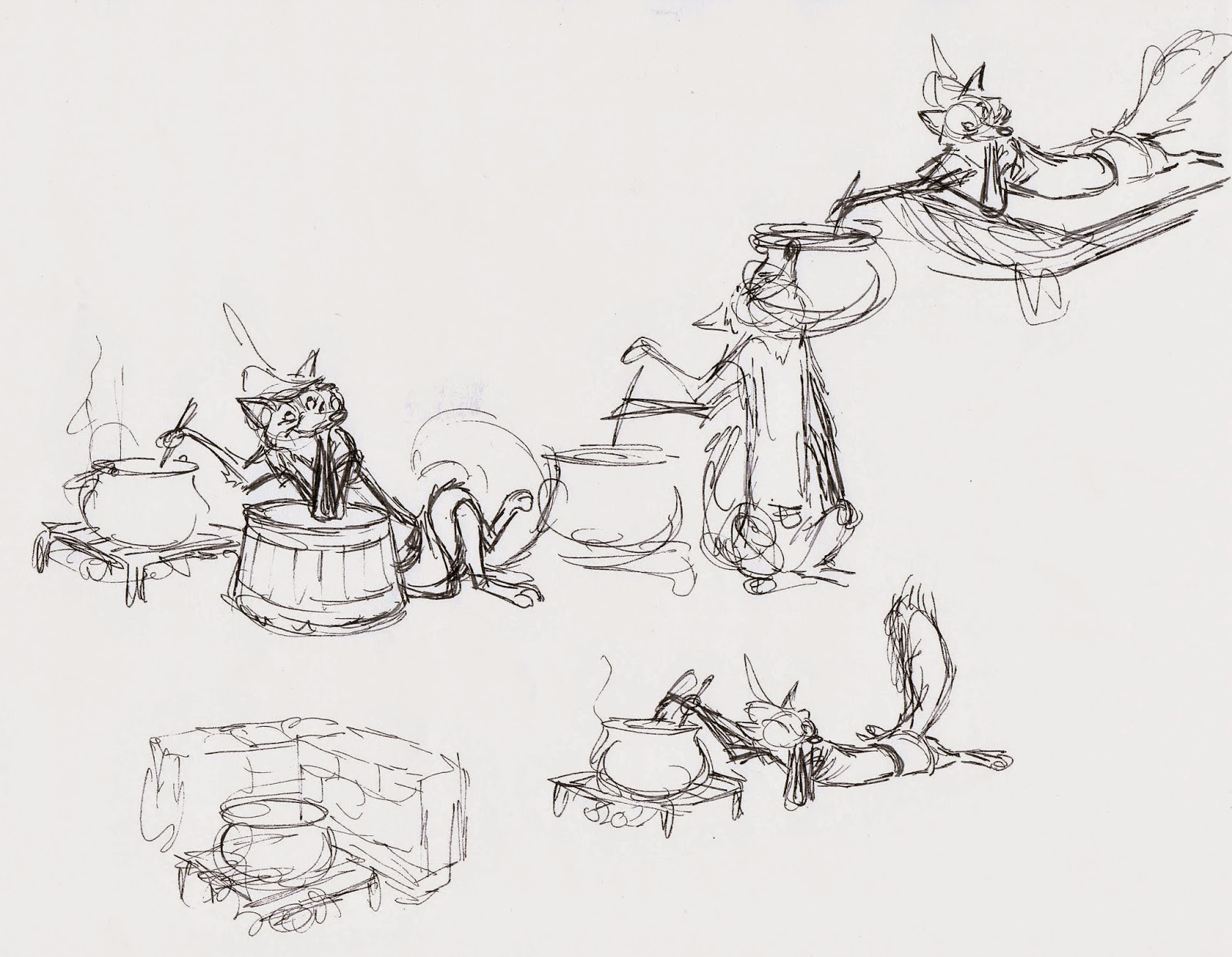
Exploring the Possibilities


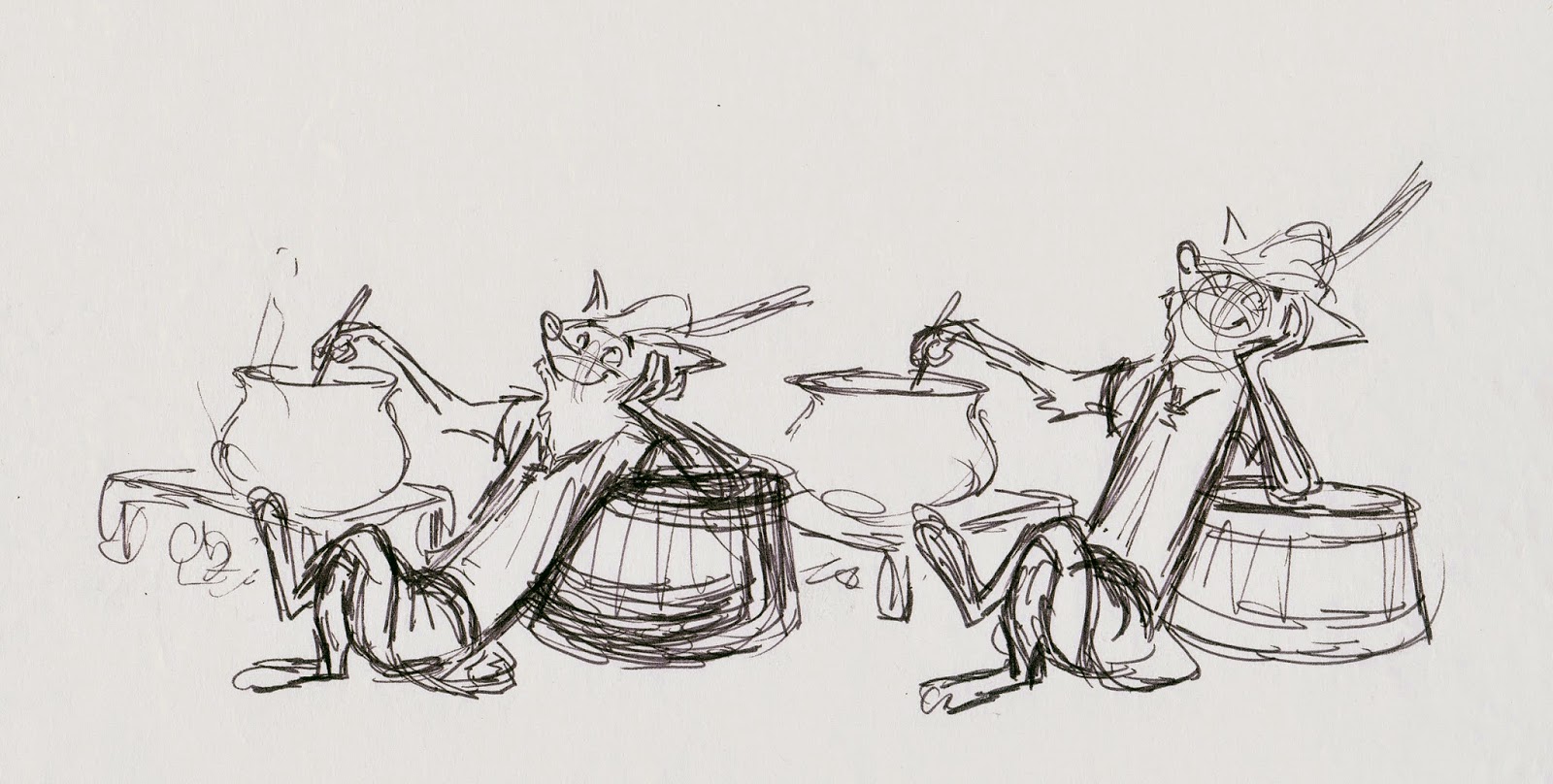
Milt Kahl used those words when he tried to explain his process for starting a new scene.
Most of you know that Milt and many other Disney animators produced a number of thumbnail sketches in preparation for the actual animation. This research can center around finding certain expressions, an acting pattern or -like in this case- a simple pose.

In this scene Robin is stirring the soup while daydreaming about Maid Marian. 
The image above is a frame from that scene, but check out how much work Milt put into finding this one pose. He came up with a ton of variations, until he sold himself on one position that looked natural to him. 
I think that Milt actually struggled a little to get to a satisfying result. But remember what he said one time: “I actually don’t draw that well, I have to work like hell to make a drawing look good!” (At the same time he thought that he drew better than anybody else at the studio.)

It’s fascinating to see his mind in action, exploring the possibilities.


Sunday, August 17, 2014

Victory Through Air Power II


I really didn’t think I would ever do another post on this unusual Disney feature from 1943, but I want to share these terrific design sketches by Marc Davis for the film. Marc is researching animatable versions of the eagle and the octopus, who face off during the film’s climax. It is a short but dramatic sequence, animated by Bill Tytla.
These studies show Marc’s unwavering belief that you need to know and understand an animal’s internal anatomy before you can animate it convincingly. The motion range of wings, neck and claws are thoroughly studied. Marc was a “no nonsense” artist, know your stuff from the inside out before you make it move. Wether cortoony or realistic, Marc always insisted on figuring out the character’s 
inner workings first. 


I remember Marc talking about drawing snakes. He mentioned that many artists draw them by using curved lines only, which results in weak looking images. “There are plenty opportunities to add straight lines to show strength and power”. 
The same can be said about these octopus studies. Whenever a tentacle stretches, it shows tension and stress. Magnificent drawings.


To revisit my first post on Marc’s story sketches for Victory Through Air Power, go here:


It’s time to -highly- recommend this new book on the art of Marc Davis. It gives you great insight into the creative mind of this multi-talented artist, whose career covered character animation, theme park attractions and fine art. Various chapters also describe Marc as a teacher, traveller and husband.
I was honored to write about his animal studies at the zoo.
(The drawings above are not included in the book.)
The book is already available in Disney parks, the Amazon link is here:


Friday, August 15, 2014

Kley's Pastoral Kiss


I always thought that most of Heinrich Kley’s nudes have an innocence about them, sort of like Freddie Moore girls. There might be a light sensual quality in some of his illustrations, but Kley stayed away from showing truly sexual content. 
This image is very different. 
The woman is drawn delicately with a pale skin tone. By contrast her lover -a centaur- is depicted with bold ink lines. This passionate embrace represents the only Kley sketch I would call erotic.
There are parts of the composition like the shapes of the trees that support symbolically the nature of the theme. 
When I saw this piece for the first time, I was startled to see how far Kley went in drawing this intimate, amorous moment of fantasy.

Compare this illustration to to Kley’s “Centaur Family Portrait” from an earlier post:


Tuesday, August 12, 2014

Frank's Baloo & Mowgli


For the film The Jungle Book Ollie Johnston animated the introduction of Baloo and his first encounter with Mowgli, the man cub. Frank Thomas took both characters over, starting with the scene above.
Mowgli has just ran away from Bagheera, and all he wants right now is to be left alone.
But Baloo is too interested in getting to know this unusual jungle creature. He wants to have some fun and challenges Mowgli to a boxing match. After a while he let’s the kid hit him in the jaw and pretends to be on the loosing end of this game. 
This sequence is beautifully written and brilliantly animated by Frank. Since there is a lot of motion involved (broad as well as subtle) with both characters as they circle each other in this mock fight, Frank ended up doing ALL of the rough drawings himself. There are no in-betweens. 
This is actually not that unusual, since Frank usually contributed most or all of the drawings for any of his scenes. Other animators would often use a moving hold for calm moments, which involved only two key drawings with lots of in-betweens provided by the assistant. But Frank seems to always have something going on, even in the most subtle acting patterns. Something is always moving, things don’t come to a stop. 
As a result of producing so many drawings for a given scene, Frank could not focus on gorgeously designed poses or expressions. So his drawings by themselves might not look too intimidating to an animation student or professional, but watching them in motion is a whole other potato. The characters come to life in such a believable way, they breath, they move with weight, and they have real thoughts.
In other words, they have a soul.

Here are a few moments from Frank’s scenes, in which Baloo tries to cheer up Mowgli and win his affection. 


To watch some of these scenes in motion, go here:
http://andreasdeja.blogspot.com/2013/04/jungle-book-pencil-animation.html