Saturday, January 10, 2015

Pongo


Australian actor Rod Taylor died a few days ago in Los Angeles. I have always enjoyed his roles in films like The Time Machine and The Birds. For Disney he provided the voice of Pongo in the iconic 101 Dalmatians, with a wonderful and understated performance. I don't know if  any other actors were considered for the role, but Taylor turned out to be perfect.


A few of Milt Kahl's many facial studies, based on the appearance of life Dalmatians, brought into the studio for observation.
For more Pongo life drawings by Milt, Marc Davis as well as Frank and Ollie, go to this earlier post:
http://andreasdeja.blogspot.com/2012/01/dalmatians.html


It is interesting to see how Milt tried early on to incorporate the dark edges of a Dalmatian's mouth into the design, an idea that was eventually dropped.


A beautiful sheet showing Pongo holding Roger Radclliff's hat. Masterful sketches, and it's nice to see that even Milt occasionally corrected himself, like re-positioning the dog's left front foot.


Another type of design, with a larger muzzle and a very small pelvis area. The size of Pongo's muzzle became the subject of debate between Milt and story man Bill Peet. You can read about it here:
http://andreasdeja.blogspot.com/2012/01/pongo-muzzle-issue.html
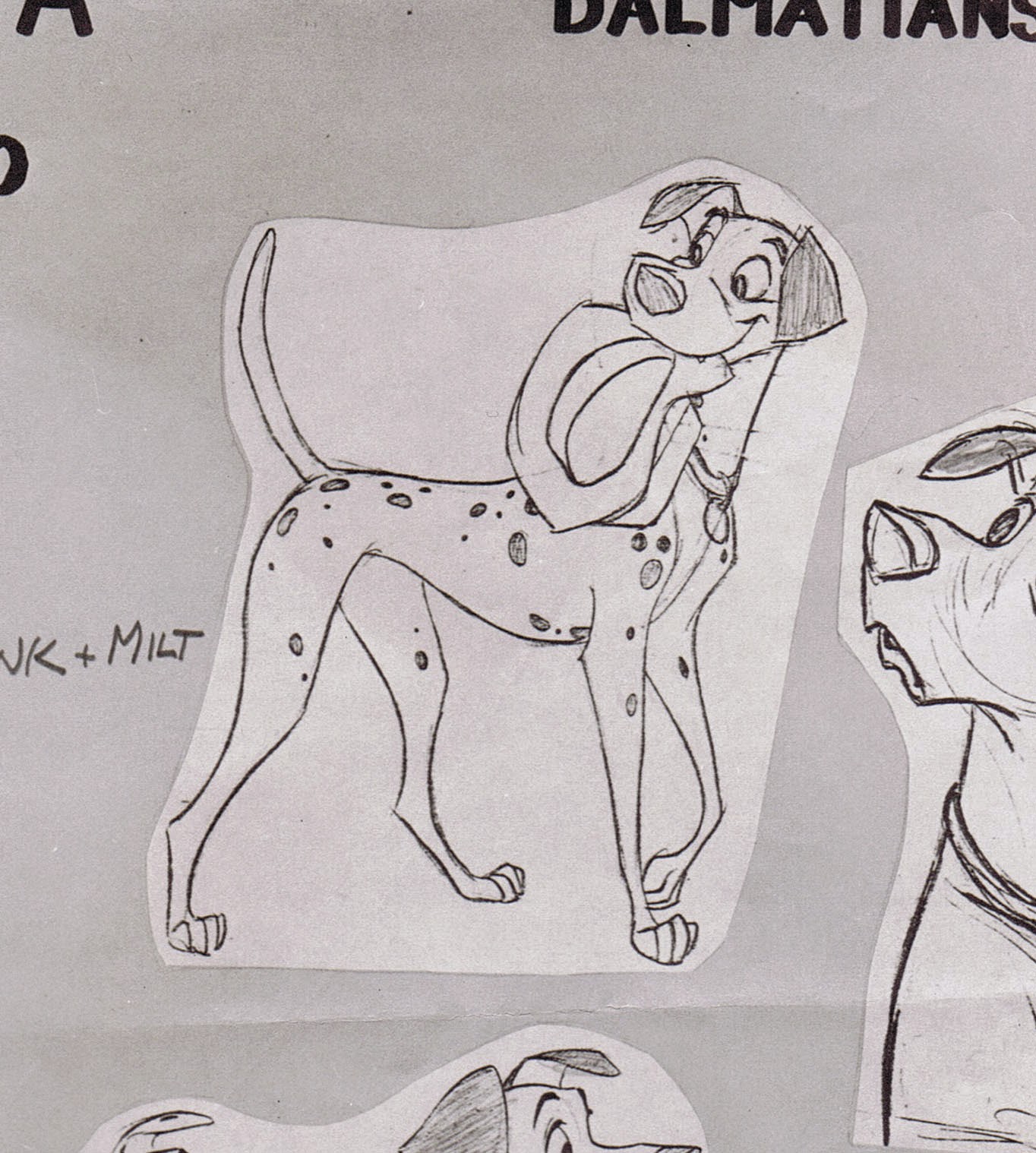


The corrected and final version of this pose ended up in the film and on the model sheet. Perfect proportions and appeal!


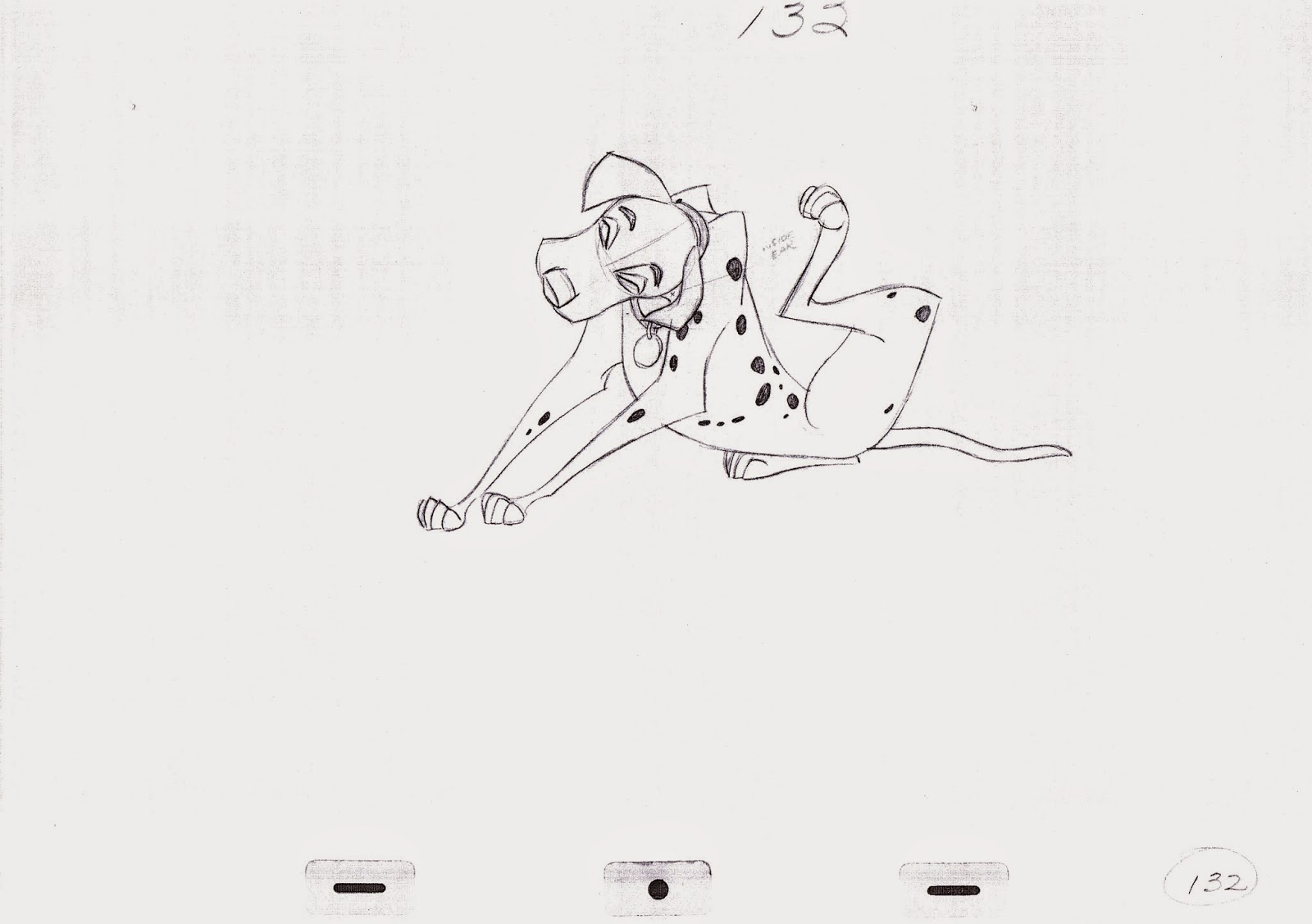
Ollie Johnston animated the melancholic sequence with Pongo as he tries to comfort Perdita, who is hiding under a stove. The first drawing is an Ollie rough, followed by a Milt drawing, as he clarifies forms and shapes without loosing the sentiment of the moment.


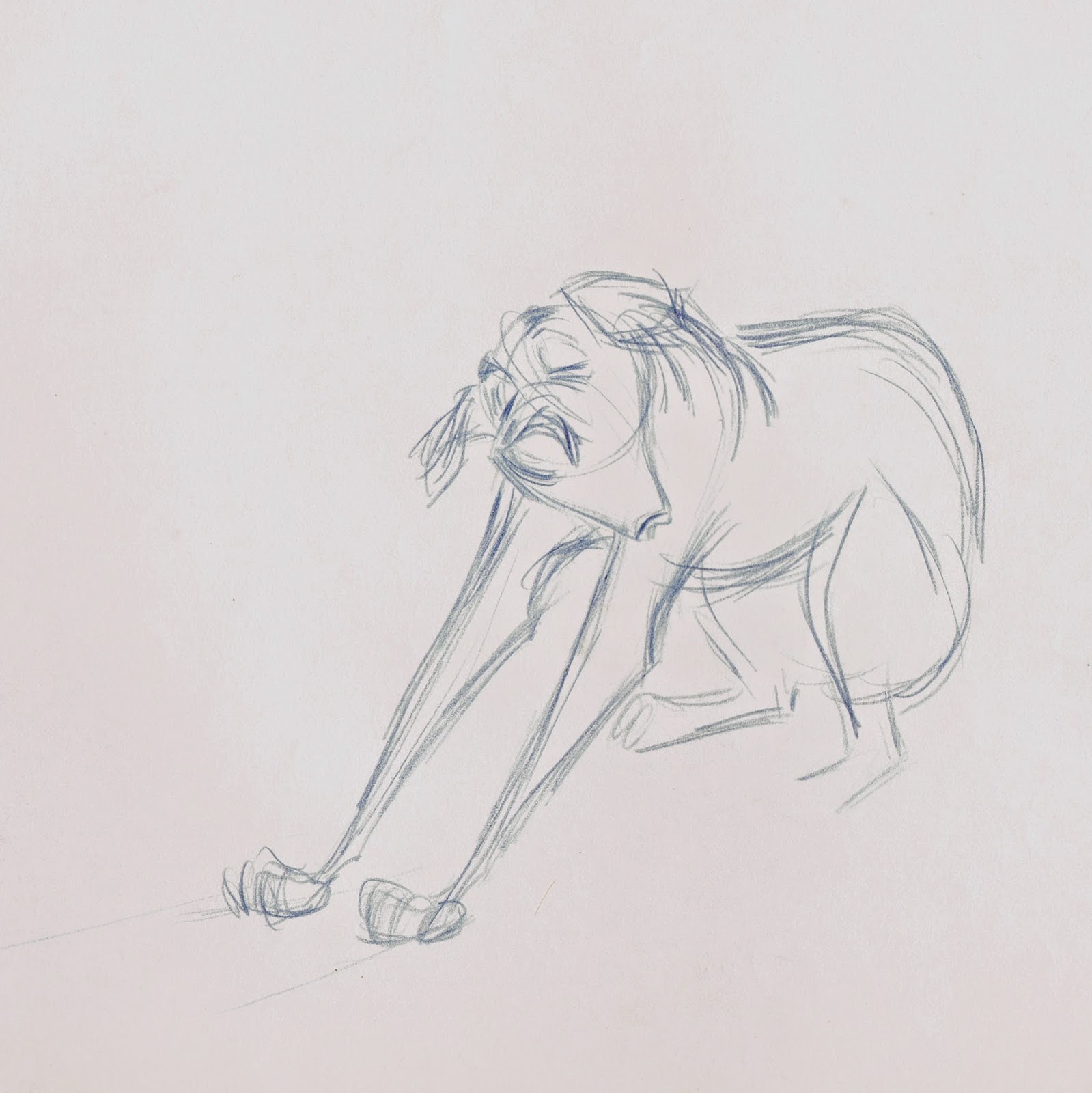


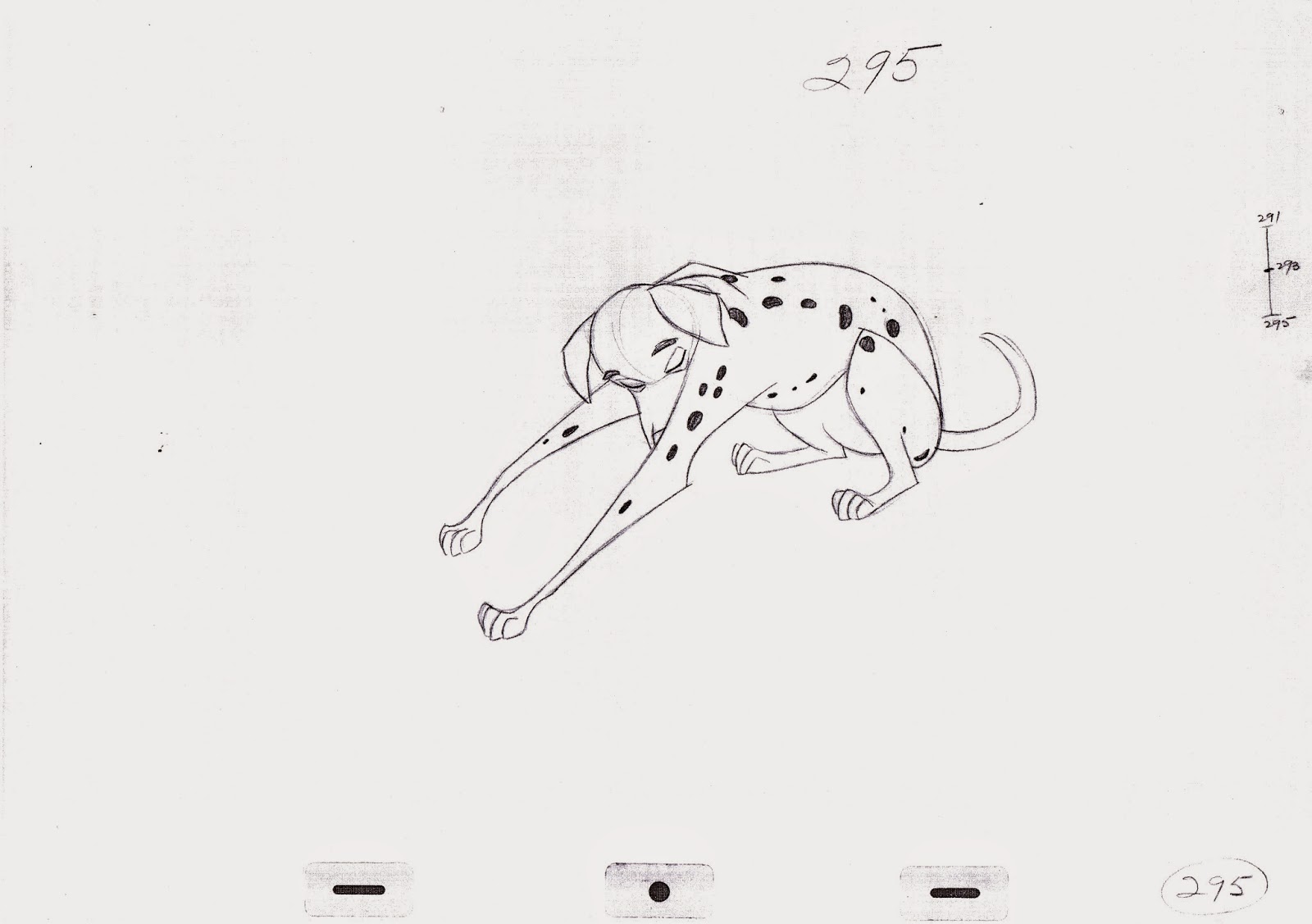
Here are a couple exploratory drawings from one of my all time favorite scenes. The rough above is a  discarded animation drawing, probably rescued from Milt's trash bin by an assistant.
Milt goes very, very far here as far as graphic representation of this scene. Razorsharp points and an intense balance of straight against curved lines make Pongo look like a Picasso creation. Yet anatomical correctness is never compromised. Even if some people don't appreciate such a stylized approach to Disney drawing, they buy into it because of the scene's weight and  fluidity of motion.
Not to mention the overall convincing emotions a dog goes through when scratching, yawning and collapsing on to a pillow. 
Just a few years earlier Milt had animated a similar scene with Tramp, as he wakes up inside a barrel near the train tracks. It was in Milt's nature to constantly challenge himself and try different ways to handle a situation that was somewhat familiar to him.
Animated sometime in 1960, even after so many decades this remains a MODERN animated masterpiece.


A gorgeous drawing showing Pongo examining the cover of one of Roger's magazines. I love Milt's scribbly version of a pin up pose. Thanks to my friend Wil for offering a scan of this sketch.


So here's to Walt Disney's 101 Dalmatians and the main character's voice actor Rod Taylor, who's charismatic performance in this animated film as well as in other movies enriched many people's lives.


Thursday, January 8, 2015

Alice and the Caterpillar


When Alice meets the eccentric Caterpillar she realizes that she is not in London anymore.
Like most scenes from the film, this encounter was filmed in live action as an aid to the animators.
Kathryn Beaumont acted out these moments beautifully, and Milt Kahl started animation on the title character of the film for this sequence. (Reflecting on his work years later, Milt thought he came up with a cute Alice here, but that some other animators fell short of producing quality footage with the girl.)
I am not particularly fond of the Caterpillar's design, I think that several book illustrators came up with more intriguing concepts for this character, like this illustration by Harry Rountree:


Backgrounds and cels don't match in these images, but they provide a glimpse into the astonishing stylized art direction of the movie.


A couple of many beautiful color sketches Mary Blair produced for this sequence.


Images Disney/Heritage Auctions

Monday, January 5, 2015

From Thumper to Shere Khan


Milt Kahl is showing off model sheets of Bagheera from The Jungle Book to colleague Eric Larson, who seems somewhat less excited than Milt. During the 1960s practically all Disney model sheets were comprised of Milt's rough animation drawings. No turn-around sheets, no character maquettes, just Milt's animation drawings from his first production scenes. Director Woolie Reitherman realized that nobody drew and designed new Disney characters better than Milt Kahl. Milt's drawings were the final word, the standard all other animators looked up to. Their goal was to come as close as possible to these sophisticated designs graphically, but still insert their own approach to the characters  as far as acting and performing.
I want to show a high in Milt's career from the golden age of Disney animation to a later high, just before his boss passed away. Both drawing styles are astonishingly beautiful, one round and dimensional, the other graphic and sophisticated. It is so interesting to me that neither Milt, Frank and Ollie, or other animators recognized these two different styles within Disney Animation. I remember asking Eric Larson about the change in approaching Disney drawing, and he just mentioned that the animators drew what was required of them. To Eric there didn't seem to be new approach at all, you drew the characters a certain way in order to get the best results.

Milt's rough animation drawings from Thumper's famous scene: "If you can't say something nice..."


Key drawings from Milt's first few scenes with Shere Khan.


Saturday, January 3, 2015

Peter Pan Key Drawings


Nice publicity photo of Walt Disney and young actor Bobby Driscoll on the stage set, where live action footage was filmed to aid the animators in their work. Milt Kahl was the supervising animator for Peter, and he generally ignored the live action reference when animating the character. He felt strongly that an animator, who is worth anything in the industry, should know how things (humans and animals) move. I can detect a handful of Milt's scenes where he based his animation somewhat on Bobby Driscoll's live performance. When Peter Pan angrily confronts the Lost Boys for shooting down Wendy out of the sky, his acting is emotional and graphically clear. Those scenes still show traces of a live actor's motions, but they don't stick out compared to the animation that came from Milt's imagination.
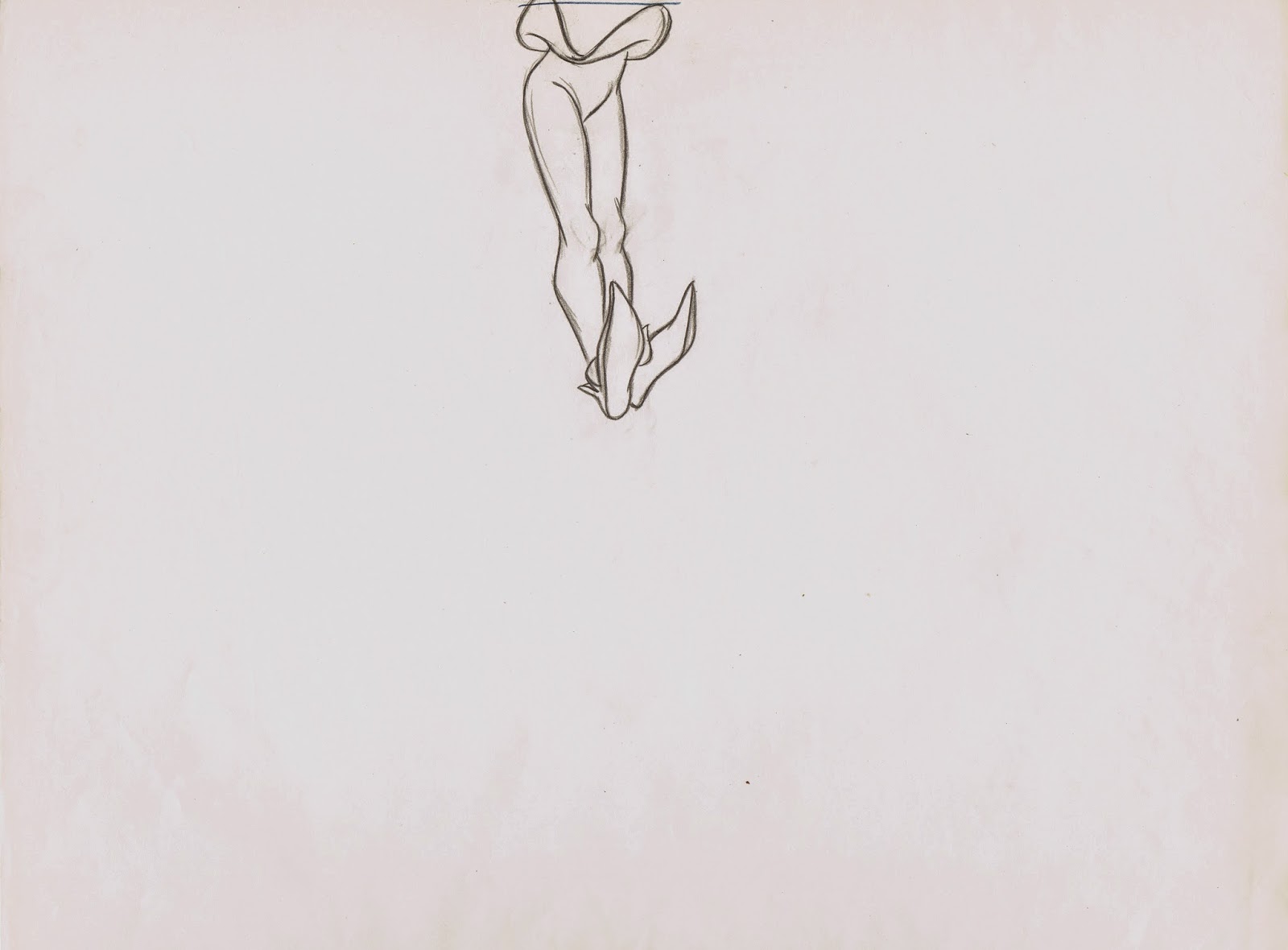
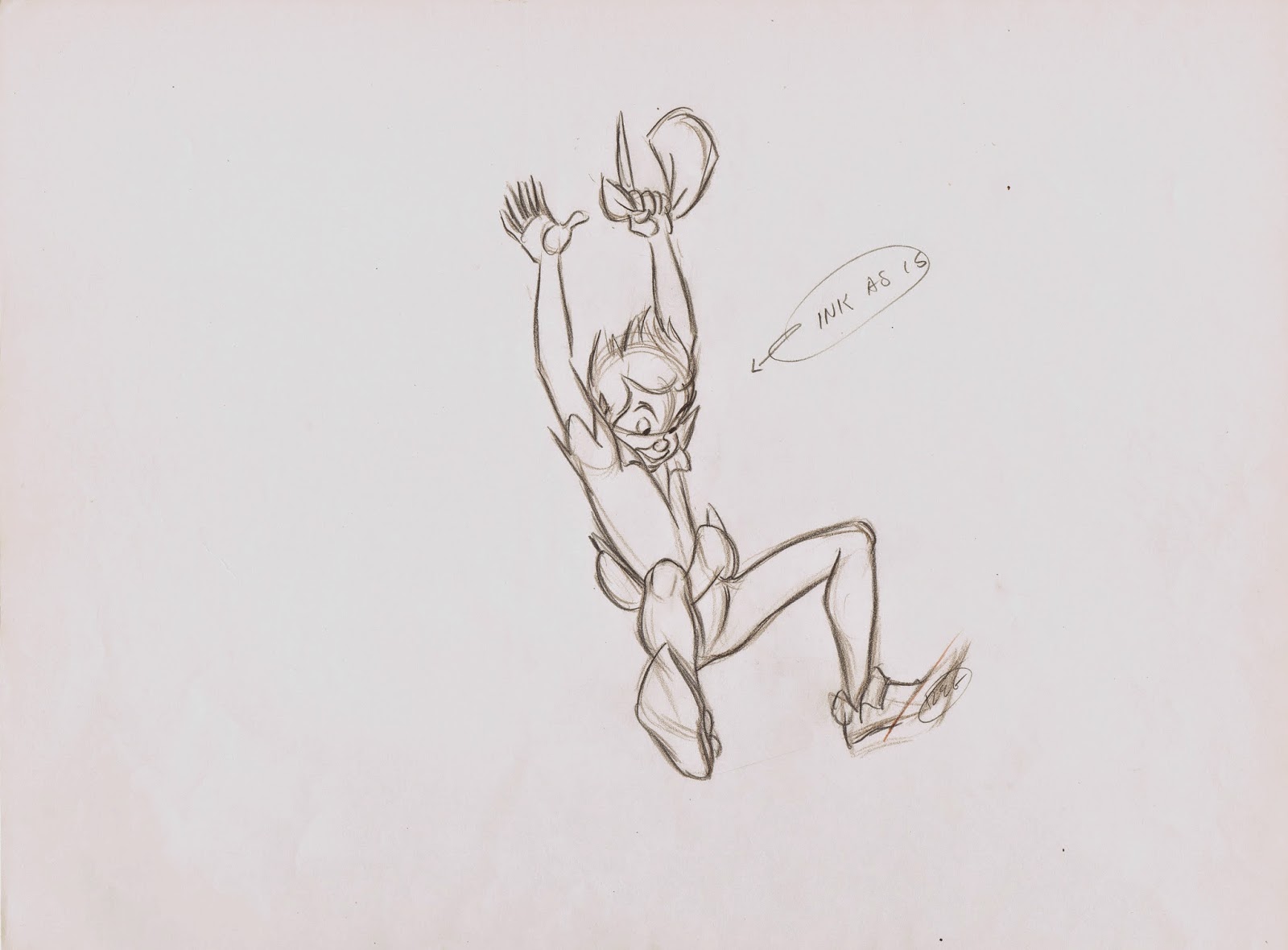
The drawings below are from one of those scenes. Inside Scull Rock Peter Pan slides down a boulder, positioning himself before impersonating Captain Hook. These few keys demonstrate basic animation principles in a way that live action probably wouldn't. As Pan moves downward, his arms and feet point upward to counter the action. When he arrives at the the low point, the arms come down, and his legs swing upward because of the motion's momentum.
A cartoony piece of animation, thoroughly analyzed and realistically drawn with ultimate appeal.
Drawings like these are extremely useful to everyone who studies anatomy in motion.

#2

#5

#7

#10

#12


Design sketches from this earlier post show how Milt modeled Peter Pan after Bobby Driscoll's appearance:
http://andreasdeja.blogspot.com/2011/08/peter-pan.html

Friday, January 2, 2015

Jasper and Horace


Cruella De Vil's henchmen Jasper and Horace were principally animated by John Lounsbery (and beautifully so), but their final design was created by Milt Kahl based on story man Bill Peet's rough character concepts. These two second rate criminals share a fairly low IQ, but in appearance they form a fun, strong contrasting duo. Jasper is tall, thin and gangly, Horace is tubby, short and  roly-poly.
Some of their scenes were based on live action reference, but the animation never looks rotoscoped or floaty. Lounsbery had a great time bringing these comic villains to life, and as you can see in these drawings, Milt again pushed the graphic/personality boundaries for new Disney characters.


Tuesday, December 30, 2014

Counting Scars...


I cannot believe that I am am just now finding out about this video, made by "Oh My Disney".
Apparently in some survey about Disney villains Scar won this year as the most evil one.
What a production number...(it reminds me of certain parties when I lived in Paris, Disney themed always).
Well...this is a big ego booster, I try and not let it go to my head. Check it out!!

https://www.youtube.com/watch?v=VqrBsMFRaLA


Maleficent


Animator Marc Davis went through a few experimental designs before settling on the final look for Sleeping Beauty's villain Maleficent. We all know her final appearance, as can be seen in the image above. Marc's color ideas for the character clashed with production designer Eyvind Earle. Instead of a combination of black and red, Earle insisted on black and purple. Marc was never happy with this concept, to him the color red represented fire, an appropriate element in defining Maleficent's appearance.


Maleficent surrounded by a group of  Goons, who proved to be rather useless to her in finding the whereabouts of Aurora.


Marc also did design work on characters he didn't animate like this group of forest animals pretending to act as Prince Charming.


Monday, December 29, 2014

Ben & Me

A gorgeous background from Ben & Me, a 20 minutes film released by Disney in 1953. Wikipedia says:

"Ben and Me was Disney's first animated two-reel short subject and released theatrically on November 10, 1953. It was adapted from the children's book written by author/illustrator Robert Lawson and first published in 1939. Though both book and film deal with the relationship between a mouse and American founding father Benjamin Franklin, the book, with illustrations by Lawson, focused more heavily on actual historical events and personages.
The short received an Academy Award nomination for Best Short Subject. It was released on VHS under the Walt Disney Mini Classics label in 1989 and was later released on DVD as a short film in the "Disney Rarities" volume of the Walt Disney Treasures collection. It was also released on DVD in 2012 under the Disney Generations Collection."

The film was directed by Ham Luske, Bill Peet wrote and sketched the screen story. Among the group of animators were top talents like Woolie Reitherman, John Lounsbery, Ollie Johnston and Les Clark.Here are a few of Peet's continuity drawings that deal with personality development, layout and camera moves. They show just how much of a storyteller and cinematographer Bill Peet was. 


Images Disney/Heritage Auctions

Saturday, December 27, 2014

Paul Jouve's Big Cats


A while ago I posted artwork from one of Europe's most important animal artists, Paul Jouve.
He was an expert in depicting all animals, but I am particularly impressed with his big cats. They remain a constant reminder during my work on Mushka, that it is essential to capture the power as well as elegance and grace of these magnificent animals.
The image above is a book illustration showing Shere Khan, an Indian tiger. But his heavy, bulky body reminds me of the Siberian tiger I am dealing with in my film.
Jouve knows big cat anatomy like nobody's business, yet occasionally he does things like putting leopard spots on what is essentially a tiger drawing. Or he puts stripes on a cat that resembles a leopard. The main thing though is that he is a master when it comes to drawing or painting feline poses. A great source of inspiration for my film.


For my first post on Paul Jouve, go here:

http://andreasdeja.blogspot.com/2011/08/paul-jouve.html