Tuesday, February 23, 2016
Mr. Toad
Disney's version of Kenneth Grahame's book The Wind in the Willows is one of those few productions that I would label as a good film, but not a great one. First conceived as a full feature film, before being cut down to featurette length, the trouble the story guys had with getting a hold of the material is evident to me. The whimsical quality of the original book never made it to the screen.
(Many years later Winnie the Pooh succeeded more on that level).
You get to know Toad, Rat and Mole only to a point, perhaps this should have been a full length feature to allow for deeper character development.
That being said...I love watching the film , because there are many animated highlights. Milt Kahl's Angus McBadger, Frank's Toad animation and the trial sequence are just terrific. Well worth studying frame by frame.
The overall character designs are pretty nifty as well, with the exception of bartender Winkie, who looks like a stock character.
Here are early character suggestions by Ray Jacobs (?).
Great sketch by story artist Homer Brightman.
A comparative size sheet drawn by Frank Thomas.
And a clean up model sheet using poses from Frank's animation. Milt had something to do with the way hands, clothing and facial expressions are drawn.
What a beautiful sketch from the film's prologue. That's what I call great staging.
A Life Magazine article, published around the time of the film's 1949 release.
Sunday, February 21, 2016
Roger Rabbit Scenes II
"Pasword!" "Walt sent me".
The writers of Who Framed Roger Rabbit had a field day as they came up with all kinds of inuendos that referenced the golden age of Hollywood animation.
I remember animating this little scene, it was a little tricky to lock the gorilla's partial face into the subtle camera move.
A reminder, this film's animation was still painted on cels. The red shading in the gorilla's eye was rendered with a color grease pencil right on to the cels. (As were Jessica's lips.)
This was supposed to be the bouncer of all bouncers, absolutely huge.
Bob Hoskins knew this when filming the scene, he looked up way high as he imagined this oversized gorilla.
This was a tricky scene as well. Hoskins was filmed hanging on wires as he approaches the camera fast. It turned out that a believable throw needed to be faster though, so the live action footage was sped up by skipping a few frames. I liked the challenge of animating the gorilla as he is holding on to Hoskins before throwing him forward.
This was my first eye popping Tex Avery take. I animated Roger's eyes coming forward during a stagger, but my first test didn't show a perfect eye contact between human and toon. So Dick Williams made me change Roger's eye direction in order to follow Hoskin's movements.
It was a good call. Made the scene much more believable.
Oh boy, here is a scene that I thought was un-doable. Both characters argue for a while before Roger jumps on the bed in order to get his point across, being closer to Hoskins. The camera moved in on them EVER so slowly. The photostats I had to work with didn't show the wrinkles in the bed sheet, so how was I to register Roger's feet during the camera truck in?
Again, Dick Williams came to the rescue. He said, the rabbit is agitated anyway, so don't animate his feet planted on the bed the whole time. Instead have him do little nervous steps, so the contact is only for a short while each time.
My animation is not technically perfect in this scene, but apparently good enough. I didn't get fired.
Roger's acting is ok though, I think.
The reason Roger is holding his right hand way up high at this moment is because Hoskins is looking in that direction. So in many cases as an animator you needed to be clever to come up with gestures that accommodated the actors' eye line.
After all these years KUDOS to Bob Hoskins, who should have won an Academy Award for this role. He was absolutely BRILLIANT!
A Pecos Bill Myth
Ward Kimball and Milt Kahl both animated personalty scenes of Pecos Bill from the 1948 Disney movie Melody Times. This was outstanding casting, Ward brought zaniness to the character, while Milt added believable (yet often hilarious) character animation.
I do remember Ward talking in lectures and interviews about one specific scene. When Slue Foot Sue embraces Pecos before planting a big kiss, his pistols go off by themselves to show...excitement.
Ward took credit for animating the scene, and was almost giddy about the fact that Walt Disney never caught on to the real meaning of the scene...Pecos is getting his rocks off (Ward's own words).
Well, Ward didn't animate that scene, it was one of Milt's. I don't have to check with the animation draft (even though I did) to realize that drawing and staging is pure Milt Kahl.
I don't know if Ward had anything to do with the idea for the scene, but this episode makes for good story telling.
A clean up model sheet made up of Milt's key drawings, including the scene in question.
Thursday, February 18, 2016
Dwarfs
I have had color xeroxes of these beautiful rough animation drawings on 12 field paper for a while. They feature a few of Snow White's dwarfs drawn by three animators at the time of production.
The first batch is unmistakably the work of the ridiculously gifted Fred Moore, who was in his mid 20s when he worked on the movie. I call him a terrific freak of nature. Even before Snow White Fred had helped transform the early rubber hose Disney style into a medium that presented flesh and blood, living, breathing characters.
Ollie Johnston stated that Walt Disney gave Fred tons of notes during sweatbox sessions. Walt knew that this kid was just right to head up the "Dwarfs unit", but he wanted to see acting and entertainment on a superior level. So with Walt's input Fred ended up with animation that was overflowing with personality...and charm.
In this pose Dopey is anticipating a kiss from Snow White. Perfect staging!
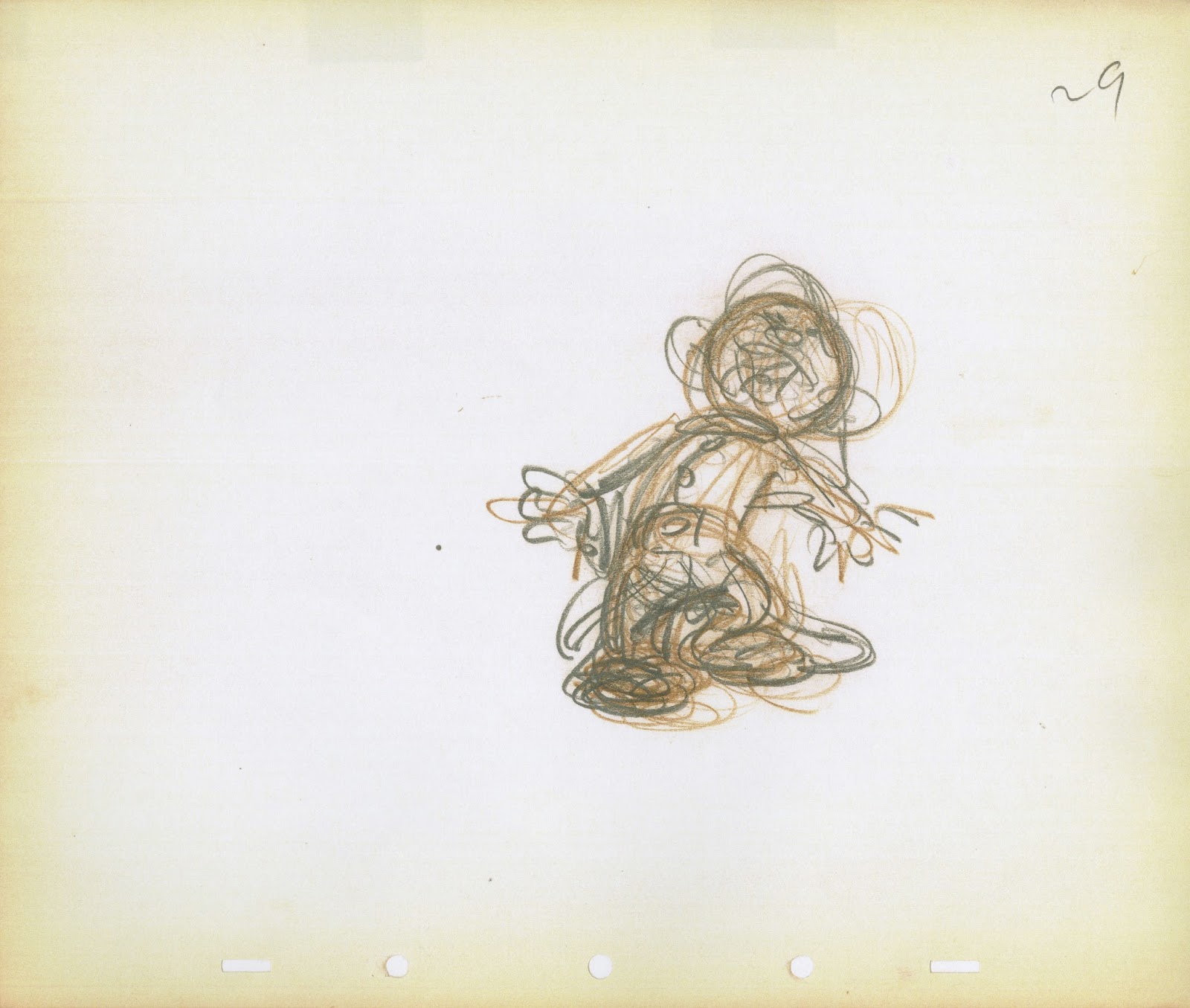
Occasionally Fred worked on a pose intensely to get a result that felt right to him. Sure, most of the time his drawings have a light touch, but when a scene required to dig deeper in order to carve out the right emotion, he was perfectly capable of scribbling intently until the character's personality communicated clearly.
What a master at distortion, when it comes to broad motion. Tytla, too, animated loose, fleshy skin on Grumpy, and later on Stromboli.
These are among the roughest drawings by Fred Moore I have seen. This is tough brain work, but at the same time there is confidence and fearlessness.
Many of Bill Tytla's drawings, like these two featuring Grumpy, are not as "pretty" as Fred's work. His pencil strokes are short, and the poses seem less solid. But when seen in motion the power of a super animator surfaces. A single drawing meant very little to him, he knew that only a series of sketches will bring something to life. And in his case in the most vigorous way.
Ward Kimball's soup eating sequence was cut from the final film, but not because of his outstanding character animation. Kimball took Moore's appealing draughtsmanship and applied it to his own way of character acting. He made every dwarf slurp down the soup in a distinctive and inventive manner.
Another child genius.
Tuesday, February 16, 2016
Ollie Johnston...20 Questions
I don't know who asked Ollie to answer these questions, but this questionnaire is currently available on ebay. Other artists from the field of entertainment did the same, such as Jane Russell and Carol Burnett.
This sheet seems trivial at first, but you do find out about Ollie's hobbies, his favorite TV show and his favorite animators.
It is actually a little puzzle piece in trying to figure out what made one of Disney's greatest animators tick.
Monday, February 15, 2016
More Busch Circus Sketches
These beautiful, spontaneous sketches by Wilhelm M. Busch date back to 1984.
Drawing from life really doesn't get any better than this. Within seconds Busch scribbles down characteristic poses of animals, and his overall compositions are equally impressive.
The power of great draughtsmanship!
I love the last two drawings with the lion and lion tamer. There is a real relationship that comes through in just a few pencil lines.
For more on Busch's circus sketches go here:
http://andreasdeja.blogspot.com/2014/12/busch-circus-elephant-sketches.html
Friday, February 12, 2016
Roger Rabbit Scenes
As I mentioned before in a previous post, the scene above was the first one I animated on Who Framed Roger Rabbit ? I had never worked on animation/live action scenes before. It was pretty scary to get started.
The ostrich was less of a problem, since we don't see her feet contacting the ground. Frames later the full figure frog does show that contact, but luckily the pattern of the floor tiles gave me something to register him to.
The following, very long scene turned out to be the most difficult one (technically). A lot of characters involved, starting with the brooms from Fantasia holding on to real brooms, which had been manipulated by puppeteers. All on ones, and to the beat of the music. Then this crazy pelican postman shows up on a live action bicycle, loosing control. He zips of screen with a fish in his beak, before the camera catches up with him on the ground after he crashed, flying mail all around him. That part was animated by Dave Spafford.
Bob Hoskins then bounces into a Fantasia Hippo. He proceeds with his walk on the Maroon Studio's backlot. There is a cattle call, starting with a sort of Preston blair kind of a cow, then Clarabelle Cow and so on.
A big pig head enters the scene, walking in the opposite direction. He was fun to do, just this happy, big guy, minding his own business. There are more characters Hoskins encounters like the goons from Sleeping Beauty, but I didn't do those. At the end of the scene we catch up with the Hippo, who is getting ready to have lunch, but as she sits down the bench crashes, sending a man flying.
All this was pretty labour intense stuff, so we were all shocked to find out that the live action photostats for the scene had been printed with the wrong fielding. The actual live action footage showed the camera a little further back with more image around the frame. For the love of God, we thought...now what?? My animation just did not fit into the live action. There was talk that I might have to redraw the whole scene over, in proportion to properly sized photostats.
Luckily another solution was found. ILM, who did all of our final compositing, zoomed into the live action footage a little to compensate for the mistake.
So when you watch the scene again, keep in mind that there was more scenery in the shot, but we don't see it. The drama of filmmaking!!!
Subscribe to:
Posts (Atom)