Monday, May 18, 2015

Jiminy Cricket


Designing a character can be a tricky thing. Sometimes the first few sketches an artist does hit the mark right away, and everybody agrees that this is the character as he or she should appear in the film. Then again, occasionally there are those times when nothing you draw seems to please the directors or the studio chief.
I remember what troubles I had when trying to get the required appearance for Gaston. Scar by contrast was a breeze. 
Ward Kimball surely was looking forward to animating Jiminy Cricket, after the bad experience he just had on Snow White. His brilliantly animated "Soup Eating Sequence" had been cut from the film, and now it was time for a fresh start on the next feature film Pinocchio. Even though Walt Disney personally assigned the Cricket to Kimball, the animator didn't seem to be able to please the boss with his initial designs. Not appealing, too grotesque and insect like! After many revised versions in which Ward de-insectified the design, Walt finally approved a design that though very appealing had very little to do with the anatomy of a real cricket. 
Joe Grant came up with these early rough model sketches, shown above.

The folks over on Fantasia drew cricket designs like this one, when a variety of insects were part of a musical piece for the film. Kimball basically used this kind of concept for his initial Jiminy designs.


Joe Grant's model department created this maquette, based on early concepts. I really love this version of the character.


The final model, in Kimball's words, turned out to be a little man with an egg-shaped head.


This beautiful animation drawing by Ward shows that he came to terms with Walt's vision for the character. Frank and Ollie thought that his animation of Jiminy Cricket was the most sincere he ever did.


In case you don't know yet, there will be Christmas this May. At the end of the month, J. B. Kaufman's book on the making of Pinocchio will be out, and I guarantee that it will be a major treat.
Here is the link to Amazon:

http://www.amazon.com/Pinocchio-Making-Disney-J-B-Kaufman/dp/1616288094/ref=sr_1_1?s=books&ie=UTF8&qid=1431930372&sr=1-1&keywords=pinocchio


Some images are Heritage Auctions/Disney.

Saturday, May 16, 2015

Celebrating Pinocchio


I don't know why there isn't more hullabaloo around Pinocchio's 75th anniversary. The film remains a milestone in animation history. Artistically and in terms of dedication there is no other film like it.
Walt and his studio were running in overdrive, there were worlds to conquer in animation.
Milt Kahl got his big break during the production of the film, he designed the title character and became a supervising animator.
Over the years Milt got criticized by his colleagues for not being emotionally enough involved in his work, and that great draughtsmanship became his main tool to communicate.
Take a look at these rough drawings featuring Geppetto's and Pinocchio's reunion.


Wednesday, May 13, 2015

A Lecture on Animating Hercules


That photo was taken years ago after we had just finished work on the 1997 film Hercules. I had fun animating this character, even though it was a challenging assignment. Though stylized in appearance, his acting needed to be pretty realistic in order to communicate subtle emotions like self doubt, shyness and falling in love.
I will talk more about Hercules and share original never before shown pencil tests this coming Saturday, May 16, at 11 am PDT. My friends at Virtual Animators will make this event possible. If you are interested in joining me, here is the link:


Monday, May 11, 2015

More Mme Bonfamille


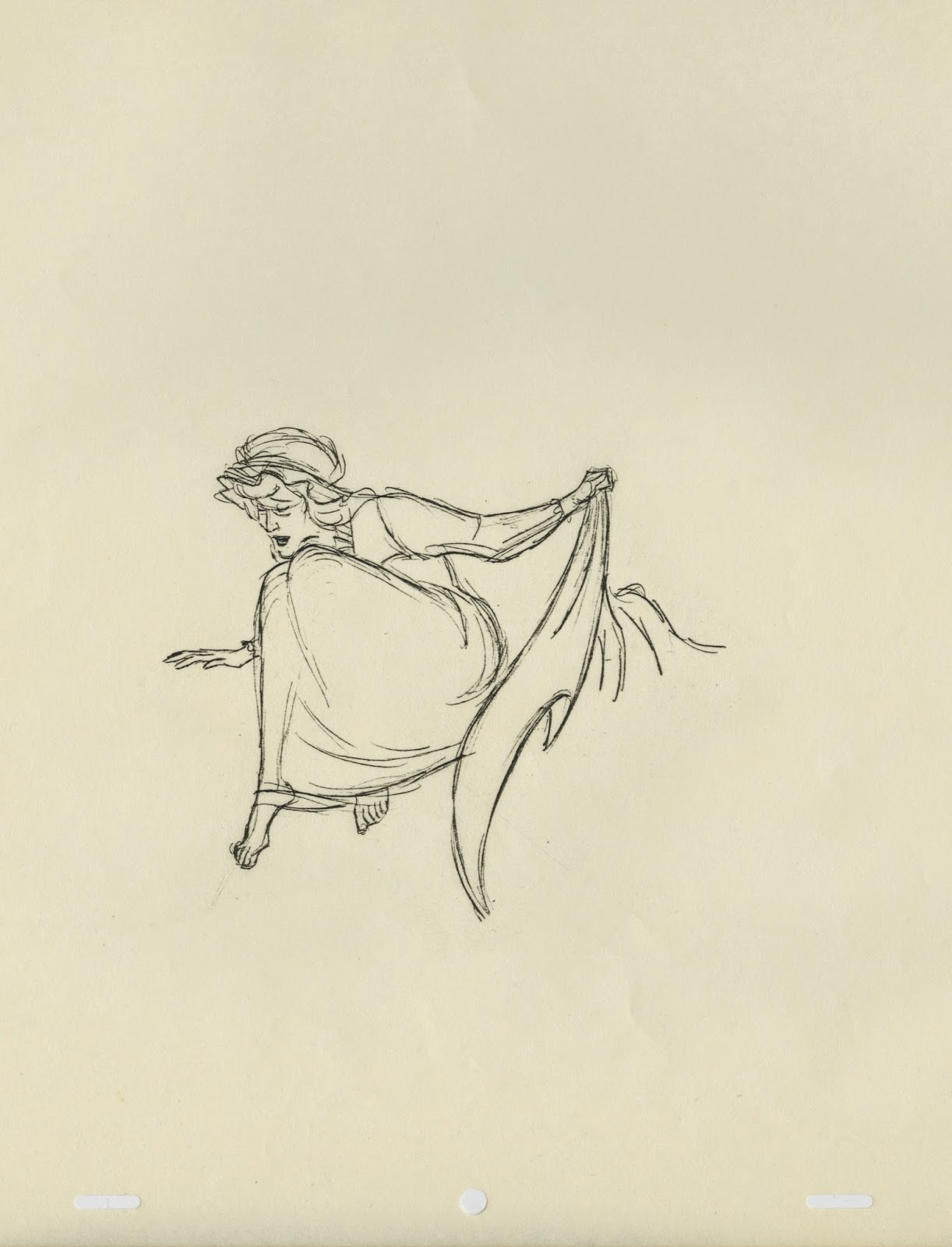
It seems extraordinary to realize that Milt Kahl animated Mme Bonfamille's scenes without any live action reference. Milt had such command and control over the mechanics of the human body, he was able to animate any human type out of his head, realistic or caricatured.
This character is as close to total realism as you could possibly get. Milt employed the might of his drawing powers as well as subtle acting to bring her too life. He reminisced later that he thought the one moment in which she comes alive is when she finds her cats gone. She shows strong feelings there, allowing Milt to show her emotionally engaged.
These rough animation drawings are from that sequence. It starts with Mme Bonfamille waking up during a stormy night.


#1


#27


#35


#43


#51


#59


#67


#73


#79


#111


#149


#181


She puts on a gown and approaches the cats' night quarter. (What stunning drawings.)


A tight close up shows her disbelief.


#7


#31


#51


#71


She runs out of her bedroom and calls for her cats.


#9


#11


#15


#87


#104


About characters like this one Milt said that though not very enjoyable to do, you know that you DO have more entertaining characters in the picture, so it doesn't hurt to do a straight job once in a while.

Sunday, May 10, 2015

Roquefort


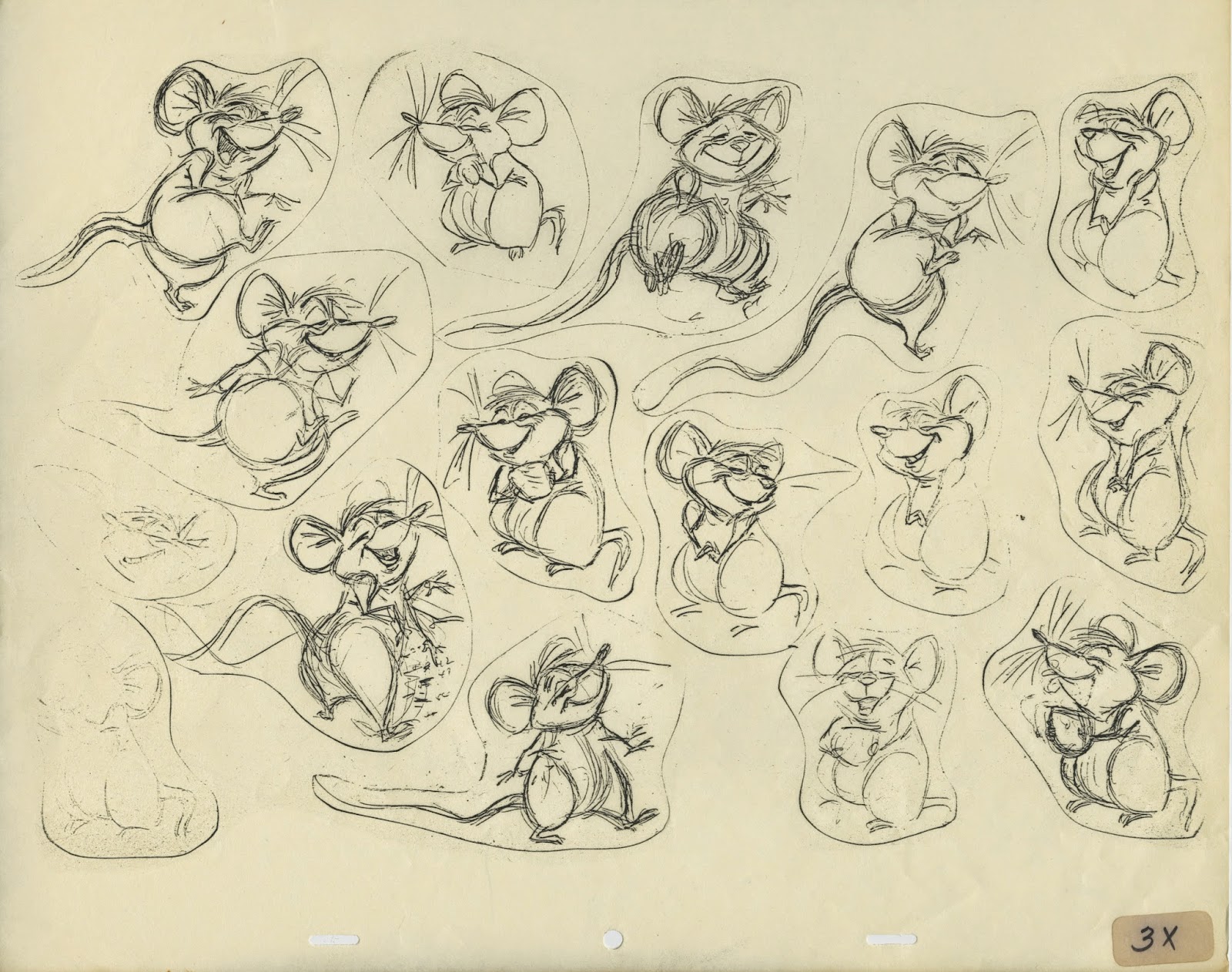
This sympathetic mouse character from the 1970 Disney film The Aristocats was animated by my mentor Eric Larson. Eric enjoyed one of his last animation assignments, before focusing full time on training new people joining Disney during the late 1970s.
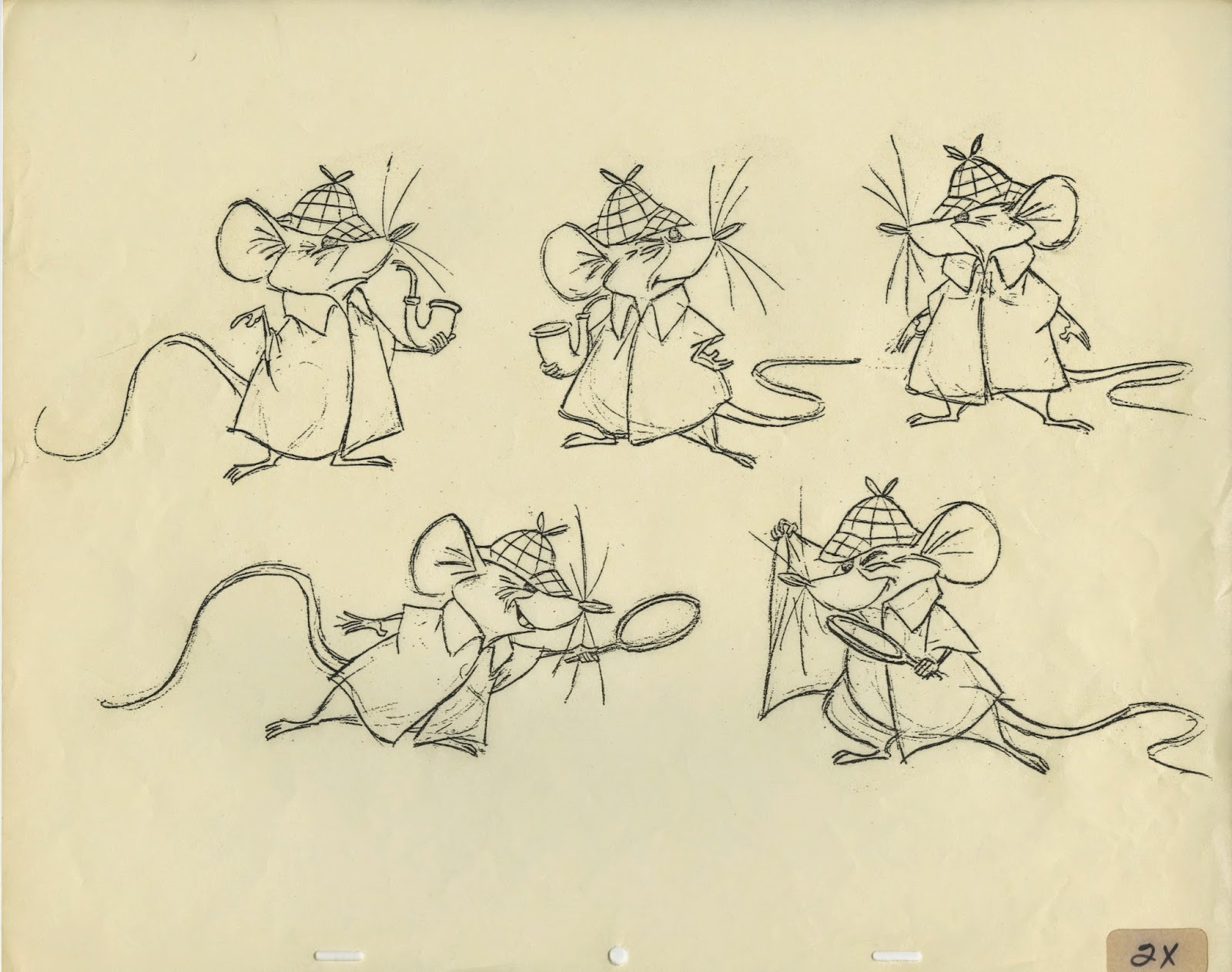
Milt Kahl came up with this early design concept above, heavily based on Bill Peet's earlier concept for the character of Amos from the 1953 featurette Ben and Me. 


As much a I like Milt's drawings, Eric created a new mouse for Disney Animation, which was certainly a challenge, within a medium full of mice characters. Eric remains one of the most underrated animators. No matter what the assignment, animal crowds on Snow White, the cat Figaro in Pinocchio, Flying Horses in Fantasia, Eric performed these characters  believably and beautifully.
He was a Master animator!!

Thursday, May 7, 2015

Nobertine Bresslern-Roth


Nobertine Bresslern-Roth was an extremely gifted Austrian painter and graphic artist. She lived from 1891 until 1978. She was an expert in depicting animals either in portraits or in dramatic situations like the one above. I can't believe I just recently found out about her astonishing work. Her main medium was the linocut, but she was also comfortable with oil and watercolor.
In 1928 she traveled to North Africa, a trip that stimulated her talent as an animal artist.
What can I say...only superlatives are in order to describe her work justly. Her knowledge of anatomy, her compositions, her color...everything is top notch! What an inspiration!!!


I believe these images which show a considerable amount of rendering represent her earlier work.