Strangely animation maquettes are often finalized late, toward the end of production, and Mushka is no exception. Hand sculpted by Craig Elliott, cast and hand painted, after a sketch of mine.
That's the title of a brand new exhibition at the Walt Disney Family Museum. If you happen to be in the Bay area, you don't want to miss it. I myself will head up North soon. Can't wait to see what curator and WW II historian Kent Ramsey and the Museum staff put together regarding this important chapter in Disney history. For detailed infos go here:
https://www.waltdisney.org/wwii
Here is an early example of live action use for animation at Disney. All human characters in Snow White and the Seven Dwarfs relied on rotoscoping, except for the dwarfs. The more realistic a character concept, the more live action footage was used to help the animators get a nuanced performance on to the screen.
But rotoscoping is a tricky business. If not altered and interpreted by an animator, the result can be stiff and lifeless. Changes have to be made in order to portray these filmed performances for for graphic motion. A good animator will mess with the timing and proportions of the photostats.
Some of my favorite Disney characters who were successfully based on live action are Cruella de Vil and Roger and Anita Radcliff. Their design has various degrees of caricature, but the motion always feels reel.
Then there is Cinderella's Stepmother, a very realistic looking character based on live action, and she comes across as being very powerful.
Milt Kahl's comments about the use of live action cracks me up: "If you are going to have realistic animated human characters, I think the use of live action is necessary. If everybody on the picture was a Milt Kahl it wouldn't be necessary. But unfortunately they aren't."
Here is the Hunter from Snow White.
The Walt Disney Archives just posted a few photos of Milt Kahl in celebration of his birthday. I believe they were taken just before Milt left Disney in April of 1976 after completing animation of Madame Medusa.
Look at these two images. Proof that artists unconsciously portray themselves in their work.

I have written plenty about Milt and his art over the years. Just enter his name in the blog search space, and all those posts will come up.
Milt loved the way The Sword in the Stone turned out. He never understood why the film underperformed at the box office. "The studio didn't have confidence in it. Some theaters even showed it in a double bill with the Three Stooges (an American vaudeville/comedy team). If that won't kill, than what will?"
Here are Milt's key drawings for a scene with Merlin and Archimedes. The owl has just crashed under a tree after saving Wart -in the form of a fish- from a hungry pike. Merlin approaches to pick up Archimedes, who is dripping wet.
A short, simple and gorgeous scene. Before bending down, Merlin anticipates the move on #5. He then lowers himself to pick up the owl by one foot. He takes one step before placing Archimedes on a tree branch during the following scene.
Kathryn Beaumont at an early story meeting for Alice in Wonderland with Winston Hibler, Ed Penner and others.
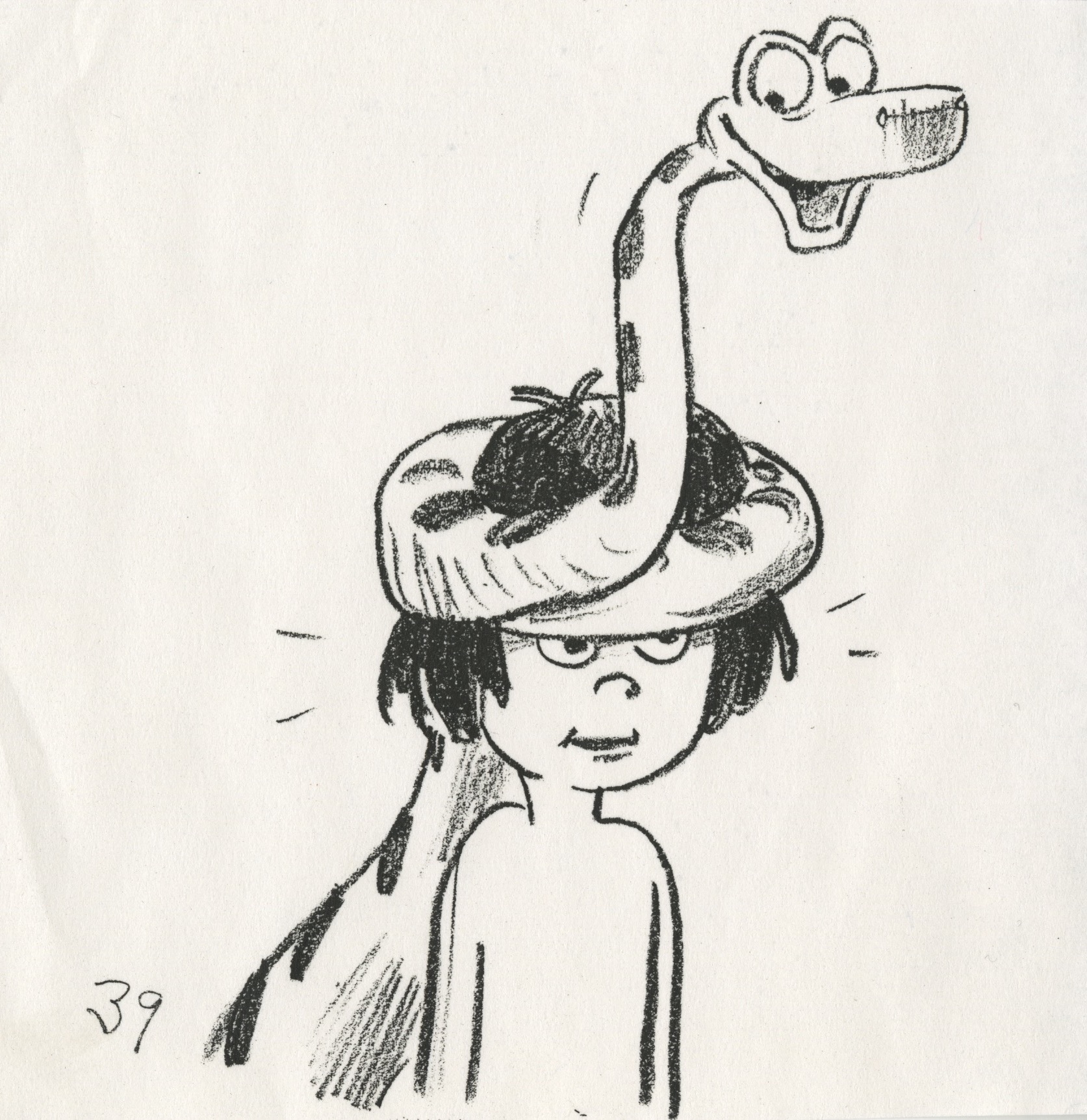
Here is a story sketch by Vance Gerry, who boarded the sequence in which Kaa tries for the second time to hypnotize Mowgli. I believe young Floyd Norman also contributed story drawings for this section of The Jungle Book. There are plenty of terrific personality gags here. I love that Kaa's body can turn into specific but unexpected forms to interact with Mowgli. A swing, a staircase etc.
Frank Thomas animated the whole sequence, and he made sure that each scene has great entertainment value. He would call this character business.